Showing posts with label George W. Bush. Show all posts

Monday, May 18, 2009

Investigating Torture: An Interview With Former Federal Prosecutor Elizabeth de la Vega

Former federal prosecutor Elizabeth de la Vega has recently made news urging that we don’t rush into appointing a special prosecutor to investigate crimes of torture during George W. Bush’s presidency. In a provocative April 20th post entitled “Of Black Holes and Radio Silence,” Ms. de la Vega wrote:
“There is no doubt that sometime in 2002 - if not before - Bush administration officials and their lawyers began orchestrating a torture campaign, which they calculatedly attempted to justify through specious legal memos. They continued to abuse prisoners, and to conceal that mistreatment from Congress and the public, through at least 2008. In all of this conduct, they have committed grave crimes for which they must be held accountable. I believe this to be a national imperative of the highest order.”
However, she also argues that,
“First, the bottom line: From the perspective of anyone who wants Bush and Cheney and their top aides to be held accountable for their crimes, the designation of some sort of independent prosecutor right now would be the worst possible eventuality. It's a move that has so many downsides - and holds so few real benefits - that I would be more inclined to question President Obama's motives if he appointed a special prosecutor than if he did not. There is a reason why former prosecutor Arlen Specter - a Republican senator from Pennsylvania - has voiced support for a special prosecutor, while former prosecutors Patrick Leahy and Sheldon Whitehouse - Democratic senators from Vermont and Rhode Island, respectively - would prefer a public inquiry.”
Please note that Ms. de la Vega’s post was written prior to Pennsylvania Senator Arlen Specter becoming a Democrat.

Overall, Ms. de la Vega contends that appointing a special prosecutor now would undermine the cause of truth and accountability. It is her contention that transparent and public hearings would facilitate more popular support for prosecuting wrong doers than currently exists. As she wrote on April 20th:
“What we continue to need, in sum, are unwavering spotlights, even more civic education, and, most importantly, an irrefutable and cohesive factual narrative - comprised of direct and circumstantial evidence - that links the highest-level officials and advisers of the Bush administration, ineluctably, to specific instances and victims of torture. What we will surely have, however, if a special prosecutor is named, will be precisely the opposite: The initiation of a federal grand jury investigation right now would be roughly the equivalent of ceremoniously dumping the entire issue of torture into a black hole. There will be nothing to see and we will be listening intently to radio silence, trying to make sense of intermittent static in the form of the occasional unreliable leak. For years. There may never be any charges and we will almost certainly never have the unimpeachable historical narrative that we need.”
On May 10th, she posted a followed up piece entitled “Prosecuting Torture: Is Time Really running Out?”and argued that the statutory clock in section 2340A, otherwise known as the “torture statute” didn’t start ticking until Bush’s presidency ended on January 20, 2009 – when President Obama reversed our policies. Her May 10th post was in response to those who are clamoring for the immediate appointment of a special prosecutor because they claim the statute of limitations for torture crimes that began in 2002 were scheduled to expire in 2010.

Ms. de la Vega’s position stems from her longtime experience as a federal prosecutor. She served as a Justice Department Attorney under Presidents Reagan, Bush I, Clinton and Bush II. She is the winner of numerous Attorney General's and community awards, including the prestigious Director's Award for Superior Performance. For over twenty-years, Ms. de la Vega targeted violent gangsters and sophisticated white-collar criminals in Minneapolis where she served as an Assisted United States Attorney and San Jose, where she was Branch Chief and a member of the Organized Crime Strike Force.

Since retiring from government service in 2004, Ms. de la Vega has been among the most vocal in pushing for accountability on a broad range of crimes allegedly committed during the Bush administration. In 2006, her book, the United States vs. George W. Bush, et al was a New York Times best seller. A year ago, Ms. de la Vega wrote an incisive piece supporting Ohio Congressman Dennis Kucinich’s thirty-five articles of impeachment against President Bush.

She has also contributed to numerous print and online publications, including the Los Angeles Times, Christian Science Monitor, Nation magazine, Chicago Sun-Times, Mother Jones, Common Dreams, TomDispatch, Truthout and Alternet.

Ms. de la Vega agreed to a telephone podcast interview with me about her views with respect to investigating torture and support for public transparency. Special thanks to Vern Radul, known in the blogosphere as Edger where he manages Antemedius.com for persuading Ms. de la Vega for doing the interview. Our conversation was just under twenty-minutes as I posed numerous devil’s advocate questions. Please refer to the flash media player below.


This interview can also be accessed at no cost via the Itunes store by searching for either “Robert Ellman” or the “Intrepid Liberal Journal.”

Sunday, April 19, 2009

Truth & No Consquences

Unless hermetically sealed in a dungeon, I assume readers are aware of the “torture memos” authored by Bush administration lawyers in 2002-2003 and released to the public this past week by the Justice Department. Their release followed intense debate between Attorney General Eric Holder who advocated transparency and CIA Director Leon Pannetta who argued on behalf of secrecy.

Each time I started to read one I stopped out of disgust. I finally read them all yesterday after initially avoiding it. Ultimately, as citizens we all have a duty to familiarize ourselves with this dark chapter in our history yet it took me a couple days to overcome my reluctance and read these documents. Having done so I urge everyone to do the same and not simply rely upon the punditocracy and blogosphere for interpretation.

President Obama courageously and in my view rightly, authorized their release because we must not shield shameful truths under the false pre-text of national security. The criticism of former Bush officials notwithstanding, releasing these memos is an important step in the Obama administration’s efforts to rehabilitate America’s image.

The cost to our national security in releasing memos with respect to banned torture techniques is outweighed by the higher consideration of restoring America’s respectability with the civilized world. We can’t ignore our immoral transgressions because the world hasn’t and the national security argument is a false construct. Indeed, these now banned policies were ineffective at best and harmed our national security by further radicalizing the world against us.

Many on the left are understandably outraged at the administration’s decision not to prosecute intelligence operatives who implemented these policies and have invoked the “Nuremberg defense” in venting their criticism. I sympathize with their argument even as I feel conflicted about it. Yes, I acknowledge feeling conflicted about what to do with CIA employees who were promised legal cover. Not all “truths” are absolute.

It doesn’t seem right to prosecute these people after the Justice Department promised they would not be prosecuted in the first place. To do sends a message that we expect these people to do our dirty work with the understanding they will be abandoned once the going gets tough.

I’d like to think I would have the moral courage to say no after receiving orders to engage in torture and resist the criminal rationalizations of White House Counsel Alberto Gonzales and Justice Department lawyer John Yoo. It’s easy for any of us on the outside to say these people should be prosecuted. We might feel differently if we had to walk in their shoes.

It also doesn’t seem right to simply ignore what they did. The CIA required cover from the Justice Department because they knew the Bush administration torture guidelines were illegal as well as immoral. Suppose this administration or succeeding presidents order their operatives to conduct immoral and illegal activities with respect to future detainees?

Is it not better to establish a precedent that punishes “following orders” that are illegal and reward those who stand up for the rule of law? Even if these employees are not criminally prosecuted they should pay a professional price and be fired. The culture needs to be changed and won’t be without some kind of accountability.

Without hesitation I firmly believe those who helped design these policies such as White House counsel Alberto Gonzales and John Yoo merit prosecution to the fullest extent of the law. Prosecution should also include Defense Secretary Donald Rumsfeld, Vice President Dick Cheney and President George W. Bush and anyone else identified either through a truth and reconciliation commission or congressional investigation as designing and ordering criminal policies in our country’s name. It is to our everlasting shame that foreign courts are willing to prosecute Americans for war crimes, while we allow our own to go on as if nothing ever happened.

President Obama apparently believes absolving the prior administration for war crimes is analogous to President Ford’s pardon of Richard Nixon: the only way to allow the country to move ahead. At least President Ford though “pardoned” Richard Nixon. The act of pardoning Nixon, although condemned at the time, at least acknowledged the man committed acts subject to prosecution. And Nixon had already paid a price.

There has been no reckoning for the figures that shamed our country or any sort of official acknowledgment that they engaged in criminal behavior. Congressional Democrats should have insisted upon accountability while the Bush administration was in power. It is to the everlasting shame of the Democratic Party that they did not impeach Bush, Cheney, Rumsfeld and Gonzales after he later became Attorney General, when they had the chance.

I believe a mature democracy should be able to conduct the people's business and simultaneously pursue the truth no matter where or how high up it leads. If President Obama however truly believes prosecuting former members of the Bush administration, including Bush and Cheney to be a distraction the nation can’t afford, then he should pardon them. Let's assume for the sake of argument that President Obama is correct. That criminal prosecution of Bush, Cheney and their minions would paralyze the body politic at a time when action is needed on multiple fronts.

At least the act of pardoning sends a message that the United States of America acknowledges their wrongdoing for posterity. It would also forever mark those pardoned long after bloggers like me are dead. Pardoning them would further stain those who enabled their heinous policies. Those enablers not only include the Republican Party but Democratic leaders such as Nancy Pelosi and Jay Rockefeller of the Senate Intelligence Committee who were briefed on these policies. Even if the entire Bush cabal never serves a second in prison, pardoning them is far preferable than simply “not prosecuting” the most feculent administration in American history.

Otherwise, releasing these memos amounts to truth without any consequences. And that's not acceptable.

Saturday, April 11, 2009

The Slow Pivot


I am preparing for a podcast interview tomorrow afternoon and family obligations during Passover prevented me from posting more frequently this week.

In the meantime though, President Obama's weekly address is an opportunity to note that at least rhetorically, he's attempting to condition the American people for today’s new world order. Yet at the same time, Obama is also trying to be reassuring with religious references to Passover and Easter as well as reiterating that American "leadership" is the key to meeting today's global challenges.

It's a tough balancing act as most Americans grew up in a world in which we were respected and feared and enjoyed enduring prosperity. After World War Two, the global financial system that emerged known as Bretton Woods, was exceptionally favorable to the United States. Furthermore, America was the number one super power in a bipolar world. For damn sure nobody used the term "existential threat" with respect to nation states such as Iran.

Today however, both China and India are emerging superpowers, Russia has become a petro state on steroids, globalization is depressing American wages, Pakistan and its nuclear arsenal is on the verge of becoming a failed state, addressing global warming requires difficult consensus and stateless terrorist actors are consumers in the nuclear proliferation market. Even worse, greed and insipid American leadership ruined the same financial system we created and we find ourselves at the mercy of other countries forbearance as a result.

Hence, while America remains powerful, we must pivot from an empire culture to a more cooperative posture. Yet simultaneously, America must remain vigilant in a dangerous world in which conflict and brutality remain humanity's default state in too many places. So, President Obama preaches cooperation and diplomacy while requesting congress appropriate $83 billion for war.

People like me are pushing Obama to pivot from empire to cooperation more aggressively. Personally, while I acknowledge the world is certainly dangerous, I believe Obama's foreign policy is still too unilateral. Politically however, I suspect Obama is straddling the same fence most Americans are sitting on: many feel isolated after George W. Bush, ashamed at the immorality of our foreign policy transgressions, but also don’t want to relinquish our status as a superpower and leader.

Today’s weekly address illustrates the challenge confronting Obama as he gently nudges Americans to leave the perks of an empire behind while retaining his political viability. I wish him well in that endeavor but believe he will eventually have to cook up a new omelet by breaking a few eggs. A slow pivot may not be fast enough.

Thursday, January 15, 2009

Bush Was Right


I agree with one segment of George W. Bush's Farewell Address:
"But good and evil are present in this world and between the two, there can be no compromise. Murdering the innocent to advance an ideology is wrong every time, everywhere.

Freeing people from oppression and despair is eternally right. This nation must continue to speak out for justice and truth. We must always be willing to act in their defense and to advance the cause of peace."
It is for the very reasons President Bush articulated in those five sentences, that I and other liberal activists opposed his administration, his party and his reign of indecency. In opposing Bush, we challenged a predatory ideology that perverted our nation's highest ideals to justify empire, sadism, corporatism, theocracy and needless war. I regret that our activism failed to prevent the crimes committed in my country's name. George W. Bush leaves behind a legacy of darkness, destitution and death.

Thursday, January 01, 2009

Some Blasts From The Past

It's day one of a new year but before looking ahead, here is an entertaining video montage of the pitiful Bush years courtesy of David Letterman. As the saying goes, laughter is better then tears.

Saturday, December 13, 2008

Can Obama Be A Transformative President?

Listening to conservatives whine that America is a "center-right" country in spite of the recent election has me reflecting about Ronald Reagan as well as pondering what makes a transformative presidency. During the Reagan era, liberals like me frequently complained that America really wasn't that conservative. We cited polls that illustrated the American people really preferred the Democrat's policies on issues ranging from healthcare to nuclear weapons and only supported Reagan because of his "personality."

Yet Reagan got his way, America moved to the right and his presidency is regarded as transformative. Reagan was a transformative president because he laid the foundation in which America's center of political gravity remained to the right for a quarter century with respect to economic, social and foreign policy. Even two terms of a Democratic Bill Clinton presidency did not alter America's conservative course regarding de-regulation and raging privatization.

Transformative presidencies with broad popular support like Reagan's are rare. The Reagan model was to nurture an above partisanship veneer while aggressively waging partisan warfare and exploiting racial cultural subtexts. Presidents that successfully thread the needle between partisanship and statesmanship achieve an exceptional leadership nexus and transform the center of political gravity as Reagan did. In achieving this leadership nexus, Reagan was able to prosecute class warfare from the top and still enjoy popular support from America's middle class.

A more positive example of this transformative leadership model is liberal Franklin Roosevelt. Both Roosevelt and Reagan enjoyed the support of key core constituencies that strongly identified each with their respective parties. Yet both Roosevelt and Reagan were also perceived as being far above the body politic while their administrations ruthlessly engaged in partisan combat. As we liberals note with fondness and gratitude, Roosevelt shifted the center of political gravity in a manner that grew and nutured the middle class. Even two terms of a Republican Dwight Eisenhower presidency did not alter the body politic's support for Roosevelt's New Deal. Remarkably, both Roosevelt and Reagan retained the support of white working class blue collar voters.

From the earliest days of his presidential campaign, Barack Obama has assidiously laid the foundation to become a transformative figure. One who retains the enthusiasm of his core supporters while simultaenously appearing inclusive and respectful to the entire body politic. I must admit that following Bill Clinton's triangulation and George W. Bush's partisan reign of indecency, I saw little benefit to this approach.

Hence, my initial preference for John Edwards who adopted the Theodore Roosevelt model: progressive change by aggressively taking on the entrenched forces of America's kleptocracy. Before the Iowa caucuses (remember that?!?) the Edwards approach made far more sense to me than Obama's fight fire with water persona or rewarding Hillary Clinton's efforts to be the custodian of her husband's pro-corporatist/pro-war political machine. Ultimately, Edwards was unable to compete against the celebrity power of Clinton or Obama and as it turned out his personal failings would have doomed his candidacy anyway.

Nearly a year after Iowa, as I observe Obama during the transition I can envision the potential for a transformative presidency. Reagan appointed political figures that were reassuring to the establishment and upset his core supporters such as his Chief of Staff James Baker. Similarly, Obama has picked some figures for his inner circle that don't thrill me such as Rahm Emanuel, Timothy Geitner and ironically, Hillary Clinton.

Yet as we analyze the policy direction we're likely to see in the coming years, dramatic progressive domestic change will take place. Obama has signaled his committment to invest heavily in infrastructure and tackle global warming with his "green team." His nomination of Tom Daschle as Secretary of Health and Human Services also suggests a committment to healtchare reform as a component of a comprehensive economic recovery plan.

With respect to foreign policy, Obama's national security team of Hillary Clinton at the State Department, National Security Advisor James Jones and the retention of Robert Gates at the Pentagon concerns me greatly. Hopefully, this team will give Obama the political cover he needs to leverage Israel to the bargaining table and nuture a foreign policy that transitions America from its imperial ambitions of empire and instead forms sensible coalitions. If it turns out Clinton, Gates and Jones enable Obama to preside over a shift in our geopolitical paradigm then a liberal transformative presidency is not out of reach.

Sadly, the cascading global economic crisis, the ticking time bomb of global warming and weak national governments such as Israel, India and Pakistan that preside in powder keg regions means anything less than a transformative presidency will result in more calamity, destitution and turmoil. Of course greatness does not stem from times of tranquility.

Sunday, October 21, 2007

An Interview With Iranian Expert and Journalist Barbara Slavin

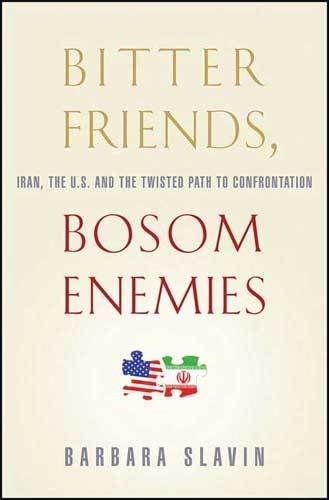
Barbara Slavin, senior diplomatic correspondent for USA Today since 1996 and author of the recently published book, Bitter Friends, Bosom Enemies: Iran, the U.S., and the Twisted Path to Confrontation (St. Martin’s Press), writes that,
“Iran and the United States are like a once happily married couple that has gone through a bitter divorce. Harsh words have been exchanged – husband and wife have come to blows and employed others to inflict more punishment. Apologizing is hard and changing behavior even harder. This relationship is unequal, with one side or the other feeling more vulnerable at any given time and afraid the other will take advantage of concessions.”
Currently, the public faces of both nations, presidents George W. Bush and Mahmoud Ahmadinejad, have been content to throw rhetorical bombs and raise the diplomatic temperature – increasing the likelihood of war. Indeed, at times it appears that conservative hardliners in both countries are eager for conflict as a means to maintain their respective grips on power.

The journey from the CIA backed coup that overthrew Iran’s democratically elected leader Mossadeq in 1953 and replaced him with the Shah, to the Islamic Revolution of 1979 and current tensions is replete with ill conceived schemes that damaged both nations. Slavin, using her extensive contacts among the powerful inside Iran and the United States, documents missed opportunities for reconciliation between both countries during the administrations of the first President Bush as well as Bill Clinton and George W. Bush.

The combination of her remarkable access to people such as Madeline Albright, Condelezza Rice, Iranian reformers like former President Mohammad Khatami, longtime establishment figures such as Ali Rafsanjani, as well as dissidents like Akbar Ganji and everyday citizens, allows Slavin to shed sunlight on a nation most Americans know very little about. She is also the first newspaper reporter from the United States to interview Iranian President Ahmadinejad.

Slavin has accompanied three secretaries of State on their official travels and reported from Iran, Libya, Israel, Egypt, North Korea, Russia, China, Saudi Arabia and Syria. She is also a regular commentator for U.S. foreign policy on National Public Radio, the Public Broadcasting System's Washington Week In Review and C-Span. This month, she joined the U.S. Institute of Peace as a Jennings Randolph fellow, to continue her research on Iran. Slavin also serves as a member of the Council on Foreign Relations.

Prior to joining USA Today, Slavin was a Washington-based writer for The Economist and the Los Angeles Times, covering domestic and foreign policy issues, including the 1991-93 Middle East peace talks in Washington. From 1985-89, she was The Economist's correspondent in Cairo. During her career, Slavin has traveled widely in the Middle East, covering the Iran-Iraq war, the 1986 U.S. bombing of Libya, the political evolution of the Palestine Liberation Organization and the resurgence of Islamic fundamentalism. Earlier in the 1980s, Slavin also served as The Economist's correspondent in Beijing and reported from Japan and South Korea.

Prior to moving abroad, she worked as a writer and editor for The New York Times Week in Review section and a reporter and editor for United Press International in New York City.

Slavin agreed to a podcast interview with me about her book, Iran and their turbulent relationship with the United States. Please refer to the media player below. Our conversation is just under thirty minutes. This interview can also be accessed via the Itunes Store by searching for “Intrepid Liberal Journal.”

Sunday, April 08, 2007

Memo To Conservatives: George W. Bush Is Not An Aberration

Conservatives want you to believe the presidency of George W. Bush is an aberration. Those of us in the reality-based community understand the Bush Administration can’t be separated from conservative ideology. The blowback of the Bush years is in fact the collective legacy of Barry Goldwater, Richard Nixon, Gerald Ford, Ronald Reagan, George Herbert Walker Bush, Newt Gingrich, Bob Dole, Trent Lott, Dick Cheney, Tom DeLay, Dick Hastert, John McCain, Pat Robertson, Jerry Falwell the American Enterprise Institute, the Heritage Foundation and the rest of the feculent conservative cabal.

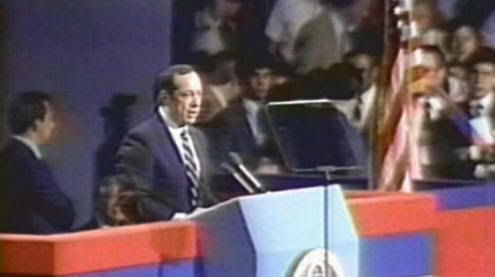
Take a moment to read the text of New York Governor Mario Cuomo’s keynote address to the 1984 Democratic National Convention below or click here to listen to it. Whether you read or listen to Cuomo’s words from twenty-three years ago, it’s remarkable how relevant his speech is today. His repudiation of Ronald Reagan echoes across time as conservatives have eviscerated our infrastructure, debased public education, disintegrated the middle class, neglected veterans, sacrificed universal healthcare to profit industry raped our Constitution, exploited fear and pursued recklessly immoral foreign policies. Hopefully, 2008 will not simply be a slight changing of the pendulum but signal a new era of sense, compassion, and progress. The direction Mario Cuomo spoke of in 1984.

“Thank you very much.

On behalf of the great Empire State and the whole family of New York, let me thank you for the great privilege of being able to address this convention. Please allow me to skip the stories and the poetry and the temptation to deal in nice but vague rhetoric. Let me instead use this valuable opportunity to deal immediately with the questions that should determine this election and that we all know are vital to the American people.

Ten days ago, President Reagan admitted that although some people in this country seemed to be doing well nowadays, others were unhappy, even worried, about themselves, their families, and their futures. The President said that he didn't understand that fear. He said, "Why, this country is a shining city on a hill." And the President is right. In many ways we are a shining city on a hill.

But the hard truth is that not everyone is sharing in this city's splendor and glory. A shining city is perhaps all the President sees from the portico of the White House and the veranda of his ranch, where everyone seems to be doing well. But there's another city; there's another part to the shining the city; the part where some people can't pay their mortgages, and most young people can't afford one; where students can't afford the education they need, and middle-class parents watch the dreams they hold for their children evaporate.

In this part of the city there are more poor than ever, more families in trouble, more and more people who need help but can't find it. Even worse: There are elderly people who tremble in the basements of the houses there. And there are people who sleep in the city streets, in the gutter, where the glitter doesn't show. There are ghettos where thousands of young people, without a job or an education, give their lives away to drug dealers every day. There is despair, Mr. President, in the faces that you don't see, in the places that you don't visit in your shining city.

In fact, Mr. President, this is a nation -- Mr. President you ought to know that this nation is more a 'Tale of Two Cities' than it is just a 'Shining City on a Hill.'

Maybe, maybe, Mr. President, if you visited some more places; maybe if you went to Appalachia where some people still live in sheds; maybe if you went to Lackawanna where thousands of unemployed steel workers wonder why we subsidized foreign steel. Maybe -- Maybe, Mr. President, if you stopped in at a shelter in Chicago and spoke to the homeless there; maybe, Mr. President, if you asked a woman who had been denied the help she needed to feed her children because you said you needed the money for a tax break for a millionaire or for a missile we couldn't afford to use.

Maybe -- Maybe, Mr. President. But I'm afraid not. Because the truth is, ladies and gentlemen, that this is how we were warned it would be. President Reagan told us from the very beginning that he believed in a kind of social Darwinism. Survival of the fittest. "Government can't do everything," we were told, so it should settle for taking care of the strong and hope that economic ambition and charity will do the rest. Make the rich richer, and what falls from the table will be enough for the middle class and those who are trying desperately to work their way into the middle class.

You know, the Republicans called it "trickle-down" when Hoover tried it. Now they call it "supply side." But it's the same shining city for those relative few who are lucky enough to live in its good neighborhoods. But for the people who are excluded, for the people who are locked out, all they can do is stare from a distance at that city's glimmering towers.

It's an old story. It's as old as our history. The difference between Democrats and Republicans has always been measured in courage and confidence. The Republicans -- The Republicans believe that the wagon train will not make it to the frontier unless some of the old, some of the young, some of the weak are left behind by the side of the trail. "The strong" -- 'The strong,' they tell us, 'will inherit the land.'

We Democrats believe in something else. We democrats believe that we can make it all the way with the whole family intact, and we have more than once. Ever since Franklin Roosevelt lifted himself from his wheelchair to lift this nation from its knees -- wagon train after wagon train -- to new frontiers of education, housing, peace; the whole family aboard, constantly reaching out to extend and enlarge that family; lifting them up into the wagon on the way; blacks and Hispanics, and people of every ethnic group, and native Americans -- all those struggling to build their families and claim some small share of America. For nearly 50 years we carried them all to new levels of comfort, and security, and dignity, even affluence. And remember this, some of us in this room today are here only because this nation had that kind of confidence. And it would be wrong to forget that.

So, here we are at this convention to remind ourselves where we come from and to claim the future for ourselves and for our children. Today our great Democratic Party, which has saved this nation from depression, from fascism, from racism, from corruption, is called upon to do it again -- this time to save the nation from confusion and division, from the threat of eventual fiscal disaster, and most of all from the fear of a nuclear holocaust.

That's not going to be easy. Mo Udall is exactly right -- it won't be easy. And in order to succeed, we must answer our opponent's polished and appealing rhetoric with a more telling reasonableness and rationality.

We must win this case on the merits. We must get the American public to look past the glitter, beyond the showmanship to the reality, the hard substance of things. And we'll do it not so much with speeches that sound good as with speeches that are good and sound; not so much with speeches that will bring people to their feet as with speeches that will bring people to their senses. We must make -- We must make the American people hear our "Tale of Two Cities." We must convince them that we don't have to settle for two cities, that we can have one city, indivisible, shining for all of its people.

Now, we will have no chance to do that if what comes out of this convention is a babel of arguing voices. If that's what's heard throughout the campaign, dissident sounds from all sides, we will have no chance to tell our message. To succeed we will have to surrender some small parts of our individual interests, to build a platform that we can all stand on, at once, and comfortably -- proudly singing out. We need -- We need a platform we can all agree to so that we can sing out the truth for the nation to hear, in chorus, its logic so clear and commanding that no slick Madison Avenue commercial, no amount of geniality, no martial music will be able to muffle the sound of the truth.

And we Democrats must unite. We Democrats must unite so that the entire nation can unite, because surely the Republicans won't bring this country together. Their policies divide the nation into the lucky and the left-out, into the royalty and the rabble. The Republicans are willing to treat that division as victory. They would cut this nation in half, into those temporarily better off and those worse off than before, and they would call that division recovery.

Now, we should not -- we should not be embarrassed or dismayed or chagrined if the process of unifying is difficult, even wrenching at times. Remember that, unlike any other Party, we embrace men and women of every color, every creed, every orientation, every economic class. In our family are gathered everyone from the abject poor of Essex County in New York, to the enlightened affluent of the gold coasts at both ends of the nation. And in between is the heart of our constituency -- the middle class, the people not rich enough to be worry-free, but not poor enough to be on welfare; the middle class -- those people who work for a living because they have to, not because some psychiatrist told them it was a convenient way to fill the interval between birth and eternity. White collar and blue collar. Young professionals. Men and women in small business desperate for the capital and contracts that they need to prove their worth.

We speak for the minorities who have not yet entered the mainstream. We speak for ethnics who want to add their culture to the magnificent mosaic that is America. We speak -- We speak for women who are indignant that this nation refuses to etch into its governmental commandments the simple rule "thou shalt not sin against equality," a rule so simple -- I was going to say, and I perhaps dare not but I will. It's a commandment so simple it can be spelled in three letters: E.R.A.

We speak -- We speak for young people demanding an education and a future. We speak for senior citizens. We speak for senior citizens who are terrorized by the idea that their only security, their Social Security, is being threatened. We speak for millions of reasoning people fighting to preserve our environment from greed and from stupidity. And we speak for reasonable people who are fighting to preserve our very existence from a macho intransigence that refuses to make intelligent attempts to discuss the possibility of nuclear holocaust with our enemy. They refuse. They refuse, because they believe we can pile missiles so high that they will pierce the clouds and the sight of them will frighten our enemies into submission.

Now we're proud of this diversity as Democrats. We're grateful for it. We don't have to manufacture it the way the Republicans will next month in Dallas, by propping up mannequin delegates on the convention floor. But we, while we're proud of this diversity, we pay a price for it. The different people that we represent have different points of view. And sometimes they compete and even debate, and even argue. That's what our primaries were all about. But now the primaries are over and it is time, when we pick our candidates and our platform here, to lock arms and move into this campaign together.

If you need any more inspiration to put some small part of your own difference aside to create this consensus, then all you need to do is to reflect on what the Republican policy of divide and cajole has done to this land since 1980. Now the President has asked the American people to judge him on whether or not he's fulfilled the promises he made four years ago. I believe, as Democrats, we ought to accept that challenge. And just for a moment let us consider what he has said and what he's done.

Inflation -- Inflation is down since 1980, but not because of the supply-side miracle promised to us by the President. Inflation was reduced the old-fashioned way: with a recession, the worst since 1932. Now how did we -- We could have brought inflation down that way. How did he do it? 55,000 bankruptcies; two years of massive unemployment; 200,000 farmers and ranchers forced off the land; more homeless -- more homeless than at any time since the Great Depression in 1932; more hungry, in this world of enormous affluence, the United States of America, more hungry; more poor, most of them women. And -- And he paid one other thing, a nearly 200 billion dollar deficit threatening our future.

Now, we must make the American people understand this deficit because they don't. The President's deficit is a direct and dramatic repudiation of his promise in 1980 to balance the budget by 1983. How large is it? The deficit is the largest in the history of the universe. It -- President Carter's last budget had a deficit less than one-third of this deficit. It is a deficit that, according to the President's own fiscal adviser, may grow to as much 300 billion dollars a year for "as far as the eye can see." And, ladies and gentlemen, it is a debt so large -- that is almost one-half of the money we collect from the personal income tax each year goes just to pay the interest. It is a mortgage on our children's future that can be paid only in pain and that could bring this nation to its knees.

Now don't take my word for it -- I'm a Democrat. Ask the Republican investment bankers on Wall Street what they think the chances of this recovery being permanent are. You see, if they're not too embarrassed to tell you the truth, they'll say that they're appalled and frightened by the President's deficit. Ask them what they think of our economy, now that it's been driven by the distorted value of the dollar back to its colonial condition. Now we're exporting agricultural products and importing manufactured ones. Ask those Republican investment bankers what they expect the rate of interest to be a year from now. And ask them -- if they dare tell you the truth -- you'll learn from them, what they predict for the inflation rate a year from now, because of the deficit.

Now, how important is this question of the deficit. Think about it practically: What chance would the Republican candidate have had in 1980 if he had told the American people that he intended to pay for his so-called economic recovery with bankruptcies, unemployment, more homeless, more hungry, and the largest government debt known to humankind? If he had told the voters in 1980 that truth, would American voters have signed the loan certificate for him on Election Day? Of course not! That was an election won under false pretenses. It was won with smoke and mirrors and illusions. And that's the kind of recovery we have now as well.

But what about foreign policy? They said that they would make us and the whole world safer. They say they have. By creating the largest defense budget in history, one that even they now admit is excessive -- by escalating to a frenzy the nuclear arms race; by incendiary rhetoric; by refusing to discuss peace with our enemies; by the loss of 279 young Americans in Lebanon in pursuit of a plan and a policy that no one can find or describe.

We give money to Latin American governments that murder nuns, and then we lie about it. We have been less than zealous in support of our only real friend -- it seems to me, in the Middle East -- the one democracy there, our flesh and blood ally, the state of Israel. Our -- Our policy -- Our foreign policy drifts with no real direction, other than an hysterical commitment to an arms race that leads nowhere -- if we're lucky. And if we're not, it could lead us into bankruptcy or war.

Of course we must have a strong defense! Of course Democrats are for a strong defense. Of course Democrats believe that there are times that we must stand and fight. And we have. Thousands of us have paid for freedom with our lives. But always -- when this country has been at its best -- our purposes were clear. Now they're not. Now our allies are as confused as our enemies. Now we have no real commitment to our friends or to our ideals -- not to human rights, not to the refuseniks, not to Sakharov, not to Bishop Tutu and the others struggling for freedom in South Africa.

We -- We have in the last few years spent more than we can afford. We have pounded our chests and made bold speeches. But we lost 279 young Americans in Lebanon and we live behind sand bags in Washington. How can anyone say that we are safer, stronger, or better?

That -- That is the Republican record. That its disastrous quality is not more fully understood by the American people I can only attribute to the President's amiability and the failure by some to separate the salesman from the product.
And, now -- now -- now it's up to us. Now it's up to you and to me to make the case to America. And to remind Americans that if they are not happy with all that the President has done so far, they should consider how much worse it will be if he is left to his radical proclivities for another four years unrestrained. Unrestrained.

Now, if -- if July -- if July brings back Ann Gorsuch Burford -- what can we expect of December? Where would -- Where would another four years take us? Where would four years more take us? How much larger will the deficit be? How much deeper the cuts in programs for the struggling middle class and the poor to limit that deficit? How high will the interest rates be? How much more acid rain killing our forests and fouling our lakes?

And, ladies and gentlemen, please think of this -- the nation must think of this: What kind of Supreme Court will we have?

Please. [beckons audience to settle down]

We -- We must ask ourselves what kind of court and country will be fashioned by the man who believes in having government mandate people's religion and morality; the man who believes that trees pollute the environment; the man that believes that -- that the laws against discrimination against people go too far; a man who threatens Social Security and Medicaid and help for the disabled. How high will we pile the missiles? How much deeper will the gulf be between us and our enemies? And, ladies and gentlemen, will four years more make meaner the spirit of the American people? This election will measure the record of the past four years. But more than that, it will answer the question of what kind of people we want to be.

We Democrats still have a dream. We still believe in this nation's future. And this is our answer to the question. This is our credo:

We believe in only the government we need, but we insist on all the government we need.

We believe in a government that is characterized by fairness and reasonableness, a reasonableness that goes beyond labels, that doesn't distort or promise to do things that we know we can't do.

We believe in a government strong enough to use words like "love" and 'compassion' and smart enough to convert our noblest aspirations into practical realities.

We believe in encouraging the talented, but we believe that while survival of the fittest may be a good working description of the process of evolution, a government of humans should elevate itself to a higher order.

We -- Our -- Our government -- Our government should be able to rise to the level where it can fill the gaps that are left by chance or by a wisdom we don't fully understand. We would rather have laws written by the patron of this great city, the man called the "world's most sincere Democrat," St. Francis of Assisi, than laws written by Darwin.

We believe -- We believe as Democrats, that a society as blessed as ours, the most affluent democracy in the world's history, one that can spend trillions on instruments of destruction, ought to be able to help the middle class in its struggle, ought to be able to find work for all who can do it, room at the table, shelter for the homeless, care for the elderly and infirm, and hope for the destitute. And we proclaim as loudly as we can the utter insanity of nuclear proliferation and the need for a nuclear freeze, if only to affirm the simple truth that peace is better than war because life is better than death.

We believe in firm -- We believe in firm but fair law and order.

We believe proudly in the union movement.

We believe in a -- We believe -- We believe in privacy for people, openness by government.

We believe in civil rights, and we believe in human rights.

We believe in a single -- We believe in a single fundamental idea that describes better than most textbooks and any speech that I could write what a proper government should be: the idea of family, mutuality, the sharing of benefits and burdens for the good of all, feeling one another's pain, sharing one another's blessings -- reasonably, honestly, fairly, without respect to race, or sex, or geography, or political affiliation.

We believe we must be the family of America, recognizing that at the heart of the matter we are bound one to another, that the problems of a retired school teacher in Duluth are our problems; that the future of the child -- that the future of the child in Buffalo is our future; that the struggle of a disabled man in Boston to survive and live decently is our struggle; that the hunger of a woman in Little Rock is our hunger; that the failure anywhere to provide what reasonably we might, to avoid pain, is our failure.

Now for 50 years -- for 50 years we Democrats created a better future for our children, using traditional Democratic principles as a fixed beacon, giving us direction and purpose, but constantly innovating, adapting to new realities: Roosevelt's alphabet programs; Truman's NATO and the GI Bill of Rights; Kennedy's intelligent tax incentives and the Alliance for Progress; Johnson's civil rights; Carter's human rights and the nearly miraculous Camp David Peace Accord.

Democrats did it -- Democrats did it and Democrats can do it again. We can build a future that deals with our deficit. Remember this, that 50 years of progress under our principles never cost us what the last four years of stagnation have. And we can deal with the deficit intelligently, by shared sacrifice, with all parts of the nation's family contributing, building partnerships with the private sector, providing a sound defense without depriving ourselves of what we need to feed our children and care for our people. We can have a future that provides for all the young of the present, by marrying common sense and compassion.

We know we can, because we did it for nearly 50 years before 1980. And we can do it again, if we do not forget -- if we do not forget that this entire nation has profited by these progressive principles; that they helped lift up generations to the middle class and higher; that they gave us a chance to work, to go to college, to raise a family, to own a house, to be secure in our old age and, before that, to reach heights that our own parents would not have dared dream of.

That struggle to live with dignity is the real story of the shining city. And it's a story, ladies and gentlemen, that I didn't read in a book, or learn in a classroom. I saw it and lived it, like many of you. I watched a small man with thick calluses on both his hands work 15 and 16 hours a day. I saw him once literally bleed from the bottoms of his feet, a man who came here uneducated, alone, unable to speak the language, who taught me all I needed to know about faith and hard work by the simple eloquence of his example. I learned about our kind of democracy from my father. And I learned about our obligation to each other from him and from my mother. They asked only for a chance to work and to make the world better for their children, and they -- they asked to be protected in those moments when they would not be able to protect themselves. This nation and this nation's government did that for them.

And that they were able to build a family and live in dignity and see one of their children go from behind their little grocery store in South Jamaica on the other side of the tracks where he was born, to occupy the highest seat, in the greatest State, in the greatest nation, in the only world we would know, is an ineffably beautiful tribute to the democratic process.

And -- And ladies and gentlemen, on January 20, 1985, it will happen again -- only on a much, much grander scale. We will have a new President of the United States, a Democrat born not to the blood of kings but to the blood of pioneers and immigrants. And we will have America's first woman Vice President, the child of immigrants, and she -- she -- she will open with one magnificent stroke, a whole new frontier for the United States.

Now, it will happen. It will happen if we make it happen; if you and I make it happen. And I ask you now, ladies and gentlemen, brothers and sisters, for the good of all of us, for the love of this great nation, for the family of America, for the love of God: Please, make this nation remember how futures are built.

Thank you and God bless you.”

Tuesday, March 06, 2007

Scooter Libby Is Collateral Damage

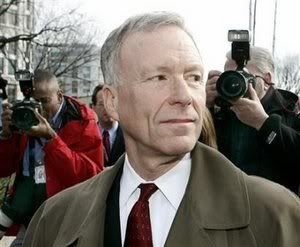
Sentient beings across the four corners of the world learned today that I. “Scooter” Libby, former Chief of Staff to Vice President Cheney, was found guilty of obstruction of justice, perjury and making a false statement. Libby faces a maximum sentence of 25 years in prison and a fine of $1 million. Much of the blogosphere is in a joyful tizzy about Libby’s fate.

However, I can’t muster much enthusiasm over it. As far as I’m concerned, one of the jurors named Dennis Collins had the best perspective about it. According to CNN, Collins said:

"It was just very hard to believe how he could remember it on a Tuesday and forget it on a Thursday and then remember it two days later," Collins told reporters outside U.S. District Court. "Having said that, I will say that there was a tremendous amount of sympathy for Mr. Libby on the jury."

"It was said a number of times, 'What are we doing with this guy here? Where's [Karl] Rove ... where are these other guys?'

"We're not saying we didn't think Mr. Libby was guilty of the things we found him guilty of, but it seemed like ... he was the fall guy."
Mind you, I don’t have any sympathy for Mr. Libby. He willfully did the bidding for a warmongering cabal of corporatist gangsters. However, the man is nothing more than acceptable collateral damage for the neocons. They managed to prevent any exposure about the Plame affair from costing Bush re-election in 2004. Furthermore, the Bush Administration’s cover-up successfully prevented anyone from being prosecuted for outing Valerie Plame or lying about the Iraq War. Libby was the instrument used to perpetuate a cover-up about a cover-up and protect the President.

It’s doubtful Mr. Libby will spend even one hour in jail. He’ll play the system through the appeal process or President Bush will simply pardon him. Meanwhile, the war goes on. More blood is spilled. Sociopaths Bush and Cheney continue to avoid accountability. We’re losing Afghanistan too. Al Quaeda is winning. So, forgive me if I don’t feel like celebrating this verdict.

Tuesday, February 27, 2007

Irony and Death

Liberal activists such as myself resent the Bush Administration’s cynical exploitation of fear. Bush and his enablers in the Republican Party have utilized fear to justify an immoral and unnecessary war in Iraq. A cabal of reckless warmongers and profiteers undermined our moral authority and geopolitical position. Even worse, while the Bush Administration was busy hyping the strategic importance of Iraq, Al Quaeda reconstituted itself. America is in great danger as a result.

Frank Rich is a liberal columnist not prone to exaggeration or fear mongering. In his most recent New York Times column, Rich noted how the CIA’s former head of the Bin Laden unit, Michael Scheuer told MSNB’s Keith Olberman, that Al Quaeda,

“are going to detonate a nuclear device inside the United States.”
I believe him. Tactical nuclear weapons are quite obtainable and these fanatics believe mass murder serves a higher purpose. Such warnings resemble the intelligence community's desperate attempt getting both Presidents Clinton and Bush to pay attention to the threat of an Al Quaeda attack prior to 9/11. Clinton was properly engaged but hamstrung politically following the Monica Lewinsky scandal. Bush wasn't even stirred by that infamously straightforward memo of August 2001.

Immediately after 9/11, I debated my fellow liberal friends about the merits of toppling the Taliban government in Afghanistan because of their support for Al Quaeda. I found myself in the unusual position of justifying a military response. The loss of innocent life utterly sickened me but there was no way we couldn’t respond. My problem was I didn’t trust an administration stocked with corporatist ideologues and imperialists.

As we’ve seen, the Bush Administration’s obsession with Iraq has facilitated
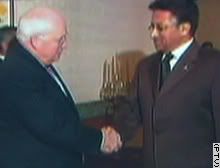
Al Quaeda's resurgence in Afghanistan and Pakistan. It’s bitterly ironic how Vice President Cheney’s meeting with Pakistan’s President Musharraf earlier today, featured a suicide bomber targeting him. The sort of terrorists the Bush Administration opted to neglect signaled they’re very much here by attempting to take our Vice President out.

The bomber killed 23 people instead. Much of the civilized world would not have grieved had Cheney been killed. Symbolically, today’s bombing was a propaganda bonanza for Al Quaeda.

It’s said that laughing is better than crying. How comically ironic that after letting Bin Laden escape in Tora Bora in December 2001, redirecting resources from Afghanistan to the Iraq theatre and giving Musharraf’s regime billions in aid, the Bush Administration finally decided to express displeasure at their ally in Islamabad. A useless exercise, because what can Musharraf effectively do without jeopardizing his own regime’s grip on power?

America’s enemies are ascending. Our veracity and moral legitimacy is not trusted by many of our western allies. Five and a half years after 9/11, we still haven’t developed a containment policy with the civilized world that provides a bulwark against radical Islam and empowers moderates. The “global war on terror” is perpetuating a treadmill of death with no end in sight.

January 20th, 2009 can’t get here soon enough. Hopefully, the next occupant of the White House won’t be a moron. Otherwise, the next attack may be far more catastrophic than two airplanes crashing into a building.

Thursday, December 28, 2006

President Ford Revealed Opposition To Iraq War In July 2004

Bob Woodward reported in today’s Washington Post (CLICK HERE) that President Ford revealed his opposition to the Iraq War during a July 2004 interview. According to the article, Woodward’s interview with Ford was “embargoed” until after his death. Yesterday I was charitable to President Ford in describing his legacy as mixed and I stand by that. Nevertheless, Woodward’s article makes me feel less kindly to President Ford’s memory. An ex Republican President critical of key former members of this administration such as Cheney and Rumsfeld was too important to be kept a secret. Ford had an obligation to make his opposition public just as former Secretary of State Collin Powell should have in 2003. Perhaps it might have impacted the 2004 presidential election and saved some lives. Ford is supposedly a symbolic figure of a bygone era when love of country mattered more than allegiance to one’s political party. I can’t help but wonder if Ford’s opposition would have remained “embargoed” if a Democrat were in the White House.

Wednesday, December 27, 2006

The Mixed Legacy of Gerald R. Ford

Gerald R. Ford, a man fate placed on a stage far bigger than his modest persona suggested he belonged is dead at 93. In August 1974 he was appointed America's 38th president when Richard Nixon resigned in disgrace because of the Watergate scandal. Had he not resigned Nixon surely would’ve been impeached in the House of Representatives and convicted by the Senate.

Ford became Nixon’s vice president when Spiro Agnew himself was forced to resign after pleading no contest to tax evasion. According to the Constitution, congress must approve a new vice president when a replacement is needed during a presidential term. As Nixon’s crimes were increasingly exposed to the public the stakes were high when selecting a new vice president. Tip O’Neill who later became Speaker of the House and was friendly with Ford recalled in his memoirs that,

“Another reason we favored Jerry Ford was that we didn’t think the Republicans should benefit from Agnew’s resignation. While Jerry had been an excellent leaderin the Congress, he didn’t seem to have the desire, the personality, or the charisma to be elected president on his own. He had even said that in the event he was selected, he wouldn’t seek the presidency in 1976. We found that reassuring, although nobody was prepared to hold him to that promise.”

The mainstream media prefers to lionize former presidents when they die and Ford is regarded as a decent caretaker who restored confidence in the republic. Ford does deserve credit for not resorting to the politics of slash and burn when campaigning for reelection in 1976. Nixon’s electoral success was partly attributed to exploiting resentments of working class whites. These voters later became “Reagan Democrats” and combined with evangelical Christians and traditional supporters from business interests to form a powerful coalition.

Future Republican presidents Ronald Reagan, George Herbert Walker Bush and George W. Bush prevailed partly by exploiting the politics of division. Ford unleashed his running mate Senator Robert Dole into the “briar patch” but otherwise campaigned on his competence and experience. Carter opened a big lead following the Democratic convention but Ford closed strong in spite of his controversial pardon of Nixon and debate gaffes by both him and Dole. Ford lost in a squeaker but resisted the temptation to resort to race baiting as Ronald Reagan did in Philadelphia, Mississippi during the 1980 campaign.

Ford also deserves credit for the 1975 Helsinki Accords signed by the United States, Canada, the Soviet Union and most European countries. At the time conservative critics such as Ronald Reagan who ultimately challenged Ford for the Republican nomination in 1976 protested the agreement because it recognized the Soviet Union’s territorial gains after World War Two. However, the Helsinki Accords also reduced Cold War tensions and put the Soviets on record as supporting human rights. Consequently the Helsinki Accords served to undermine the Soviet regime’s legitimacy and facilitated the communist empire’s demise.

National healing and the Helsinki Accords are not small accomplishments for a president that wasn’t elected. However, there is a dark side to the Ford legacy: the rise of the neocons. Ford’s Chief of Staff was a young man named Dick Cheney and Donald Rumsfeld was his Secretary of Defense. They persuaded Ford to cave under pressure from conservative critics in the assessment of Soviet military strength. As a result, CIA director George Herbert Walker Bush commissioned a competitive threat assessment known as “Team B” in July 1976.

Team B was comprised of ideologues such as Paul Nitze and they greatly exaggerated the Soviet military threat. Hence, under the Ford Administration a precedent was established for rewarding the views of ideologues over the assessment of national security professionals who knew their business. Although the Carter Administration gave little credence to Team B’s reports the national security bureaucracy was infected with an insidious cancer that ravaged its guts.

Senator Patrick Moynihan noted years later the CIA failed to predict the Soviet Union’s demise, as it should have. The iron triangle of the defense industry and bureaucracy needed to promote the myth of a formidable Soviet menace. This mindset is partly responsible for wasted billions of dollars spent on the delusional missile defense scheme known as “Star Wars.”

Ford partly surrendered to this pressure because of trouble on his political right. California Governor Ronald Reagan posed a serious challenge in the summer of 1976. Conservative critics such as Reagan had managed to make the word “détente” as dirty as the word “liberal” and Secretary of State Henry Kissinger was viewed with contempt. Remarkable that Henry Kissinger who is considered a war criminal by many was also regarded as soft on communism by conservative ideologues.

Consequently Ford established the precedent of appeasing conservative ideologues to ensure his political survival. All politicians want to survive and perhaps most would’ve done the same. Unfortunately, Ford’s political weakness helped pave the way for the ascendancy of dark political forces responsible for much of America’s abysmal leadership today. And that too is part of Ford’s legacy.
*********************************************************************************
ADDENDUM:
My thanks to "Real History Lisa" for promoting a crossposting of the above topic at Progressive Historians.
CLICK HERE to review comments from that community. Progressive Historians as one can infer from the name is a community blog devoted to analyzing history from a progressive perspective.