I've always had mixed feelings about Delaware Senator Joe Biden. On domestic issues his support of the bankruptcy bill undermined both wage earners and small business entrepreneurs. However, his home state relies on the financial services industry for jobs so I understood.
In October 2002, Biden showed poor judgment in supporting the resolution to go to war against Iraq. Overall though he's been an articulate voice on foreign policy. I thought his presidential campaign was an honorable attempt at substance over show biz and deserved more attention from the media.
Today, Biden effectively responded to President Bush's disgraceful fear mongering before the Israeli Knesset. Bush was specifically targeting American Jewish voters on behalf of McCain. Jewish voters typically vote for Democrats about seventy percent of the time. Obama has a perceived weakness among that constituency. As an American Jew I was offended by Bush's pandering through fear mongering and appreciate Biden's forceful response.
Iran is a complex and layered society. To learn more about the Iranian people and their system of government, click here to listen to an interview I conducted with Mideast expert Barbara Slavin last year. Slavin's informative book, Bitter Friends, Bosom Enemies: Iran, the U.S., and the Twisted Path to Confrontation had just been published when the interview took place.
Showing posts with label Barbara Slavin. Show all posts
Showing posts with label Barbara Slavin. Show all posts
Thursday, May 15, 2008


Tuesday, December 04, 2007
Inside Track: Off the Warpath?

Barbara Slavin, a guest writer here at the Intrepid Liberal Journal, just published an important article in the National Interest entitled "Inside Track: Off the Warpath?" Both the National Interest and Barbara Slavin have graciously granted their permission for her article to be posted here.
Barbara Slavin is a senior diplomatic reporter for USA Today on leave as a Jennings Randolph fellow at the U.S. Institute of Peace and the author of Bitter Friends, Bosom Enemies: Iran, the U.S. and the Twisted Path to Confrontation. I interviewed Barbara Slavin about her book and U.S./Iranian relations on October 21st. You can listen to that interview by clicking here.
The smiles on the faces of several U.S. military personnel at a previously scheduled Washington think tank session on Iran’s “bomb” said it all Tuesday: The United States is not going to start a third Middle East war anytime soon.
Monday’s new National Intelligence Estimate (NIE) stating “with high confidence that in fall 2003, Tehran halted its nuclear weapons program” dropped the big one on those in Washington and elsewhere who have been urging the Bush Administration to strike Iran “before it is too late.”
Despite President Bush’s efforts at his press conference to act as though nothing has changed, everything has. Chuck Frelich, a former Israeli deputy national security adviser, called the news “an earthquake” that “gives us more time to explore the diplomatic route.” The Nixon Center’s Geoffrey Kemp, appearing on the same panel at The Washington Institute for Near East Policy, agreed. The NIE “changes the political dynamics in this town”, he said. “The out of the blue pre-emptive strike . . . is a long way off.”
There are still many questions about the new estimate and its origins. The intelligence community, in its eagerness not to promise another “slam dunk”, may have erred on the side of caution. Iran has accelerated its overt enrichment program since 2005 and could produce enough fissile material for a bomb in as little as two years, more plausibly by 2015, the estimate said.
But a key conclusion of the NIE is that a negotiated solution is possible. Iran, it turns out, is not a nation of mad mullahs but a country whose “decisions are guided by a cost-benefit approach.” Its leaders are susceptible to pressure and worried about Iran’s international posture. Iran shut down the weapons program in 2003 because it had been caught cheating and in a post-9/11 environment, was worried about the consequences. At the same time it started negotiations with Great Britain, France and Germany—negotiations that it thought would be quickly joined by the United States.
That did not happen. President Bush, at his news conference, misspoke when he said that the United States “facilitated” the European talks with Iran in 2003. In fact, then–under secretary of state John Bolton did nothing to help. He actively tried to sabotage the talks with leaks about threatening Iranian remarks to the Europeans. Bush also misspoke when he said that “at that point in time” (2003) his administration said it would stop blocking Iran’s application to join the World Trade Organization and provide spare parts for civilian airliners if Iran halted its program. Those carrots were not put on the table until 2005, shortly before Iranian presidential elections replaced Mohammad Khatami with the more belligerent Mahmoud Ahmadinejad. The United States did not offer to actually join the negotiations until May 2006—and only then if Iran suspended its uranium program.
Will Bush now pursue a diplomatic option more strenuously? New sanctions will be harder to achieve but it will be easier to justify talks with Tehran. At the very least, Bush will not bomb Iran before he leaves office. And that is something for which everyone around the world—not just the overstretched U.S. military—should be grateful.
Tuesday, October 23, 2007
How the U.S. Helped Sink Larijani
Editor's Note: This is Barbara Slavin's first post with the Intrepid Liberal Journal. She is a senior fellow at the U.S. Institute of Peace and author of "Bitter Friends, Bosom Enemies: Iran, the U.S. and the Twisted Path to Confrontation." Barbara has also covered the Middle East for over twenty-years as a reporter, most recently as a senior diplomatic corresspondent with USA Today. I'm most gratified at Barbara's willingness to share her unique perspective. The views expressed here are her own.Bush administration officials often say they don't understand the Iranian government. They have proven this time and time again by undermining those mostly likely to negotiate crucial differences with the United States. Now the administration appears to have lost yet another opportunity to slow Iran's march to nuclear power and its efforts to play the spoiler in the Middle East.
The loss this time involves Ali Larijani, a red-bearded intellectual who styles himself Iran's Henry Kissinger. A conservative who ran for president and lost to Mahmoud Ahmadinejad in 2005, Larijani got the consolation prize of chief nuclear negotiator and secretary of Iran's national security council. This weekend, Larijani resigned from the negotiator post. His replacement: an obscure deputy foreign minister, Saeed Jalili, who is said to be an ally of Ahmadinejad.
Despite a reputation as a hardliner, Larijani began reaching out to the United States soon after Iranian elections in 2005. In an interview he gave me in Tehran in February 2006, Larijani praised his U.S. counterpart, Stephen Hadley, as a "logical thinker" and said "there is no limitation on our side" to negotiations with the United States.
Larijani authorized a deputy, Mohammad Javad Jaffari, to ask for backchannel talks with Hadley or a designated emissary. When the White House did not respond, Larijani publicly on March 16, 2006, accepted a prior U.S. offer for talks limited to the situation in Iraq. A week later, supreme leader Ayatollah Ali Khamenei endorsed the proposal -- a dramatic step for someone who had up until then threatened those who publicly advocated talks with the United States as traitors. An Iranian website close to the conservative leadership, Baztab, announced that the Iranians had put together a high-level delegation and that talks would begin in Baghdad on April 9. But the Bush administration got cold feet. Its refusal to meet undermined Larijani within the Iranian power structure and humiliated Khamenei. The chief beneficiary was Ahmadinejad.
The United States finally agreed to enter nuclear negotiations at the end of May 2006 but only if Iran would suspend its efforts to enrich uranium and as part of talks including Britain, Germany, France and the European Union. (Larijani did take part in a half dozen subsequent meetings with EU foreign policy chief Javier Solana but without success.) Direct U.S.-Iran talks about Iraq did not take place until May of this year. Delay on both fronts has been costly: Despite a U.S.-driven campaign of pressure and sanctions, Iran-backed attacks on U.S. forces in Iraq have escalated and Iran is much closer to the ability to make nuclear bombs. President Bush said last week an Iran with nuclear weapons would usher in "World War III."
A U.S. decision to talk to Iran unconditionally in 2006 might not have stemmed this escalation. But it is impossible to know -- just as it is impossible to say what would have happened had the Bush administration not put Iran on an "axis of evil" in 2002 or accepted an offer for comprehensive negotiations with the government of Ahmadinejad's predecessor, Mohammad Khatami, in May 2003.
Administration officials argue that U.N. and other sanctions are exacerbating divisions within the Iranian regime and that Iran will eventually knuckle under to pressure. Divisions certainly are increasing in Tehran but the "reasonable people," as Secretary of State Condoleezza Rice likes to call them, are still not getting their way. The victors so far are those like Ahmadinejad who argue that the best way to earn U.S. respect and recognition is to confront Americans in Iraq and elsewhere and gain the capacity to build nuclear bombs as soon as possible.
Sunday, October 21, 2007
An Interview With Iranian Expert and Journalist Barbara Slavin
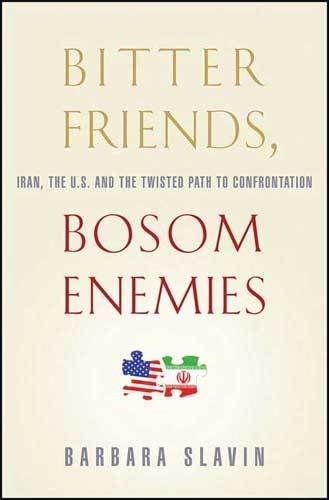 Barbara Slavin, senior diplomatic correspondent for USA Today since 1996 and author of the recently published book, Bitter Friends, Bosom Enemies: Iran, the U.S., and the Twisted Path to Confrontation (St. Martin’s Press), writes that,
“Iran and the United States are like a once happily married couple that has gone through a bitter divorce. Harsh words have been exchanged – husband and wife have come to blows and employed others to inflict more punishment. Apologizing is hard and changing behavior even harder. This relationship is unequal, with one side or the other feeling more vulnerable at any given time and afraid the other will take advantage of concessions.”Currently, the public faces of both nations, presidents George W. Bush and Mahmoud Ahmadinejad, have been content to throw rhetorical bombs and raise the diplomatic temperature – increasing the likelihood of war. Indeed, at times it appears that conservative hardliners in both countries are eager for conflict as a means to maintain their respective grips on power.
The journey from the CIA backed coup that overthrew Iran’s democratically elected leader Mossadeq in 1953 and replaced him with the Shah, to the Islamic Revolution of 1979 and current tensions is replete with ill conceived schemes that damaged both nations. Slavin, using her extensive contacts among the powerful inside Iran and the United States, documents missed opportunities for reconciliation between both countries during the administrations of the first President Bush as well as Bill Clinton and George W. Bush.
The combination of her remarkable access to people such as Madeline Albright, Condelezza Rice, Iranian reformers like former President Mohammad Khatami, longtime establishment figures such as Ali Rafsanjani, as well as dissidents like Akbar Ganji and everyday citizens, allows Slavin to shed sunlight on a nation most Americans know very little about. She is also the first newspaper reporter from the United States to interview Iranian President Ahmadinejad.
Slavin has accompanied three secretaries of State on their official travels and reported from Iran, Libya, Israel, Egypt, North Korea, Russia, China, Saudi Arabia and Syria. She is also a regular commentator for U.S. foreign policy on National Public Radio, the Public Broadcasting System's Washington Week In Review and C-Span. This month, she joined the U.S. Institute of Peace as a Jennings Randolph fellow, to continue her research on Iran. Slavin also serves as a member of the Council on Foreign Relations.
Prior to joining USA Today, Slavin was a Washington-based writer for The Economist and the Los Angeles Times, covering domestic and foreign policy issues, including the 1991-93 Middle East peace talks in Washington. From 1985-89, she was The Economist's correspondent in Cairo. During her career, Slavin has traveled widely in the Middle East, covering the Iran-Iraq war, the 1986 U.S. bombing of Libya, the political evolution of the Palestine Liberation Organization and the resurgence of Islamic fundamentalism. Earlier in the 1980s, Slavin also served as The Economist's correspondent in Beijing and reported from Japan and South Korea.
Prior to moving abroad, she worked as a writer and editor for The New York Times Week in Review section and a reporter and editor for United Press International in New York City.
Slavin agreed to a podcast interview with me about her book, Iran and their turbulent relationship with the United States. Please refer to the media player below. Our conversation is just under thirty minutes. This interview can also be accessed via the Itunes Store by searching for “Intrepid Liberal Journal.”
Subscribe to:
Posts (Atom)