President Obama is beginning his much-anticipated Mideast trip today in Saudi Arabia that includes a heavily promoted address to the Muslim world in Cairo, Egypt tomorrow. This trip coincides with President Obama and his Secretary of State, Hillary Clinton, making news criticizing Israel's settlment policy in the occuppied territories. With respect to the criticism, Israel's settlement policy is both illegal and immoral.
Obama's willingness to criticize Israel for it is certainly a change in rhetoric from standard American practice in recent years. The real test however will come as the Netenyahu government continues to defy the world and build within existing settlements. Will there be any consequences? I doubt it.
At this point there is no organized counterweight to the American Israeli Public Affairs Committee ("APAC"). As a Jewish American who cares about Israel, I once again express my regret that an effective counterweight to APAC does not exist. Without one, Israel will continue down a dark and perilious path and eventually reap a catastrophic whirlwind. In the meantime, blood is being shed.
I suspect Obama's Israeli criticism is partly calculated to enhance his credibility prior to engaging the leadership of the Muslim world. Translation: "I'm being honest with Israel and not coddling them. So I'm going to be honest with you too and say, Israel has legitimate security concerns that need to be addressed." That won't be enough.
In fairness to Obama, I don't see how any president can resolve the Israeli-Palestinian crisis. Netanyahu, even if he wanted too, can't deliver diplomatic breakthroughs without fracturing his fragile coalition or provoking civil war with Israeli settlers. The Palestinian leadership under Abbas is even less capable of coming through with what is known in the world of diplomacy as "deliverables." With Hamas shut out, the Palestinian Authority has no credibility with its own people as it struggles to survive.
Both Israeli and Palestinian societies are dysfunctional. After forty years of a brutal occupation, the Palestinians don't have the institutions or an established civil culture to govern itself as a peaceful neighbor. That won't change unless Palestinian society can have a transition period without the heavy yoke of occupation. The Palestinian young have known nothing but struggle, hardship and violence. They are jaded and easy prey to do the terrorist bidding of demagogues.
Meanwhile, Israeli society has been morally corrupted as an occupier and the extremist settler movement further ties their government’s hands. Even worse, there is no effective political left in Israel serving as an opposition. The onetime proud Labor Party is serving in Netanyahu's coalition and the opposition Kadima Party is not much better than Netanyahu's Likud government. Curiously, the Israeli press is far more critical of the occupation than the American press. Nonetheless, no viable center-left opposition party capable of challenging Israel’s posture towards the Palestinians exists.
It's heartbreaking but the cycle of violence appears unbreakable.
Showing posts with label Israel. Show all posts
Showing posts with label Israel. Show all posts
Wednesday, June 03, 2009


Tuesday, February 10, 2009
Israeli Exit Polls Project Livini's Kadima As Winnter
 Israel's Haaretz is projecting Tzipi Livini of the "centrist" Kadima Party as the winner in today's election. Overall, the new math for Israel's Knesset, is projected as Kadima having won 29 seats, while Bibi Netenyahu's Likud Party doubled their total with 27 seats and Ehud Barak's Labor fell all the way back to 14 seats. Truthfully, none of the options were very good but Ehud Barak and Labor were the best of bad options. It is dismaying that Israel's once proud Labor Party was so thoroughly routed. The political left in Israel is a distant memory.
Please note that Israeli exit polls are notoriously unreliable. Hence, the homicidal Netenyahu may still prevail. If Livini is the victor, she will likely struggle to cobble a coalition of centrist parties together. Alas, if Netenyahu prevails over current projections, he will be able to form a majority government with far right crazy parties. Among the most dangerous of Netenyahu's likely coalition partners is Israel's answer to Pat Buchanan, Avigdor Lieberman of the Israel Is Our Home Party.
I cried when Yitzhak Rabin was assassinated in November 1995. Rabin, a soldier-statesman, was the last political figure in Israel with any credibility possessing the will to pursue peace. A decade later the caliber of Israel's political class appears degraded beyond repair.
Sunday, February 08, 2009
Reinventing America's Relations With the Muslim World: An Interview With Former CIA Analyst Emile Nakhleh
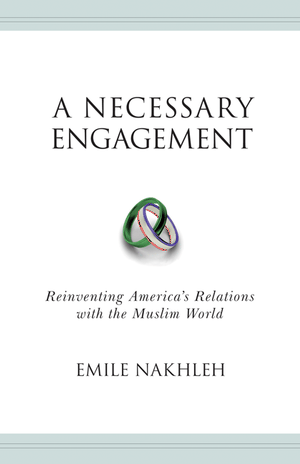 Building consensus within America’s body politic and national security establishment for a new way forward with Muslims worldwide is a formidable challenge. Many Americans still don’t appreciate the complex nuances of Muslim society and remain stubbornly Islamophobic almost seven and half years after 9/11. Equally formidable is earning the goodwill of Muslims worldwide following the Iraq War as well as American atrocities perpetrated upon Islamic detainees at Guantanamo Bay and Abu Ghraib. Hopefully, President Obama’s historic election has finally opened a path for constructive conversation about how America can most effectively engage the Muslim world.
The CIA’s former point man on Islam, Emile Nakahleh, has vigorously entered this conversation with his new book, A Necessary Engagement: Reinventing America’s Relations With the Muslim World (Princeton University Press). From 1991 to 2006, Nakahleh served as the director of the Political Islam Strategic Analysis Program in the Directorate of Intelligence at the CIA. He holds a PhD in international relations and is a member of the Council on Foreign Relations.
Nakhleh’s book combines a revealing memoir with in-depth analysis and proposals for the future. Ever since his retirement from the CIA in 2006, Nakhleh has been a vociferous critic of the Bush Administration’s legacy with respect to American-Muslim relations. Indeed, in September 2006, Nakhleh told Harper’s Magazine that because of Bush’s policies,
“We've lost a generation of goodwill in the Muslim world.”Nakhleh's proposals for improving American-Muslim relations stems from his conversations with Muslim "interlocutors" spanning three decades. These conversations include government ministers, Islamic activists, academics and radicals. Nakhleh also examined and analyzed considerable polling data of Muslims worldwide.
Overall, Nakhleh contends that the vast majority of Muslims and America have common interests and values. His blueprint includes robust dialogue with mainstream Islamic political parties as well as a tangible commitment towards democracy in the Muslim world, even if we don’t always like the short-term electoral results. His book is an accessible 160 pages and divided into four chapters: (Chapter 1) Political Islam and Islamization, (Chapter 2) Intelligence, Political Islam, and Policymakers, (Chapter 3) Public Diplomacy: Issues and Attitudes and (Chapter 4) Public Diplomacy: A Blueprint.
Nakhleh was born in Galilee, north of Nazareth in Palestine and raised a Greek Catholic. He emigrated from Israel to the United States approximately 50 years ago and attended a Benedictine university in Minnesota for his B.A., a Jesuit university in Washington, D.C., for an M.A. and was awarded a Ph.D. from the American University in Washington, D.C. Prior to joining the CIA he taught at a catholic college in Maryland for 26 years.
Nakhleh agreed to a telephone interview with me in podcast format. Among the topics we discussed was whether he believes the surge in Iraq worked, the proxy war between Saudi Arabia and Iran inside Iraq, President Obama’s new strategy in Afghanistan, Hamas and America’s role in resolving the Israeli-Palestinian conflict and his argument that American commitment to democracy in the Muslim world is imperative to our long term interests.
Some of Nakhleh’s answers and views may surprise many listeners. Our conversation was just over 47 minutes. Please refer to the flash media player below.
Either searching for the “Intrepid Liberal Journal” or “Robert Ellman” can also access this interview at no cost via the Itunes Store.
Update: I erred in the introduction in the podcast when I said Emile Nakhleh worked for the CIA between 1991-1996. I meant to say he worked with the CIA between 1991-2006. Also, my apologies for the echo sound on Emile's side. Sometimes technology has its limits.
Thursday, January 15, 2009
This Video Speaks For Itself
As a Jewish American New Yorker I am appalled by many of the comments seen on this video. I am every bit as appalled as I was at the ignorant racist comments made against Barack Obama during the presidential campaign. The sheer disregard these people have for the Palestinian casualties in Gaza is repugnant. There is an old cliche that if one is not careful they're at risk of resembling their enemies. Some of the people seen in this video express the same sort of hateful diatribes uttered by "Islamic terrorists." I have no adequate words to express my anger and sorrow.
Thursday, January 08, 2009
Israel's Colin Powell
 A decade ago, I hoped current Israeli Defense Minister and former Prime Minister Ehud Barak would be the next Yitzhak Rabin. Sadly, Barak has morphed into Israel's Colin Powell instead. Today's New York Times profile of Barak's rising political fortunes is a sad commentary about Israel's body politic and Barak himself.
A decade ago I respected Barak and believed him to be Yitzak Rabin’s natural heir. His mentor Rabin was a soldier statesman who bled for Israel's self-preservation from day one but later took personal risks for peace. During the 1980s, Rabin served as Defense Minister in the Labor/Likud coalition government and implemented a "broken bones" policy to put down the first Palestinian Infitada. Rabin though was not comfortable strategically or morally with Israel as an occupying power and he later collaborated with his onetime Labor Party rival Shimon Peres to facilitate the Oslo Accords with Yasser Arafat.
Oslo is ridiculed today and the famous 1993 handshake with Arafat as Bill Clinton cajoled a reluctant Rabin is far removed from today's world. Sadly, Rabin paid the ultimate price and was assassinated by a right wing nut in November 1995. I'm convinced that had Rabin lived a two state solution would be within reach today. Alas, we'll never know.
Islamic extremists exploited Rabin's assassination and used terrorism to undermine Shimon Peres's government. Peres had never prevailed in a national election before and didn't possess Rabin's national security credentials. That opened the door for the despicable Benjamin Netenyahu in 1996 who zealously pursued a reckless policy to achieve a "Greater Israel."
Ehud Barak defeated Netenyahu in May 1999 but not before the peace constituencies in both Israeli and Palestinian societies were severely dispirited. Both Arafat and Barak also blundered at Camp David in 2000-2001 as President Clinton desperately tried to bridge the divide. With neither Arafat nor Barak possessing the political capital or will to make the necessary compromises, super-hawk Ariel Sharon provoked conflict with his stroll into the Temple Mount as the Israeli public elected him to succeed Barak in 2001. The Palestinians reaped the whirlwind as Barak opted to leave politics.
Barak returned to serve in Prime Minister Olmert's Kadima-Labor coalition government following the disastrous war with Lebanon in 2006. As the New York Times reported, he opposed military aggression in Gaza just as Colin Powell disagreed with Bush, Cheney and Rumsfeld over the Iraq War. As the article also notes, Barak initially resisted warmongers in Israel’s body politic as an old soldier who is horrified by war and didn’t believe a harsh military response to Gaza made strategic sense.
Indeed, Barak was rightfully more concerned with the strategic long view with respect to Iran and believed occupying Gaza would be self-defeating. Yet just like Colin Powell, Barak opted not to resign or publicly oppose his government's policy.
So Barak is now prosecuting a war he knows to be immoral and strategically self-defeating. A war that international aid organizations such as the Red Cross are properly condemning Israel for after four children were discovered next to the bodies of their dead mothers. And Barak's political fortunes are rising because of it as nation states typically rally in a time of war. There is a good chance he will prevail in the upcoming election for Prime Minister against the transparently narcistic Netanyahu and feckless Kadima Foreign Minister, Tzipi Livini.
As I've previously written, Hamas also merits condemnation for regarding their people as collateral damage just as Arafat did while he lived the good life inside Lebanon back in 1982. Nonetheless, Israel has responded disproportionately to Hamas's provocations. The number of Israeli deaths does not justify the mass killing of innocent Palestinian civilians. As someone dedicated to peace and human rights as well as a Jew who cares about Israel, my heart feels as if it's impaled on a dull blade.
And Barak, the hero of the Entebbe Rescue in 1976 and onetime Yitzak Rabin protégé is an enabler. Pitifully, Barak actually represents the best Israel's body politic has to offer. A decade ago Barak's political ascendancy represented hope. Today this talented man is a symbol of Israel's decaying body politic that has gone insane. Just like Colin Powell and America’s body politic in 2002.
Sunday, December 28, 2008
Going Blind In Gaza
 I feel obliged to at least comment about Israel's military activity in Gaza. As a Jew, both Israel's existence as well as their national character matter to me. Hence, my outrage at Israel's immoral brutality and anger at their strategic stupidity. Israel never seems to learn that as the Prussian General Clausewitz once said,
"Politics is war by other means."Invading Lebanon did not enhance their security in 1982. Instead, Israel only succeeded in radicalizing the Lebanese population against them as occupying the country became a strategic liability. Israel was also weakened by their disproportionate response to the kidnapping of their soldiers by Lebanon's Hezbollah in 2006.
With respect to what is happening in Gaza today, Israel is playing into Hamas's hands. The truce was for Hamas to exploit a strategic pause and mobilize against Israeli ground forces. They want this fight. Just as Hezbollah gained prestige in 2006, Hamas will also be strengthened politically as the humanitarian crisis in Gaza intensifies. Meanwhile, Abbas and his Fatah movement will be further weakened while Hamas presents itself as the Palestinians only legitimate government standing up to Israeli aggression. And the rockets being fired against Israel won't stop and will never stop until a peace settlement is reached. A just peace settlement is infinitely more difficult to achieve when much of the civilized world is opposed to your actions.
Hamas of course also merits condemnation as they prefer shedding blood over coexisting with a Jewish state. They would rather provoke a humanitarian crisis among their own people then acknowledge Israel's right to exist and negotiate a settlement. From Hamas's point of view the deaths of their own people represents acceptable collateral damage that will gain sympathy and enhance their prestige. These people are thugs and Israel took their bait.
As Booman writes at Booman Tribune,
"I doubt that Israel can stop the rocket attacks without further worsening their reputation in the world, which is now about as low as it has ever been. Israel outsmarted itself with its settler policy and they're never going to have security again, ever, until they concede that the settlers are the gravest danger to their Nation's security and do something about it.I agree with Booman's observation and would only add that the Israeli government is afraid taking on their settlers will result in a civil war. These fundamentalist nut jobs believe they answer to a higher authority then any civilian law and are more than willing to wage terrorism against their own government in opposition. The only hope Israel has is for their body politic to express itself and give new leadership a mandate to not back down against the settlers.
You'd think a country that was defending itself from rocket attacks would get some leeway. You'd be wrong."
But Israel's body politic will never elect the right caliber of leadership until the the United States is perceived as an "honest broker." The nascent Obama Administration won't have the political cover to become an honest broker as long as The American Israel Public Affairs Committee ('AIPAC") is perceived as the most representative voice in Washington of American Jewish opinion. Israel's worst friend in America is AIPAC because they're encouraging behavior that is both immoral as well as self-destructive.
American Jewish opinion however is far from monolithic. And Jewish Americans like me need to mobilize and present a counterweight to voices such as AIPAC's. Israel's security as well America's are at stake as well as the lives of Israelis and Palestinians on both sides.
American liberal Jews like me often feel beleaguered. Many on the left truly are Anti-Semitic and regard the Israeli/Palestinian conflict as a pretext to justify their hatred of Jewish people. I've seen it on the blogosphere where even liberal Jews opposed to the occupation are vilified and accused of being right wing apologists. To them the Palestinians bear no responsibility and any Israeli deaths are morally acceptable. Meanwhile, we have family and friends that believe Israel can do no wrong and we're selling them out. Yet express ourselves we must or the cycle will never end.
As Mahatma Gandhi once said,
"An eye for an eye, and soon the world is blind."Sixty years after Israel was founded both sides of the conflict continue to go blind.
Friday, October 31, 2008
Did Joe Klein Have An Ephiphany?
Many liberals like me have been tough on Joe Klein during the Bush years. Early last year I even had a post entitled "The Insipid Joe Klein." I and other liberal bloggers were angered by Klein's eagerness to embrace the neocon worldview about national security, terrorism and civil liberties. Even more infuriating, Klein has always been regarded as a liberal pundit while defending appalling policies.
Apparently, Klein is reading the tea leaves and realizes the center of political gravity is about to change in America. His writing and commentary are quite different this campaign season. Today, in Swampland, Klein posted a thoughtful essay about the role of Jewish neo-conservatives and the McCain campaign. As a Jewish American I've been dismayed by how neo-cons have defended Israel's brutal expansionist policies in the name of our national security interests. Hence, I was gratified by Klein's post today in which he specifically addresses the ridiculous controversy of Khalid Rashidi and McCain's slanderous efforts to link Obama with someone they describe as an anti-semite. To his credit, Klein rightfully quotes, Jeff Goldberg, the author of Prisons that being pro-Palestinian doesn't make one antisemitic:
Since I've started blogging I've received many hate emails accusing me of anti-Semitism. Although personally agnostic I am also proud of my Jewish heritage and identity. My grandfather escaped Nazi persecution in Poland while other relatives perished during the Holocaust. So being accused of anti-Semitism because I disagree with Israeli policy has always ticked me off. For the record I've also received hate email from people on the right and left simply for being Jewish.
Hopefully, Klein's post today illustrates that we're poised for a new era in which we can rationally discuss the Israeli/Palestinian conflict without silly name calling and guilt by association politics. Maybe, just maybe Joe Klein is a bellwether for what's to come after election day. Both America and Israel too would benefit.
Apparently, Klein is reading the tea leaves and realizes the center of political gravity is about to change in America. His writing and commentary are quite different this campaign season. Today, in Swampland, Klein posted a thoughtful essay about the role of Jewish neo-conservatives and the McCain campaign. As a Jewish American I've been dismayed by how neo-cons have defended Israel's brutal expansionist policies in the name of our national security interests. Hence, I was gratified by Klein's post today in which he specifically addresses the ridiculous controversy of Khalid Rashidi and McCain's slanderous efforts to link Obama with someone they describe as an anti-semite. To his credit, Klein rightfully quotes, Jeff Goldberg, the author of Prisons that being pro-Palestinian doesn't make one antisemitic:
"But about Khalidi -- he's a fierce partisan of the Palestinian cause, of course, and in my conversations with him, and in his writing, I see that his sympathies frequently cause him to distort Middle East history. But an anti-Semite? I don't think so. In fact, Rashid Khalidi is one of the rare Palestinian advocates who argues, as he has with me, that Arabs must study Jewish history, including and especially the history of Jew-hatred, in order to better understand Israel, and to reach a compromise with it."I especially appreciated this comment from Klein:
"I find the conflation, by some Jewish neoconservatives, of Israel's interests and America's--and their truly dangerous misreading of both--to be appalling. But much worse is their rush to pin the tag of antisemitism on anyone who disagrees with them, including me."Whether Klein is sincere or merely blowing with the political winds I don't know. I am encouraged however that he felt compelled to post this today.
Since I've started blogging I've received many hate emails accusing me of anti-Semitism. Although personally agnostic I am also proud of my Jewish heritage and identity. My grandfather escaped Nazi persecution in Poland while other relatives perished during the Holocaust. So being accused of anti-Semitism because I disagree with Israeli policy has always ticked me off. For the record I've also received hate email from people on the right and left simply for being Jewish.
Hopefully, Klein's post today illustrates that we're poised for a new era in which we can rationally discuss the Israeli/Palestinian conflict without silly name calling and guilt by association politics. Maybe, just maybe Joe Klein is a bellwether for what's to come after election day. Both America and Israel too would benefit.
Thursday, May 15, 2008
Kudos To Joe Biden
I've always had mixed feelings about Delaware Senator Joe Biden. On domestic issues his support of the bankruptcy bill undermined both wage earners and small business entrepreneurs. However, his home state relies on the financial services industry for jobs so I understood.
In October 2002, Biden showed poor judgment in supporting the resolution to go to war against Iraq. Overall though he's been an articulate voice on foreign policy. I thought his presidential campaign was an honorable attempt at substance over show biz and deserved more attention from the media.
Today, Biden effectively responded to President Bush's disgraceful fear mongering before the Israeli Knesset. Bush was specifically targeting American Jewish voters on behalf of McCain. Jewish voters typically vote for Democrats about seventy percent of the time. Obama has a perceived weakness among that constituency. As an American Jew I was offended by Bush's pandering through fear mongering and appreciate Biden's forceful response.
Iran is a complex and layered society. To learn more about the Iranian people and their system of government, click here to listen to an interview I conducted with Mideast expert Barbara Slavin last year. Slavin's informative book, Bitter Friends, Bosom Enemies: Iran, the U.S., and the Twisted Path to Confrontation had just been published when the interview took place.
Tuesday, October 30, 2007
To Die In Jerusalem
When I was seven years old my brother and I were fighting in the back seat of my grandmother’s car. This particular skirmish had a back-story of recriminations and mutual dirty deeds. We were both angry. Each of us felt justified. As the fight escalated everyone in the car and others on the highway were endangered. So my grandmother turned sharply and simply said, “Stop it!” We both protested about who started what and when. My grandmother wasn’t having any of it and forcefully declared, “I don’t’ care who started it. It stops now.” We stopped. Grandma had spoken.
I recalled that incident from my childhood while watching a “screener” for the documentary, To Die in Jerusalem which premiers on HBO this Thursday at 9:00 P.M. EST.
To Die in Jerusalem recounts the tragic story about two teenaged girls – one a 17-year-old Israeli student named Rachel Levy, the other an 18-year-old Palestinian student/suicide bomber named Ayat al-Akhras – brutally entwined by fate in March 2002. They died together in a Jerusalem market when Ayat chose the path of martyrdom. Both girls made the cover of Newsweek as a result.
This documentary focuses on Rachel’s mother, Abigail Levy, efforts to coordinate a one-on-one meeting with her counterpart, Um Samir. Both mothers are in pain and victims of the ongoing Israeli-Palestinian conflict. On camera, Um Samir claims she would have stopped her daughter “by force” if she had known what Ayat planned to do. At the same time she blames the state of Israel for an occupation that has compelled Palestinians to resist by any means necessary. Naturally, Abigail Levy believes the act to be senseless murder making peace even more unattainable.
The mothers finally speak via satellite hookup. In fleeting moments there seems to be the potential for common ground. Um Samir proclaims they are both victims and observes that presidents and prime ministers who make decisions of war and peace were far above mothers like them. But as the conversation continued it was clear they were both culturally and ideologically locked and incapable of processing the other’s point of view.
Abigail Levy simply couldn’t accept that Israel’s occupation bore any responsibility for nurturing an environment of hate among the Palestinians. Um Samir seemed incapable of accepting that terrorism was only digging the Palestinians into a deeper hole of despair and therefore her daughter as well as other suicide bombers had sacrificed their lives for nothing.
The documentary ends with both giving up on trying to persuade the other because neither is truly listening to the other. When it ended my heart felt as if it were impaled on a dull blade. Um Samir had declared that presidents and prime ministers were above mothers like them. In reality the leadership of both societies largely reflect both of these mothers. Consequently, it’s doubtful we’ll see peace between both peoples in my lifetime.
Sunday, July 08, 2007
History and Hezbollah: A Podcast Interview With Augustus Richard Norton
 Trying to make sense of tribal politics in the Middle East can’t be done with simple bumper sticker slogans. The history, entangling relationships, religious dimension, shifting alliances, geography and multiple cultures are a Byzantine maze of complexity. Specifically, the Muslim world is often regarded by people in the west, especially Americans, as a large bowl of alphabet soup. As a result, policy makers who look for quick and easy fixes by force in the region overreach and miscalculate.
One tragic example of miscalculation and overreach is Lebanon. Once regarded as the “jewel” of the Middle East, Lebanon endured a brutal civil from 1975 to 1990. Surrounded by the Mediterranean Sea, Syria and Israel, this small country the size of Connecticut has flummoxed leaders in Jerusalem and Washington for two decades.
In 1982, Israel attempted to drive out the PLO from Lebanon and establish a government friendly to their interests. At the time, Yassir Arafat’s PLO had established a “state within a state” in southern Lebanon and exploited the territory as base of operations against Israel. President Ronald Reagan deployed the U.S. Marines to provide “stability” as part of a Multinational Force. A suicide bomber killed 220 marines in October 1983 and they were “redeployed’ in early 1984. Meanwhile, Israel’s occupation of Lebanon resembled America’s failure in Vietnam as well as the Soviet Union’s experience in Afghanistan and they finally withdrew in the spring of 2000.
Prior to Lebanon’s civil war ending in 1990 the country was a magnet for terrorism and kidnappings by militant Islamic groups coordinating with Iran. These activities helped contribute to the Iran-Contra scandal that plagued the final years of the Reagan Administration. Since then Lebanon has been a hotbed for proxy fights and political intrigue among Syria, Iran, Israel and the United States.
In the early eighties, a resistance movement of Shiite Muslims called Hezbollah, meaning “Party of God” was formed. With the backing of Iran as well as Syria in later years, Hezbollah helped make the price of Israel’s occupation of southern Lebanon too costly and forced their withdrawal seven years ago.
Last summer, Hezbollah infiltrated Israeli territory and kidnapped two of their soldiers - provoking a brutal war resulting in heavy civilian casualties. The kidnapping was an escalation of the tit for tat engagement that had been taking place between Israel and Hezbollah since Israel’s withdraw from southern Lebanon in 2000 otherwise known as "the rules of the game." Israel however opted to use the kidnapping as a pre-text to wipe out Hezbollah and in the process deliver a strategic blow to Iran. Afterwards, Hezbollah’s prestige was enhanced from going toe to toe with Israel.
Yet most policy makers in the United States and Israel simply regard Hezbollah as a terrorist entity and nothing more. However, Augustus Richard Norton writes in his new book, Hezbollah: A Short History (Princeton University Press) that Hezbollah is a sophisticated organization combining the functions of a militia, a social services and public works provider and a political party. He postulates that as Hezbollah’s war with Israel last summer illustrates, they’re far too entrenched in Lebanese society to disappear through the use of force.
Norton, is a Boston University professor of international relations and anthropology, as well as a member of the Council on Foreign Relations. An expert on Shiite political movements, including Hezbollah, Norton was also a military observer for the United Nations in southern Lebanon when Hezbollah and rival Shiite parties were forming there in the early 1980s. A former U.S. Army officer and West Point professor, Norton has conducted research in Lebanon for nearly thirty years. His previous book, Amal and the Shi'a: Struggle for the Soul of Lebanon is widely considered to be a classic account of the political mobilization of Lebanon’s Shiite Muslims.
Lee Hamilton, Vice Chair of the 9/11 Commission and Co-Chair of the Iraq Study Group said,
“Hezbollah is a timely and landmark work. Richard Norton draws on his extensive expertise to offer a comprehensive history that will be of interest to anyone who seeks a better understanding of Hezbollah, Lebanon, or current developments in the Middle East.”Norton agreed to a podcast interview with me about his book, Lebanon and Hezbollah. Among the topics covered during our conversation was Lebanon’s civil war, Israel’s invasion of Lebanon in 1982, Hezbollah’s origins, their relationship with Syria and Iran, the aftermath of the 2006 war with Israel, how the Hamas takeover of Gaza will impact Hezbollah and Lebanon and the current situation with the militant group Fatah al Islam. Please refer to the media player below.
This interview can also be accessed via the Itunes store by searching for Intrepid Liberal Journal.
Sunday, March 18, 2007
Crusading For Justice & Peace: A Podcast Interview With Activist Marisa Handler
 Marisa Handler lived in South Africa until she was twelve. Both her parents are Jewish liberals and they actively opposed South Africa’s racist apartheid system. Their values heavily influenced Handler during her formative years. Perhaps she was destined to become an activist as early as nine years old while attending Camps Bay Primary School in Cape Town.
One day during recess, a pre-adolescent queen bee named Joan, held court on the playground and asked several peers whom their parents were voting for in an upcoming election. One by one, the other students answered “Nats,” meaning the longtime ruling white supremacist National Party. Eventually, Joan turned her scrutiny on the self-conscious Handler who whispered “PFP.”
The PFP were the Progressive Federal Party that preached equality and represented a constituency of white liberals. Joan proceeded to interrogate Handler and asked if she really wanted to turn South Africa over to the majority blacks she called “stupid.” Fearfully, Handler held her ground and the foundation for a future activist was established: she had demonstrated the fortitude to take an unpopular stand and subject herself to ridicule.
Now thirty, Handler is a well-traveled and seasoned veteran in the pursuit of global justice and peace. Her book, Loyal to the Sky: Notes From an Activist (Berrett-Kohler Publishers, Inc.) is a stirring memoir about her personal evolution and experiences. Handler’s journey spans the playground in Cape Town, relocating with her parents to Los Angeles at the age of 12, Berkley University, Israel, Nepal, India, protesting the Free Trade Area of the Americas agreement in Miami, Ecuador, Peru, protesting the 2004 Republican National Convention in New York City and talking with soldiers in Fort Benning, Georgia.
Handler has worked as an organizer in the global justice and peace movements as well as written about socio-politics and globalization. Her work has been published in Orion Magazine, Tikkun, Salon.com, the Earth Island Journal, Alternet.org, Bitch Magazine and the San Francisco Chronicles. Currently, Handler resides in San Francisco where she is also a singer-songwriter. She plays regularly around the Bay Area and her album Dark Spoke is currently available on CD.
Handler agreed to a podcast interview with me and among the topics we covered were her book, music, work, spirituality, life experience, the Israeli-Palestinian conflict, Hindu/Muslim tensions inside India and the overall quest to achieve global justice. Please refer to the media player below.
This interview can also be accessed for free via the Itunes store by searching for Intrepid Liberal Journal.
Subscribe to:
Posts (Atom)