Showing posts with label Taliban. Show all posts

Tuesday, February 27, 2007

Irony and Death

Liberal activists such as myself resent the Bush Administration’s cynical exploitation of fear. Bush and his enablers in the Republican Party have utilized fear to justify an immoral and unnecessary war in Iraq. A cabal of reckless warmongers and profiteers undermined our moral authority and geopolitical position. Even worse, while the Bush Administration was busy hyping the strategic importance of Iraq, Al Quaeda reconstituted itself. America is in great danger as a result.

Frank Rich is a liberal columnist not prone to exaggeration or fear mongering. In his most recent New York Times column, Rich noted how the CIA’s former head of the Bin Laden unit, Michael Scheuer told MSNB’s Keith Olberman, that Al Quaeda,

“are going to detonate a nuclear device inside the United States.”
I believe him. Tactical nuclear weapons are quite obtainable and these fanatics believe mass murder serves a higher purpose. Such warnings resemble the intelligence community's desperate attempt getting both Presidents Clinton and Bush to pay attention to the threat of an Al Quaeda attack prior to 9/11. Clinton was properly engaged but hamstrung politically following the Monica Lewinsky scandal. Bush wasn't even stirred by that infamously straightforward memo of August 2001.

Immediately after 9/11, I debated my fellow liberal friends about the merits of toppling the Taliban government in Afghanistan because of their support for Al Quaeda. I found myself in the unusual position of justifying a military response. The loss of innocent life utterly sickened me but there was no way we couldn’t respond. My problem was I didn’t trust an administration stocked with corporatist ideologues and imperialists.

As we’ve seen, the Bush Administration’s obsession with Iraq has facilitated
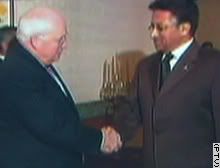
Al Quaeda's resurgence in Afghanistan and Pakistan. It’s bitterly ironic how Vice President Cheney’s meeting with Pakistan’s President Musharraf earlier today, featured a suicide bomber targeting him. The sort of terrorists the Bush Administration opted to neglect signaled they’re very much here by attempting to take our Vice President out.

The bomber killed 23 people instead. Much of the civilized world would not have grieved had Cheney been killed. Symbolically, today’s bombing was a propaganda bonanza for Al Quaeda.

It’s said that laughing is better than crying. How comically ironic that after letting Bin Laden escape in Tora Bora in December 2001, redirecting resources from Afghanistan to the Iraq theatre and giving Musharraf’s regime billions in aid, the Bush Administration finally decided to express displeasure at their ally in Islamabad. A useless exercise, because what can Musharraf effectively do without jeopardizing his own regime’s grip on power?

America’s enemies are ascending. Our veracity and moral legitimacy is not trusted by many of our western allies. Five and a half years after 9/11, we still haven’t developed a containment policy with the civilized world that provides a bulwark against radical Islam and empowers moderates. The “global war on terror” is perpetuating a treadmill of death with no end in sight.

January 20th, 2009 can’t get here soon enough. Hopefully, the next occupant of the White House won’t be a moron. Otherwise, the next attack may be far more catastrophic than two airplanes crashing into a building.

Monday, February 05, 2007

Afghanistan: The Forgotten War

How many voters went to the polls in 2004 believing Iraq was behind 9/11 and didn’t give Afghanistan a second thought? The oxygen of our political discourse is consumed by Iraq. Some of America’s most prestigious citizens collaborated on the Iraq Study Group. Politicians from both parties are proposing alternatives from supporting President Bush’s escalation, to partition and even cutting off funding.

Understandably, Iraq merits our attention. We were criminally misled into a war of choice that has jeopardized America’s geopolitical position and undermined our moral authority. Iraq is largely responsible for the Democratic Party’s congressional majority and they’ve promised intense oversight. Why I wonder doesn’t Afghanistan merit similar scrutiny? I’d be curious to learn what an Afghanistan Study Group might come up with.

It seems not enough people with power or influence give a damn about Afghanistan beyond vague references to redistributing troops from Iraq. Sloppy negligence of our war against the Taliban is too important to ignore. As important as ending the war in Iraq is, we also must demand accountability about the depth of failure in Afghanistan and properly assess whatever options we have left.

On January 27th, Dan Restrepo from the Center of American Progress, observed in an opinion piece submitted to the Boston Globe, that the Bush Administration regarded Colombia as a model for Afghanistan. President Bush even nominated our ambassador to Colombia, William Wood, to be the next chief envoy in Kabul.

I suppose we shouldn’t be too surprised. It wasn’t so long ago delusional conservatives compared Iraqi society with El Salvador in the 1980s. So why not regard the nation of Colombia, currently in the throes of scandal as a model for Afghanistan? In the Bush Administration’s peculiar logic, disaster is a model for replication.

Colombia’s experience with narco-trafficking and insurgencies is certainly worth studying as Restrepo acknowledges. Drug trafficking became Colombia’s most viable economic sector and the individuals behind the narco-trade are typically ruthless and homicidal. Without viable economic sectors beyond drug trafficking, the state of Colombia has teetered on the abyss.

Restrepo also acknowledges the Colombian government may finally have the upper hand in their enduring struggle against the Revolutionary Armed Forces of Columbia (FARC). However, as Restrepo also notes, unlike the FARC, the Taliban are enjoying safe haven in Pakistan. Restrepo closes his op-ed with this,

“The Colombianization of US-Afghanistan policy is rife with peril, not the least because it is unclear that US policy in Colombia has been a success or that Colombia is the shining example the administration would like to believe.”
While the Bush Administration pursues their policy of “Colombianization,” the Taliban are ascending. Robert Burns reported in Time Magazine that the Taliban are exploiting their recent peace with Pakistan to increase attacks on U.S. and allied forces in eastern and southeastern Afghanistan. Most disturbingly, Burns reports that,

“Lt. Gen. Karl Eikenberry, the top U.S. commander in Afghanistan, said in an interview that Taliban attacks surged by 200% in December, and a U.S. military intelligence officer said that since the peace deal went into effect Sept. 5 the number of attacks in the border area has grown by 300%.”
Currently, they’re 20,000 troops in Afghanistan and they obviously can’t pacify the metastasizing crisis. Financed by the opium trade as well as donors in the Persian Gulf and enjoying a base of operations in Pakistan, the Taliban remain formidable. As recent history suggests, blowback in Afghanistan equals calamity.

It’s fashionable to say we need more troops in Afghanistan and our forces should be diverted from Iraq. Recently, I interviewed Congressman Jerrold Nadler and he offered that opinion. Caroline Wadhams from The Center for American Progress also supports a surge in Afghanistan:

“It is not too late for America to respond. Troop levels in Afghanistan should be doubled to 40,000 from the approximately 20,000 U.S. troops deployed there today. These troops should be sent from Iraq to Afghanistan under NATO leadership as reinforcements. The United States must also provide more equipment and training for Afghan security forces.”
Yet I can’t help but wonder if a surge in Afghanistan is just as wrongheaded as the current one in Iraq. Are 20,000 additional troops really going to reverse the downward spiral in Afghanistan? Wadhams does note a troop surge by itself is insufficient:

“Many of the problems in Afghanistan, as in Iraq, will not be solved by military means alone. Greater investment in Afghanistan’s economy and its reconstruction is also essential to creating a stable state. The United States and the international community need to commit to a well-funded and well-managed long term economic development effort, and the government of Afghanistan should take the lead.”
We can’t do squat in Afghanistan without an international consensus on how to move forward. Any consenus may also require an understanding with the Iranians who are not fond of the Taliban. Deploying additional troops is simply wasted bloodshed until we can formulate a strategy of economic development, combined with fostering alliances among Afghanistan’s most effective tribal leaders. Managing relationships inside Afghanistan’s tribal culture and their brutal rivalries is tricky business – even more complicated than initiating a rapprochement with Iran. These are not exactly Jeffersonian Democrats and the leaders harbor ambitions about emerging as top dog.

Our response in Afghanistan since 9/11 has only diminished our geopolitical position. Going forward requires sophisticated presidential leadership and sagacious oversight from the legislative branch. Otherwise, Afghanistan will join Iraq as twin failures of American statecraft. Two-more years of the Bush Administration, presidential candidates offering little beyond platitudes about Afghanistan and a congress pre-occuppied with non-binding resolutions for Iraq doesn’t imbue me with confidence.