Listening to conservatives whine that America is a "center-right" country in spite of the recent election has me reflecting about Ronald Reagan as well as pondering what makes a transformative presidency. During the Reagan era, liberals like me frequently complained that America really wasn't that conservative. We cited polls that illustrated the American people really preferred the Democrat's policies on issues ranging from healthcare to nuclear weapons and only supported Reagan because of his "personality."
Yet Reagan got his way, America moved to the right and his presidency is regarded as transformative. Reagan was a transformative president because he laid the foundation in which America's center of political gravity remained to the right for a quarter century with respect to economic, social and foreign policy. Even two terms of a Democratic Bill Clinton presidency did not alter America's conservative course regarding de-regulation and raging privatization.
Transformative presidencies with broad popular support like Reagan's are rare. The Reagan model was to nurture an above partisanship veneer while aggressively waging partisan warfare and exploiting racial cultural subtexts. Presidents that successfully thread the needle between partisanship and statesmanship achieve an exceptional leadership nexus and transform the center of political gravity as Reagan did. In achieving this leadership nexus, Reagan was able to prosecute class warfare from the top and still enjoy popular support from America's middle class.
A more positive example of this transformative leadership model is liberal Franklin Roosevelt. Both Roosevelt and Reagan enjoyed the support of key core constituencies that strongly identified each with their respective parties. Yet both Roosevelt and Reagan were also perceived as being far above the body politic while their administrations ruthlessly engaged in partisan combat. As we liberals note with fondness and gratitude, Roosevelt shifted the center of political gravity in a manner that grew and nutured the middle class. Even two terms of a Republican Dwight Eisenhower presidency did not alter the body politic's support for Roosevelt's New Deal. Remarkably, both Roosevelt and Reagan retained the support of white working class blue collar voters.
From the earliest days of his presidential campaign, Barack Obama has assidiously laid the foundation to become a transformative figure. One who retains the enthusiasm of his core supporters while simultaenously appearing inclusive and respectful to the entire body politic. I must admit that following Bill Clinton's triangulation and George W. Bush's partisan reign of indecency, I saw little benefit to this approach.
Hence, my initial preference for John Edwards who adopted the Theodore Roosevelt model: progressive change by aggressively taking on the entrenched forces of America's kleptocracy. Before the Iowa caucuses (remember that?!?) the Edwards approach made far more sense to me than Obama's fight fire with water persona or rewarding Hillary Clinton's efforts to be the custodian of her husband's pro-corporatist/pro-war political machine. Ultimately, Edwards was unable to compete against the celebrity power of Clinton or Obama and as it turned out his personal failings would have doomed his candidacy anyway.
Nearly a year after Iowa, as I observe Obama during the transition I can envision the potential for a transformative presidency. Reagan appointed political figures that were reassuring to the establishment and upset his core supporters such as his Chief of Staff James Baker. Similarly, Obama has picked some figures for his inner circle that don't thrill me such as Rahm Emanuel, Timothy Geitner and ironically, Hillary Clinton.
Yet as we analyze the policy direction we're likely to see in the coming years, dramatic progressive domestic change will take place. Obama has signaled his committment to invest heavily in infrastructure and tackle global warming with his "green team." His nomination of Tom Daschle as Secretary of Health and Human Services also suggests a committment to healtchare reform as a component of a comprehensive economic recovery plan.
With respect to foreign policy, Obama's national security team of Hillary Clinton at the State Department, National Security Advisor James Jones and the retention of Robert Gates at the Pentagon concerns me greatly. Hopefully, this team will give Obama the political cover he needs to leverage Israel to the bargaining table and nuture a foreign policy that transitions America from its imperial ambitions of empire and instead forms sensible coalitions. If it turns out Clinton, Gates and Jones enable Obama to preside over a shift in our geopolitical paradigm then a liberal transformative presidency is not out of reach.
Sadly, the cascading global economic crisis, the ticking time bomb of global warming and weak national governments such as Israel, India and Pakistan that preside in powder keg regions means anything less than a transformative presidency will result in more calamity, destitution and turmoil. Of course greatness does not stem from times of tranquility.
Showing posts with label Ronald Reagan. Show all posts
Showing posts with label Ronald Reagan. Show all posts
Saturday, December 13, 2008


Wednesday, February 27, 2008
My Encounter With William F. Buckley In 1987
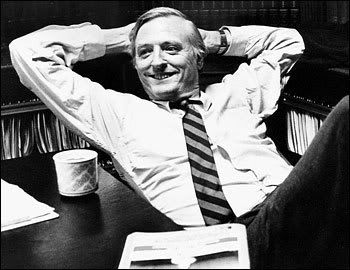 As most of you know by now, William F. Buckley Jr., the intellectual who inspired the conservative movement with his provacitive commentary died today at the age of 82. Growing up I thoroughly enjoyed watching Buckley on Firing Lane and the debates his program sponsored. Even as I disagreed with Buckley's point of view, I appreciated his wit and rhetorical skill.
I also had the unique experience of having Buckley call a question I asked him "cuckoo" in the autumn of 1987. It was my freshman year at Sarah Lawrence College and Buckley was a guest speaker. Our college president, the late Alice Illchman introduced Buckley by informing everyone that he addressed a letter to her, "Dear Intelligent American." Standing at the podium inside Sarah Lawrence's Peforming Arts Center, Illchman beamed and asked, "Mr. Buckley, how did you know?" Buckley laughed in appreciation at Illchman's humor. It helped break the tension as Sarah Lawrence College is a bastion of liberal thinking and Buckley represented an ideology most of us passionately opposed.
At the time, the reform minded Michael Gorbachev was pushing Perestroika and Glasnost in the Soviet Union. It's easy to forget now but the Cold War was still very much apart of our lives and mindset. The Berlin Wall still stood, the Iron Curtain remained and bloody regional conflicts continued to rage in Nicaragua and Afghanistan. Liberals like me were hopeful that Gorbachev presented an opportunity to end the nuclear arms race.
We had an unexpected ally in President Ronald Reagan who faced strong opposition within his own party from people such as North Carolina Senator Jesse Helms. Only a year later Helms and other conservatives would compare Reagan's rapproachment with Gorbachev to Neville Chamberlain's diplomatic appeasement with Adolph Hitler in the 1930s.
Ever the die hard cold warrior, Buckley did not share his audience's enthusiasm for Gorbachev. I distinctly remember Buckley disparaging the world for "irrationally" embracing Gorbachev and forgetting that the Soviet Union was an "evil empire." He told us that the West should remain focused on our differences with the Soviet Union and not "romanticize" what we had in common.
The floor was opened for questions. A bearded student challenged Buckley that the point of diplomacy should be to focus on "common ground" rather than exacerbate differences. I recall Buckley dismissed the student as "naive." It seemed Buckley was fatigued and perhaps a little off his game. I was dissappointed he didn't engage my fellow student more because I thought his point was valid.
Another student raised his hand and challenged Buckley about his description of the Soviet Union as an evil empire. "Couldn't one say the United States is an evil empire?" I don't remember how Buckley responded to that question. I was sitting on the floor towards the front and do remember a condescending facial expression. Buckley's body language clearly communicated he thought the question ridiculous.
I was angry at his dismissiveness and raised my hand. Although angry I was also thoroughly intimidated. Nevertheless, I gamely asked Buckley, "Isn't the point that the United States might also be an evil empire a valid one? Look at what we're doing in Nicaragua. We're torturing innocent civillians while the CIA is making money off of cocaine through the Contras. Isn't that evil?" My heart was pounding. I was also sitting next to a pretty older student I hoped to impress.
Buckley smiled and said, "That's just cuckoo. You obviously don't know what an evil empire is." He proceeded to cite dozens of the Soviet Union's worst transgressions. I didn't have the nerve or skill to follow up with him as Buckley resumed answering more questions.
From that day forward, anytime I read one of Buckley's articles or saw him on television, I would flash back to that moment. In recent years, Buckley lamented the failures of George W. Bush's presidency and expressed particular displeasure about the Iraq War. I respected and admired Buckley. How I would have loved to tell Buckley that Bush, Cheney and Rumsfeld's folly in Iraq was cuckoo.
Saturday, April 28, 2007
Tell theTruth: Are You A Liar?
 So when did you first realize our country was led by liars? Was there a particular incident, campaign or speech resulting in an epiphany? Did a cynical role model let you know our country’s decision makers could not be trusted to tell the truth?
For me it was at the age of fifteen in 1984. I was watching television when a campaign commercial for Mary Mochary, who challenged New Jersey incumbent Senator Bill Bradley, was aired. On screen appeared President Ronald Reagan sitting behind his desk at the oval office. I’ve tried to find a transcript or even footage of this commercial online but haven’t had any luck. So, I’m relying on memory.
As I remember it Reagan said, “I’m not the sort of fellow to tell another person how to vote, but I support Mary Mochary.” It was something like that. And Reagan had this self-effacing aw shucks expression when he said it. I later learned Reagan aired similarly scripted commercials on behalf of other Republican candidates that year.
It just amazed me how an American president, arguably the most political persona in the world could say with a straight face, “I’m not the sort of fellow to tell another person how to vote.” At fifteen I was politically aware. I knew Reagan was a former governor of California and had previously campaigned for president before defeating Jimmy Carter in 1980. Hence, this was somebody who told people who to vote for quite often.
The lie itself was harmless. It wasn’t about arms for hostages, the Contras or the phony war on drugs. Nevertheless, the memory stands out as the moment when I internalized how politicians would even shamelessly lie about small things. And we therefore had to listen to their words with critical ears because if they could lie about something small, a big lie was just around the corner.
Three years later, I was disillusioned when California Senator Alan Cranston was exposed as one of the infamous Keating Five. In the summer of ’86, I sent Cranston $100 which at seventeen wasn’t peanuts. Cranston was in a tough reelection fight and I admired his stance on nuclear disarmament. So in 1987, when I watched Senator Warren Rudman of New Hampshire who sat on the Senate Ethics Committee roughly question Cranston in public, I was devastated. I had believed in him.
In 1992 I supported Paul Tsongas for president. I disagreed with his economic positions but believed Tsongas was the most honest candidate seeking the Democratic Party’s nomination that year. Sadly, Tsongas wasn’t honest about his recovery from cancer and he died in 1997.
You get older and learn life isn’t always so black and white. None of us are pure and the best of us have moral lapses. And in a world of nuance, lies become easy to rationalize. Many of us lie in our personal and professional lives. We lie to our boss as our boss lies to us. We tell “white lies” to our family and friends. In the movie “The Departed,” Vera Farmiga’s character admitted she lied to keep things on an “even keel.” And she proceeded to live a lie while cheating on Matt Damon. Later she dumped Matt Damon upon learning about his lies. More often than not the “even keel” Farmiga’s character refers to are lies to preserve a self-serving image we’ve constructed.
In America our politicians and military leadership have lied for all kinds of reasons. In 1960, President Eisenhower was caught in a lie following the Gary Powers U2 spy plane incident. Embarrassing but Americans didn’t hold it against Eisenhower. It was the Cold War and the public believed their president had his heart in the right place about protecting our national security.
John Kennedy partly won the presidency in 1960 by lying about a “missile gap” with the Soviet Union that didn’t exist. President Lyndon Johnson lied about the pretext for war in Vietnam while his Pentagon misinformed the public about our "success." President Nixon lied about Vietnam as well as not being a crook and President Clinton practiced in front of mirror before telling the world, “I did not have sexual relations with that woman, Ms. Lewinsky.”
One person’s shit is another’s ice cream and some lies are considered necessary. Americans were largely in the dark about FDR’s polio and he lied about his true intentions during World War Two. He promised to keep America out and manipulated behind the scenes as best he could to put us in the conflict. Yet FDR’s place in history is secure. The Axis Powers had to be defeated to ensure our survival and a different president might have appeased Hitler. Hence we don’t judge FDR harshly for misleading about his health or war plans. FDR’s lies are deemed good lies.
Americans don't judge Clinton overly harshly either. Many of us are guilty of similar offenses and would’ve lied to protect our marriages, families and reputations. His testimony about the word “is” will always remain the butt of jokes but most Americans would gladly take him back. A friend recently confided to me that his marriage ended when his wife caught him in the act while he cheated on her. Unable to come up with a convincing lie he said, “honey it’s not what it looks like.” I don’t judge him harshly for it. Nor am I judgmental about Clinton or Vera Farmiga’s character. They didn’t lie maliciously. For them lies were shields against human frailty.
So, one could say that lies are simply part of the human condition and our leaders reflect this reality. Nonetheless, from my vantage point, a culture of destructive lying has become dangerously pervasive in recent years. This decade, corporations such as Enron shamelessly lied to their shareholders and dutiful employees, Jayson Blair hoodwinked the New York Times and Dick Cheney stood before the Republican Party National Convention in 2000 and promised the country a “stiff dose of the truth.”
Ironically, the same President Bush who promised a restoration of honor and integrity has become synonymous with lies – too many to summarize here. His Attorney General can’t keep track of his own lies. Former CIA director George Tenet has written a memoir whining about his “slam dunk” lie being taken out of context. And there are the shameful lies from the Pentagon about Pat Tillman and Jessica Lynch. If that's not bad enough, the Bush Administration is pathologically devoted to covering up evidence about global warming. From Kartina to Iraq, how many people have died because of all these lies? And how many more deaths are to come?
Recently, my Dad sagely observed to me in a telephone conversation, “None of this is new. I’ve seen all this stuff before. All politicians are full of it. They’ll always be full of it. That’s life.” Perhaps. And when it comes to life and politics, my Dad, like many Dads is a human oracle of experience and wisdom. But I remain optimistic because within this morass of deceit, a counter-culture of truth is emerging.
As our institutions and the mainstream media fail to deliver the truth, a hunger for reality is expressing itself among the people. Hence, we have the ascendancy of blogs. It’s undisciplined and irreverent out here. One has to be a discriminating consumer among thoughtful bloggers and those who are simply rhetorical bomb throwers. But there are golden nuggets of truth among ordinary people challenging elites about their destructive lies, disinformation and exploitation.
One of my favorite blogs may not be known to you and belongs to a dear personal friend, Kaiser Permanente – Corporate Ethics. My friend was an employee of Kaiser who lost her job because she’s an honest person. Her story is a long and complicated one and best learned from reading her blog. Her life is hard and she is unable to post as frequently as she’d like. Nonetheless, her site has become a repository for exposing the lies and cover-ups of Kaiser Permanente.
Not surprisingly, Kaiser mobilized their legal and PR machine to personally destroy her. But she perseveres as a courageous beacon of light against their greed culture of lies and malfeasance. More than once I observed to her that Kaiser reminds me of the Bush Administration. And as she put it to me once, “That’s because the people inside the Bush Administration come from corporate cultures such as Kaiser where truth can be tossed away like a can of tuna fish.” As only she could put it. It’s largely because of her inspiration I joined the blogosphere fray.
And there are the bloggers we know about such as JoshMarshall of Talking Points Memo, who pushed the story of the unscrupulous dismissal of the U.S. Attorneys. Marshall’s success at emphasizing a story the mainstream media initially ignored, illustrate how the façade of deceit so dutifully served and enabled by inside the beltway pundits such as David Broder, Joe Klein and David Brooks is finally cracking.
And I’m a part of it too in my own way. Of course I’m not the sort of fellow to tell another person how to vote.
*****************************************************************************
ADDENDUM: My thanks to Mike Finnigan for including me in his most recent blogroundup on Crooks and Liars.
Sunday, April 08, 2007
Memo To Conservatives: George W. Bush Is Not An Aberration
 Conservatives want you to believe the presidency of George W. Bush is an aberration. Those of us in the reality-based community understand the Bush Administration can’t be separated from conservative ideology. The blowback of the Bush years is in fact the collective legacy of Barry Goldwater, Richard Nixon, Gerald Ford, Ronald Reagan, George Herbert Walker Bush, Newt Gingrich, Bob Dole, Trent Lott, Dick Cheney, Tom DeLay, Dick Hastert, John McCain, Pat Robertson, Jerry Falwell the American Enterprise Institute, the Heritage Foundation and the rest of the feculent conservative cabal.
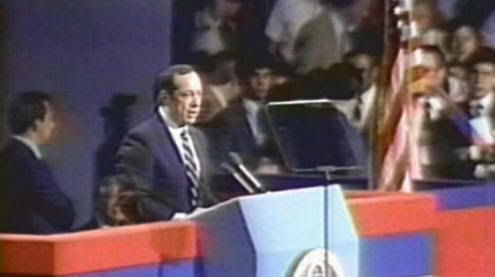
Take a moment to read the text of New York Governor Mario Cuomo’s keynote address to the 1984 Democratic National Convention below or click here to listen to it. Whether you read or listen to Cuomo’s words from twenty-three years ago, it’s remarkable how relevant his speech is today. His repudiation of Ronald Reagan echoes across time as conservatives have eviscerated our infrastructure, debased public education, disintegrated the middle class, neglected veterans, sacrificed universal healthcare to profit industry raped our Constitution, exploited fear and pursued recklessly immoral foreign policies. Hopefully, 2008 will not simply be a slight changing of the pendulum but signal a new era of sense, compassion, and progress. The direction Mario Cuomo spoke of in 1984.
“Thank you very much.On behalf of the great Empire State and the whole family of New York, let me thank you for the great privilege of being able to address this convention. Please allow me to skip the stories and the poetry and the temptation to deal in nice but vague rhetoric. Let me instead use this valuable opportunity to deal immediately with the questions that should determine this election and that we all know are vital to the American people.Ten days ago, President Reagan admitted that although some people in this country seemed to be doing well nowadays, others were unhappy, even worried, about themselves, their families, and their futures. The President said that he didn't understand that fear. He said, "Why, this country is a shining city on a hill." And the President is right. In many ways we are a shining city on a hill.But the hard truth is that not everyone is sharing in this city's splendor and glory. A shining city is perhaps all the President sees from the portico of the White House and the veranda of his ranch, where everyone seems to be doing well. But there's another city; there's another part to the shining the city; the part where some people can't pay their mortgages, and most young people can't afford one; where students can't afford the education they need, and middle-class parents watch the dreams they hold for their children evaporate.In this part of the city there are more poor than ever, more families in trouble, more and more people who need help but can't find it. Even worse: There are elderly people who tremble in the basements of the houses there. And there are people who sleep in the city streets, in the gutter, where the glitter doesn't show. There are ghettos where thousands of young people, without a job or an education, give their lives away to drug dealers every day. There is despair, Mr. President, in the faces that you don't see, in the places that you don't visit in your shining city.In fact, Mr. President, this is a nation -- Mr. President you ought to know that this nation is more a 'Tale of Two Cities' than it is just a 'Shining City on a Hill.'
Maybe, maybe, Mr. President, if you visited some more places; maybe if you went to Appalachia where some people still live in sheds; maybe if you went to Lackawanna where thousands of unemployed steel workers wonder why we subsidized foreign steel. Maybe -- Maybe, Mr. President, if you stopped in at a shelter in Chicago and spoke to the homeless there; maybe, Mr. President, if you asked a woman who had been denied the help she needed to feed her children because you said you needed the money for a tax break for a millionaire or for a missile we couldn't afford to use.Maybe -- Maybe, Mr. President. But I'm afraid not. Because the truth is, ladies and gentlemen, that this is how we were warned it would be. President Reagan told us from the very beginning that he believed in a kind of social Darwinism. Survival of the fittest. "Government can't do everything," we were told, so it should settle for taking care of the strong and hope that economic ambition and charity will do the rest. Make the rich richer, and what falls from the table will be enough for the middle class and those who are trying desperately to work their way into the middle class.You know, the Republicans called it "trickle-down" when Hoover tried it. Now they call it "supply side." But it's the same shining city for those relative few who are lucky enough to live in its good neighborhoods. But for the people who are excluded, for the people who are locked out, all they can do is stare from a distance at that city's glimmering towers.It's an old story. It's as old as our history. The difference between Democrats and Republicans has always been measured in courage and confidence. The Republicans -- The Republicans believe that the wagon train will not make it to the frontier unless some of the old, some of the young, some of the weak are left behind by the side of the trail. "The strong" -- 'The strong,' they tell us, 'will inherit the land.'We Democrats believe in something else. We democrats believe that we can make it all the way with the whole family intact, and we have more than once. Ever since Franklin Roosevelt lifted himself from his wheelchair to lift this nation from its knees -- wagon train after wagon train -- to new frontiers of education, housing, peace; the whole family aboard, constantly reaching out to extend and enlarge that family; lifting them up into the wagon on the way; blacks and Hispanics, and people of every ethnic group, and native Americans -- all those struggling to build their families and claim some small share of America. For nearly 50 years we carried them all to new levels of comfort, and security, and dignity, even affluence. And remember this, some of us in this room today are here only because this nation had that kind of confidence. And it would be wrong to forget that. So, here we are at this convention to remind ourselves where we come from and to claim the future for ourselves and for our children. Today our great Democratic Party, which has saved this nation from depression, from fascism, from racism, from corruption, is called upon to do it again -- this time to save the nation from confusion and division, from the threat of eventual fiscal disaster, and most of all from the fear of a nuclear holocaust. That's not going to be easy. Mo Udall is exactly right -- it won't be easy. And in order to succeed, we must answer our opponent's polished and appealing rhetoric with a more telling reasonableness and rationality.We must win this case on the merits. We must get the American public to look past the glitter, beyond the showmanship to the reality, the hard substance of things. And we'll do it not so much with speeches that sound good as with speeches that are good and sound; not so much with speeches that will bring people to their feet as with speeches that will bring people to their senses. We must make -- We must make the American people hear our "Tale of Two Cities." We must convince them that we don't have to settle for two cities, that we can have one city, indivisible, shining for all of its people.Now, we will have no chance to do that if what comes out of this convention is a babel of arguing voices. If that's what's heard throughout the campaign, dissident sounds from all sides, we will have no chance to tell our message. To succeed we will have to surrender some small parts of our individual interests, to build a platform that we can all stand on, at once, and comfortably -- proudly singing out. We need -- We need a platform we can all agree to so that we can sing out the truth for the nation to hear, in chorus, its logic so clear and commanding that no slick Madison Avenue commercial, no amount of geniality, no martial music will be able to muffle the sound of the truth.And we Democrats must unite. We Democrats must unite so that the entire nation can unite, because surely the Republicans won't bring this country together. Their policies divide the nation into the lucky and the left-out, into the royalty and the rabble. The Republicans are willing to treat that division as victory. They would cut this nation in half, into those temporarily better off and those worse off than before, and they would call that division recovery.Now, we should not -- we should not be embarrassed or dismayed or chagrined if the process of unifying is difficult, even wrenching at times. Remember that, unlike any other Party, we embrace men and women of every color, every creed, every orientation, every economic class. In our family are gathered everyone from the abject poor of Essex County in New York, to the enlightened affluent of the gold coasts at both ends of the nation. And in between is the heart of our constituency -- the middle class, the people not rich enough to be worry-free, but not poor enough to be on welfare; the middle class -- those people who work for a living because they have to, not because some psychiatrist told them it was a convenient way to fill the interval between birth and eternity. White collar and blue collar. Young professionals. Men and women in small business desperate for the capital and contracts that they need to prove their worth.We speak for the minorities who have not yet entered the mainstream. We speak for ethnics who want to add their culture to the magnificent mosaic that is America. We speak -- We speak for women who are indignant that this nation refuses to etch into its governmental commandments the simple rule "thou shalt not sin against equality," a rule so simple -- I was going to say, and I perhaps dare not but I will. It's a commandment so simple it can be spelled in three letters: E.R.A.We speak -- We speak for young people demanding an education and a future. We speak for senior citizens. We speak for senior citizens who are terrorized by the idea that their only security, their Social Security, is being threatened. We speak for millions of reasoning people fighting to preserve our environment from greed and from stupidity. And we speak for reasonable people who are fighting to preserve our very existence from a macho intransigence that refuses to make intelligent attempts to discuss the possibility of nuclear holocaust with our enemy. They refuse. They refuse, because they believe we can pile missiles so high that they will pierce the clouds and the sight of them will frighten our enemies into submission.Now we're proud of this diversity as Democrats. We're grateful for it. We don't have to manufacture it the way the Republicans will next month in Dallas, by propping up mannequin delegates on the convention floor. But we, while we're proud of this diversity, we pay a price for it. The different people that we represent have different points of view. And sometimes they compete and even debate, and even argue. That's what our primaries were all about. But now the primaries are over and it is time, when we pick our candidates and our platform here, to lock arms and move into this campaign together.If you need any more inspiration to put some small part of your own difference aside to create this consensus, then all you need to do is to reflect on what the Republican policy of divide and cajole has done to this land since 1980. Now the President has asked the American people to judge him on whether or not he's fulfilled the promises he made four years ago. I believe, as Democrats, we ought to accept that challenge. And just for a moment let us consider what he has said and what he's done.Inflation -- Inflation is down since 1980, but not because of the supply-side miracle promised to us by the President. Inflation was reduced the old-fashioned way: with a recession, the worst since 1932. Now how did we -- We could have brought inflation down that way. How did he do it? 55,000 bankruptcies; two years of massive unemployment; 200,000 farmers and ranchers forced off the land; more homeless -- more homeless than at any time since the Great Depression in 1932; more hungry, in this world of enormous affluence, the United States of America, more hungry; more poor, most of them women. And -- And he paid one other thing, a nearly 200 billion dollar deficit threatening our future.Now, we must make the American people understand this deficit because they don't. The President's deficit is a direct and dramatic repudiation of his promise in 1980 to balance the budget by 1983. How large is it? The deficit is the largest in the history of the universe. It -- President Carter's last budget had a deficit less than one-third of this deficit. It is a deficit that, according to the President's own fiscal adviser, may grow to as much 300 billion dollars a year for "as far as the eye can see." And, ladies and gentlemen, it is a debt so large -- that is almost one-half of the money we collect from the personal income tax each year goes just to pay the interest. It is a mortgage on our children's future that can be paid only in pain and that could bring this nation to its knees.Now don't take my word for it -- I'm a Democrat. Ask the Republican investment bankers on Wall Street what they think the chances of this recovery being permanent are. You see, if they're not too embarrassed to tell you the truth, they'll say that they're appalled and frightened by the President's deficit. Ask them what they think of our economy, now that it's been driven by the distorted value of the dollar back to its colonial condition. Now we're exporting agricultural products and importing manufactured ones. Ask those Republican investment bankers what they expect the rate of interest to be a year from now. And ask them -- if they dare tell you the truth -- you'll learn from them, what they predict for the inflation rate a year from now, because of the deficit.Now, how important is this question of the deficit. Think about it practically: What chance would the Republican candidate have had in 1980 if he had told the American people that he intended to pay for his so-called economic recovery with bankruptcies, unemployment, more homeless, more hungry, and the largest government debt known to humankind? If he had told the voters in 1980 that truth, would American voters have signed the loan certificate for him on Election Day? Of course not! That was an election won under false pretenses. It was won with smoke and mirrors and illusions. And that's the kind of recovery we have now as well.But what about foreign policy? They said that they would make us and the whole world safer. They say they have. By creating the largest defense budget in history, one that even they now admit is excessive -- by escalating to a frenzy the nuclear arms race; by incendiary rhetoric; by refusing to discuss peace with our enemies; by the loss of 279 young Americans in Lebanon in pursuit of a plan and a policy that no one can find or describe.We give money to Latin American governments that murder nuns, and then we lie about it. We have been less than zealous in support of our only real friend -- it seems to me, in the Middle East -- the one democracy there, our flesh and blood ally, the state of Israel. Our -- Our policy -- Our foreign policy drifts with no real direction, other than an hysterical commitment to an arms race that leads nowhere -- if we're lucky. And if we're not, it could lead us into bankruptcy or war.Of course we must have a strong defense! Of course Democrats are for a strong defense. Of course Democrats believe that there are times that we must stand and fight. And we have. Thousands of us have paid for freedom with our lives. But always -- when this country has been at its best -- our purposes were clear. Now they're not. Now our allies are as confused as our enemies. Now we have no real commitment to our friends or to our ideals -- not to human rights, not to the refuseniks, not to Sakharov, not to Bishop Tutu and the others struggling for freedom in South Africa.We -- We have in the last few years spent more than we can afford. We have pounded our chests and made bold speeches. But we lost 279 young Americans in Lebanon and we live behind sand bags in Washington. How can anyone say that we are safer, stronger, or better?That -- That is the Republican record. That its disastrous quality is not more fully understood by the American people I can only attribute to the President's amiability and the failure by some to separate the salesman from the product.
And, now -- now -- now it's up to us. Now it's up to you and to me to make the case to America. And to remind Americans that if they are not happy with all that the President has done so far, they should consider how much worse it will be if he is left to his radical proclivities for another four years unrestrained. Unrestrained.Now, if -- if July -- if July brings back Ann Gorsuch Burford -- what can we expect of December? Where would -- Where would another four years take us? Where would four years more take us? How much larger will the deficit be? How much deeper the cuts in programs for the struggling middle class and the poor to limit that deficit? How high will the interest rates be? How much more acid rain killing our forests and fouling our lakes?And, ladies and gentlemen, please think of this -- the nation must think of this: What kind of Supreme Court will we have?Please. [beckons audience to settle down]We -- We must ask ourselves what kind of court and country will be fashioned by the man who believes in having government mandate people's religion and morality; the man who believes that trees pollute the environment; the man that believes that -- that the laws against discrimination against people go too far; a man who threatens Social Security and Medicaid and help for the disabled. How high will we pile the missiles? How much deeper will the gulf be between us and our enemies? And, ladies and gentlemen, will four years more make meaner the spirit of the American people? This election will measure the record of the past four years. But more than that, it will answer the question of what kind of people we want to be.We Democrats still have a dream. We still believe in this nation's future. And this is our answer to the question. This is our credo:We believe in only the government we need, but we insist on all the government we need.We believe in a government that is characterized by fairness and reasonableness, a reasonableness that goes beyond labels, that doesn't distort or promise to do things that we know we can't do.We believe in a government strong enough to use words like "love" and 'compassion' and smart enough to convert our noblest aspirations into practical realities.We believe in encouraging the talented, but we believe that while survival of the fittest may be a good working description of the process of evolution, a government of humans should elevate itself to a higher order.We -- Our -- Our government -- Our government should be able to rise to the level where it can fill the gaps that are left by chance or by a wisdom we don't fully understand. We would rather have laws written by the patron of this great city, the man called the "world's most sincere Democrat," St. Francis of Assisi, than laws written by Darwin.We believe -- We believe as Democrats, that a society as blessed as ours, the most affluent democracy in the world's history, one that can spend trillions on instruments of destruction, ought to be able to help the middle class in its struggle, ought to be able to find work for all who can do it, room at the table, shelter for the homeless, care for the elderly and infirm, and hope for the destitute. And we proclaim as loudly as we can the utter insanity of nuclear proliferation and the need for a nuclear freeze, if only to affirm the simple truth that peace is better than war because life is better than death.We believe in firm -- We believe in firm but fair law and order. We believe proudly in the union movement. We believe in a -- We believe -- We believe in privacy for people, openness by government. We believe in civil rights, and we believe in human rights. We believe in a single -- We believe in a single fundamental idea that describes better than most textbooks and any speech that I could write what a proper government should be: the idea of family, mutuality, the sharing of benefits and burdens for the good of all, feeling one another's pain, sharing one another's blessings -- reasonably, honestly, fairly, without respect to race, or sex, or geography, or political affiliation.We believe we must be the family of America, recognizing that at the heart of the matter we are bound one to another, that the problems of a retired school teacher in Duluth are our problems; that the future of the child -- that the future of the child in Buffalo is our future; that the struggle of a disabled man in Boston to survive and live decently is our struggle; that the hunger of a woman in Little Rock is our hunger; that the failure anywhere to provide what reasonably we might, to avoid pain, is our failure.Now for 50 years -- for 50 years we Democrats created a better future for our children, using traditional Democratic principles as a fixed beacon, giving us direction and purpose, but constantly innovating, adapting to new realities: Roosevelt's alphabet programs; Truman's NATO and the GI Bill of Rights; Kennedy's intelligent tax incentives and the Alliance for Progress; Johnson's civil rights; Carter's human rights and the nearly miraculous Camp David Peace Accord.Democrats did it -- Democrats did it and Democrats can do it again. We can build a future that deals with our deficit. Remember this, that 50 years of progress under our principles never cost us what the last four years of stagnation have. And we can deal with the deficit intelligently, by shared sacrifice, with all parts of the nation's family contributing, building partnerships with the private sector, providing a sound defense without depriving ourselves of what we need to feed our children and care for our people. We can have a future that provides for all the young of the present, by marrying common sense and compassion. We know we can, because we did it for nearly 50 years before 1980. And we can do it again, if we do not forget -- if we do not forget that this entire nation has profited by these progressive principles; that they helped lift up generations to the middle class and higher; that they gave us a chance to work, to go to college, to raise a family, to own a house, to be secure in our old age and, before that, to reach heights that our own parents would not have dared dream of.That struggle to live with dignity is the real story of the shining city. And it's a story, ladies and gentlemen, that I didn't read in a book, or learn in a classroom. I saw it and lived it, like many of you. I watched a small man with thick calluses on both his hands work 15 and 16 hours a day. I saw him once literally bleed from the bottoms of his feet, a man who came here uneducated, alone, unable to speak the language, who taught me all I needed to know about faith and hard work by the simple eloquence of his example. I learned about our kind of democracy from my father. And I learned about our obligation to each other from him and from my mother. They asked only for a chance to work and to make the world better for their children, and they -- they asked to be protected in those moments when they would not be able to protect themselves. This nation and this nation's government did that for them.And that they were able to build a family and live in dignity and see one of their children go from behind their little grocery store in South Jamaica on the other side of the tracks where he was born, to occupy the highest seat, in the greatest State, in the greatest nation, in the only world we would know, is an ineffably beautiful tribute to the democratic process.And -- And ladies and gentlemen, on January 20, 1985, it will happen again -- only on a much, much grander scale. We will have a new President of the United States, a Democrat born not to the blood of kings but to the blood of pioneers and immigrants. And we will have America's first woman Vice President, the child of immigrants, and she -- she -- she will open with one magnificent stroke, a whole new frontier for the United States.Now, it will happen. It will happen if we make it happen; if you and I make it happen. And I ask you now, ladies and gentlemen, brothers and sisters, for the good of all of us, for the love of this great nation, for the family of America, for the love of God: Please, make this nation remember how futures are built.Thank you and God bless you.”
Wednesday, January 24, 2007
Has John Kerry Come Full Circle?
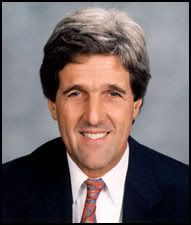 I admired John Kerry prior to his voting for the Iraq War Resolution in 2002. The early years of his senate career were terrific. During his first term, Kerry went to Nicaragua and his determined pursuit of the truth resulted in the first exposure of the Iran-Contra scandal.
His Senate elders didn’t appreciate being upstaged by the upstart Kerry and they refused to give him a seat on the joint House/Senate congressional committee that investigated the affair. Kerry didn’t make friends easily in the Senate but he did good work.
He especially captured my attention in the 1980s when I was a teenager. Kerry fearlessly tangled with the feculent Jesse Helms on the Senate Foreign Relations Committee as I watched him on CSPAN. I observed how Kerry's Democratic colleagues were far more subservient with Jesse Helms and far less aggressive about uncovering the truth of Reagan's criminal foreign policy.
In today’s context it sounds absurd but in those years Kerry appeared authentic, articulate and assertive. Kerry’s investigative work during the BCCI scandal in the early nineties and his joint effort with John McCain regarding prisoners of war in Vietnam were also important contributions. As the years passed I regarded Kerry as a statesman and hoped he would run for president.
Kerry articulated a forceful critique of the Bush Administration’s failure to capture Osama Bin Laden in Afghanistan while other Democrats remained timid. Watching Kerry on Meet the Press in the early months of 2002, I believed he was the best Democrat to challenge Bush in 2004. Alas, he opted to support Bush’s war in Iraq and my estimation of him changed.
In my opinion Kerry voted for the resolution out of expediency and not principle. I feel the same way about Hillary Clinton and Kerry’s running mate John Edwards. Consequently, I haven’t been kind to Kerry in my blog writing on this site or the community blogs.
Nevertheless, I worked my butt off for Kerry in 2004 once he earned the Democratic Party’s nomination. Kerry was flawed but at least he wasn’t Bush. I truly believed until the last days Kerry would win. Indeed, I believe Kerry really did win. What happened in Ohio was a disgrace.
But the Kerry campaign resembled an armless swimmer. He waited too long to respond to the Swift Boaters For Truth. Democrats have known since Mike Dukakis’ defeat in 1988 that failure to respond to the Republican slime machine was a recipe for disaster. Incredibly, Mike Dukakis’ former Lt. Governor didn’t heed the lesson.
This war veteran who went to Yale and could’ve opted for a draft deferment, was defined as a soft effeminate individual who “looked French.” And George Bush won re-election in spite of an approval rating under fifty percent. Even defeating Bush decisively in three debates didn’t help.
Since that campaign Kerry became a symbol of ineptitude. The gaffe about a “botched joke” towards the end of the recent mid-term election was the last straw. Thankfully, Kerry is not self-delusional and he dropped out. It’s my hope Kerry has taken a step toward becoming an elder statesman for the Democratic Party. In announcing he wasn’t running for president on the Senate floor Kerry said,
"As someone who made the mistake of voting for the resolution that gave the president the authority to go to war, I feel the weight of a personal responsibility to act, to devote time and energy to the national dialogue in an effort to limit this war and bring our participation to a conclusion."I believe he means it. Hopefully, not running for president in 2008 will liberate Kerry to be the assertive champion of truth of his early years in the Senate and the young man who testified before the Senate Foreign Relations Committee after his return from Vietnam. In life we sometimes have to come full circle before we can move forward. Today, John Kerry took a step in the right direction.
*********************************************************************************
ADDENDUM: Click here to review comments from a crosspost of the above topic on Daily Kos. One of the commenters named "fly" provided this link to the Bill Moyers 1987 documentary, "The Secrete Government: The Constitution In Crisis. "Among those interviewed in the documentary is John Kerry as a young Senator. It's been twenty years since I first watched the Moyers documentary. It's even more relevant today. Watching it again online, I can't help but resent the so called "moderates" who allowed our national security to be hijacked by insipid sociopaths.
Friday, January 19, 2007
Where's the Beef?
 It was 1984 and a youthful looking Colorado Senator named Gary Hart was getting traction as the candidate of “new ideas.” Presumptive front-runner, former Vice President Walter Mondale appeared to be a dinosaur as Hart scored an upset in New Hampshire.
The two candidates were about the same age but the combination of Gary Hart’s hair and “new ideas” slogan propelled him to the top tier. Only fifteen at the time, I was astounded how Gary Hart succeeded while offering so little substance.
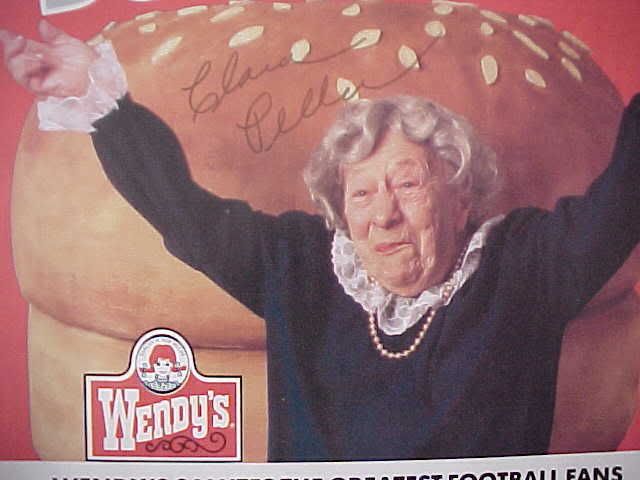
You may recall a popular television commercial for the fast food chain restaurant, Wendy’s at the time. Gray haired Actress Clara Peller stared at an unimpressive looking hamburger and asked, “Where’s the beef?” Mondale effectively neutralized Hart’s momentum by asking the same question about his rival's program.
I happen to respect Gary Hart. Our country should have heeded the report about terrorism he co-authored with former Senator Warren Rudman. This country would be far better off if we had. However, in 1984 Gary Hart was a platitude machine hiding behind the slogan of “new ideas.”
This week Barack Obama announced the formation of his exploratory committee to run for president and he noted the public wanted “something new.” Reading that I immediately thought of Gary Hart and Clara Peller. Where’s the beef?
As E.J. Dionne observed in today’s Washington Post, Democratic presidential candidate John Edwards is running on specifics. Edwards has stated his immediate priorities are not balancing the budget but addressing the nation’s investment deficit. Dionne writes:
“Most Democrats don't like to talk about it, but somebody's taxes are going to have to go up. Edwards, at least, is willing to say which taxes he would raise to keep the deficit from going through the roof. He would start by eliminating Bush's tax cuts for the top 2 percent of income earners, which he defines roughly as those earning more than $180,000 to $200,000 a year.My favored candidate for 2008 was Wisconsin Senator Russ Feingold but he’s not running. My next preference is former Vice President Al Gore but it doesn’t appear he has the fire in the belly anymore.
He wants to increase the capital gains tax for an interesting reason: In an interview this week, he argued that it's wrong to tax income from work at a higher rate than income from capital -- an extension of his long-standing theme that the country should not value ‘wealth over work.’ He also favors a windfall-profits tax on oil companies.
But since health coverage and ‘transforming the energy economy of this country’ are first on his to-do list, Edwards says he is prepared to disappoint voters who make a balanced budget their top priority.
Edwards deserves points for honesty and for stating the politically difficult truth that both fiscal and social balance demand a comprehensive health-care fix.”
As I’ve written previously, Edwards record about the Iraq War troubles me. I believe he supported the congressional resolution supporting President Bush’s misguided venture in Iraq out of political expediency. I can’t help but wonder if his “apology” for supporting the war is also about political expediency. War requires a higher standard of leadership than he’s provided. Yes, today he’s speaking out but seventy percent of the public is with him now. We needed Edwards to speak out in 2002-2003.
Nevertheless, I appreciate the progressive campaign Edwards is waging on domestic policy and the specifics he’s offering. In 2004, I regarded Edwards as a Ken Doll and his “two Americas” campaign a mere slogan. This time it appears he’s rising above platitudes.
Do platitude machines Hillary Clinton and Barack Obama have any beef to offer? A cynic might recall how Walter Mondale was honest and specific. He told a nationally televised audience at the Democratic National Convention:
“President Reagan will raise your taxes. So will I. He won’t tell you. I just did.”The deficit was out of control but Reagan promised not to raise taxes, won in a landslide and raised taxes for the middle class anyway, which he called “revenue enhancements.” And he got away with it.
An optimist however might note John Edwards on his worst day is far more charismatic than Walter Mondale ever was on his best day. Perhaps Edwards is just the candidate to sell a specific progressive program and earn a mandate for real change. Without either Feingold or Gore in the race I don’t know which candidate I’m going to volunteer for yet. For damn sure I want more than platitudes such as “something new” offered by Obama. I want to know where the beef is.
Saturday, December 30, 2006
About Saddam Hussein: A Picture Is Worth A Thousand Words
 Saddam Hussein was executed yesterday. We can expect the mainstream media to provide saturated coverage of Saddam's brutal rule the next few days when they are not too busy lionizing Gerald Ford's memory. I certainly will not mourn this man's passing. Otherwise, all I have to say is to the left is a picture of President Ronald Reagan's Special Envoy Donald Rumsfeld shaking hands with Saddam Hussein in 1984. The same Donald Rumsfeld who served as President Gerald Ford's Secretary of Defense in the 1970s and designed the incompetent occupation of Iraq under President George W. Bush. Unless you've lived in a cave the past few years this picture should be familiar. Nevertheless, a reminder is in order.
Wednesday, December 27, 2006
The Mixed Legacy of Gerald R. Ford
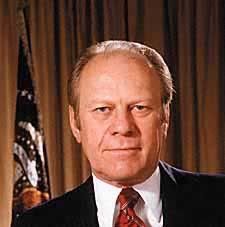 Gerald R. Ford, a man fate placed on a stage far bigger than his modest persona suggested he belonged is dead at 93. In August 1974 he was appointed America's 38th president when Richard Nixon resigned in disgrace because of the Watergate scandal. Had he not resigned Nixon surely would’ve been impeached in the House of Representatives and convicted by the Senate.
Ford became Nixon’s vice president when Spiro Agnew himself was forced to resign after pleading no contest to tax evasion. According to the Constitution, congress must approve a new vice president when a replacement is needed during a presidential term. As Nixon’s crimes were increasingly exposed to the public the stakes were high when selecting a new vice president. Tip O’Neill who later became Speaker of the House and was friendly with Ford recalled in his memoirs that,
“Another reason we favored Jerry Ford was that we didn’t think the Republicans should benefit from Agnew’s resignation. While Jerry had been an excellent leaderin the Congress, he didn’t seem to have the desire, the personality, or the charisma to be elected president on his own. He had even said that in the event he was selected, he wouldn’t seek the presidency in 1976. We found that reassuring, although nobody was prepared to hold him to that promise.”
The mainstream media prefers to lionize former presidents when they die and Ford is regarded as a decent caretaker who restored confidence in the republic. Ford does deserve credit for not resorting to the politics of slash and burn when campaigning for reelection in 1976. Nixon’s electoral success was partly attributed to exploiting resentments of working class whites. These voters later became “Reagan Democrats” and combined with evangelical Christians and traditional supporters from business interests to form a powerful coalition.
Future Republican presidents Ronald Reagan, George Herbert Walker Bush and George W. Bush prevailed partly by exploiting the politics of division. Ford unleashed his running mate Senator Robert Dole into the “briar patch” but otherwise campaigned on his competence and experience. Carter opened a big lead following the Democratic convention but Ford closed strong in spite of his controversial pardon of Nixon and debate gaffes by both him and Dole. Ford lost in a squeaker but resisted the temptation to resort to race baiting as Ronald Reagan did in Philadelphia, Mississippi during the 1980 campaign.
Ford also deserves credit for the 1975 Helsinki Accords signed by the United States, Canada, the Soviet Union and most European countries. At the time conservative critics such as Ronald Reagan who ultimately challenged Ford for the Republican nomination in 1976 protested the agreement because it recognized the Soviet Union’s territorial gains after World War Two. However, the Helsinki Accords also reduced Cold War tensions and put the Soviets on record as supporting human rights. Consequently the Helsinki Accords served to undermine the Soviet regime’s legitimacy and facilitated the communist empire’s demise.
National healing and the Helsinki Accords are not small accomplishments for a president that wasn’t elected. However, there is a dark side to the Ford legacy: the rise of the neocons. Ford’s Chief of Staff was a young man named Dick Cheney and Donald Rumsfeld was his Secretary of Defense. They persuaded Ford to cave under pressure from conservative critics in the assessment of Soviet military strength. As a result, CIA director George Herbert Walker Bush commissioned a competitive threat assessment known as “Team B” in July 1976.
Team B was comprised of ideologues such as Paul Nitze and they greatly exaggerated the Soviet military threat. Hence, under the Ford Administration a precedent was established for rewarding the views of ideologues over the assessment of national security professionals who knew their business. Although the Carter Administration gave little credence to Team B’s reports the national security bureaucracy was infected with an insidious cancer that ravaged its guts.
Senator Patrick Moynihan noted years later the CIA failed to predict the Soviet Union’s demise, as it should have. The iron triangle of the defense industry and bureaucracy needed to promote the myth of a formidable Soviet menace. This mindset is partly responsible for wasted billions of dollars spent on the delusional missile defense scheme known as “Star Wars.”
Ford partly surrendered to this pressure because of trouble on his political right. California Governor Ronald Reagan posed a serious challenge in the summer of 1976. Conservative critics such as Reagan had managed to make the word “détente” as dirty as the word “liberal” and Secretary of State Henry Kissinger was viewed with contempt. Remarkable that Henry Kissinger who is considered a war criminal by many was also regarded as soft on communism by conservative ideologues.
Consequently Ford established the precedent of appeasing conservative ideologues to ensure his political survival. All politicians want to survive and perhaps most would’ve done the same. Unfortunately, Ford’s political weakness helped pave the way for the ascendancy of dark political forces responsible for much of America’s abysmal leadership today. And that too is part of Ford’s legacy.
*********************************************************************************
ADDENDUM: My thanks to "Real History Lisa" for promoting a crossposting of the above topic at Progressive Historians. CLICK HERE to review comments from that community. Progressive Historians as one can infer from the name is a community blog devoted to analyzing history from a progressive perspective.
Subscribe to:
Posts (Atom)