Showing posts with label Barack Obama. Show all posts

Saturday, October 20, 2012

The Stakes For Generation X

On October 17th, Martin Longman, the talented proprietor of the excellent community blog, Booman Tribune had a post entitled “Romney the Destabilizer”. His post referenced recent reports that Romney was encouraging CEO’s to scare their employees into voting for him. Longman was particularly focused on how the post-New Deal consensus between employers and workers that helped nurture the middle class had broken down and the danger Romney represented to our civil society. I posted the following comment in response to Longman’s fine piece:
“Liberalism at its most effective is the indispensable alternative to revolution and reaction. At its worst liberalism is a temporary place holder to extremism like the Provisional Government after the fall of the Czar in 1917 before Communism's ascendancy or the Weimar Republic in Germany when it preceded National Socialism.

What's scary about our country in this moment in time is that Obama whether he wins or loses may be the last finger in the dike before the tsunami that comes next.

What makes Obama's position even more fragile is that his political survival required he be co-opted by some of the same institutional forces that has disintegrated the consensus you described above. When that consensus was stronger such compromises could be more easily finessed as Clinton demonstrated. But not anymore. The stability we were taught in Social Studies class way back when is long gone and Humpty Dumpty can't be put back together again.

Obama is a good man and I hope he wins but through no fault of his own, win or lose his ability to stem the tide is fragile. Romney of course would unleash a tsunami immediately. Alas, that is America's choice in 2012.”
I have second guessed my response in recent days and believe the trajectory of this election as well as our country’s future is not merely a choice between Romney’s tsunami or Obama’s fragile hold on America’s equilibrium. Win or lose, America’s future is in the hands of my age group, Generation-X which at its best is represented by Barack Obama and worst by Romney’s running mate Paul Ryan.

Generation X is unique because our collective memory includes the experience of our parents and grandparents when a strong middle class existed and the gap between rich and poor was not as grotesque as it is today. We came of age following a post-80s hangover and early ‘90s recession, rode the dot.com boom until 2000 but also reaped the whirlwind of union busting, tax policy favoring the hyper-wealthy and deregulation of Wall Street.

In today’s politics we’re largely ignored even with a Generation X president and vice presidential candidate. Much of the focus is instead on preserving Social Security and Medicare for folks over fifty-five or lamenting the bleak future of today’s Millennials.

I do not overlook the importance of preserving a safety-net for seniors or establishing upward mobility for our young people. Indeed a whole lot of our seniors served in World War Two, Korea and Vietnam while our twenty-somethings risked their lives in Iraq and Afghanistan. Many of my peers are stretching their diminished resources to raise children of their own as well as take care of their parents and grandparents. We all want upward mobility and security for our young people and folks who have worked hard their whole lives.

Nonetheless it irks me whenever I hear Mitt Romney or Paul Ryan utter assurances that people over fifty-five “have nothing to worry about” with respect to Social Security or Medicare. I’ve managed to more or less be steadily employed since 1991 and paid FICA taxes into the system the whole time. Conceivably, if I’m healthy and remain employed, I can contribute another twenty plus years of FICA taxes into the system.
Should that not count for something? Or is my generation chopped liver?

It also irks me when hard working people in my generation with kids to support and aging parents to take care have their jobs callously tossed aside, outsourced, lose their pensions or are forced to live in trailer parks due to plutocrats like Romney and shenanigans on Wall Street. They exploited their influence to enrich themselves at the expense of our fiscal solvency, gorged themselves while claiming to worship at the holy temple of job creators and proceeded to undermine the livelihoods of millions of wage earners. They do this even while wrapping themselves in the false piety of morality and patriotism.

America has an abundance of wealth that was misappropriated. And the agents of these thieves, Mitt Romney and Paul Ryan want to “reduce the size of government” for the same reason thieves want less cops on the beat: so their friends can commit even more crimes.

A civil society cannot be maintained with that trajectory. The end result ultimately means more gated communities and police intimidation to preserve the wealth stolen by the top from what used to be this country’s middle class as well as the poor. That is the trajectory we are on and it’s the very young and senior citizens who will be the most vulnerable if civil society breaks down.

Demographically, seniors are more inexplicably inclined to vote for Romney and Ryan. Young people while they favor Obama obviously will not turn out with the same enthusiasm as 2008. Much of the get out the vote efforts in this campaign’s final days are understandably focused on undecided women voters. Yet I suspect get out the vote efforts with those Generation X voters inclined to support Democrats that is really the X-factor for both the presidency and down ticket races.

Win or lose in 2012, it will also be Generation X that determines our destiny. If Obama wins he and the Democrats will need to be empowered and supported by Generation X to restore the balance between capital owners and wage earners and not give in to Tea Party crazies or greed mongers. Otherwise even with a second term President Obama will be little more than a fragile finger in the dike against Generation X plutocrats like Paul Ryan.

And if Obama loses, Generation X will have to stand up for itself and demand not to be trodden on behalf of ourselves and generations to come.  Young people are still finding their way in this world and our parents and grand parents have done all they can.

It’s up to us.

Wednesday, June 16, 2010

Predatory Conservatism Is Like A Venereal Disease

A short post this evening. After President Obama’s speech last night I pondered how the hell we got here. I’m not simply referring to the oil spill but America’s and the world’s rapidly decaying condition.

Under George W. Bush liberals warned that America was on a collision course with calamity. I suppose one could describe the Bush regime as the culmination of forty years of predatory conservatism that favored wealth over work and corporate power over community interests. Sadly, Americans were seduced by predatory conservatism’s false promises of freedom, wealth and benevolent nationalism as our center of political gravity lurched to the radical right. As of 2010, America’s predatory conservative movement boasts a legacy of economic calamity, two failed military occupations, a crumbling infrastructure and an epic environmental catastrophe as the world spirals towards global warming at breakneck speed.

It’s almost as if predatory conservatism as personified under its prodigal son, George W. Bush, unleashed a metastasizing venereal disease upon our institutions, culture, fiscal solvency and sense of social responsibility. The disease requires bold aggressive treatment. Instead, under President Obama, conservatism’s venereal disease is being treated with mild ointment.

At best Obama’s ointment can reduce the sting somewhat. But it’s not reversing the disease, which continues to metastasize. Even worse, America’s body politic is recoiling from the mild ointment as if it’s worse than the disease itself that enabled Wall Street permissiveness and the British Petroleum oil spill.

I retain my personal admiration in President Obama. But that’s where we are today.

Sunday, June 13, 2010

If Only I Could Laugh

If I didn’t care so much, if the stakes for civilization were not so high, if the fate of our ecosystem didn’t hang precariously in the balance and our blood and treasure were not so casually tossed aside on behalf of a crumbling empire, I could laugh. A hearty-belly laugh at the absurdity of current events, our mediocre at best leadership, the irredeemable whores of big industry, and the mindless corporate mouthpieces with expensive haircuts masquerading as journalists. Yes, I could laugh at the whole damn mess.

I could laugh at America’s bizarre political math that says unless sixty votes can be cobbled in the Senate we can’t do a damn thing without achieving some faux centrist nirvana at the expense of meaningful financial reform, overhauling immigration, a cleaner environment and energy independence. I could laugh at the even more bizarre math that says stimulus spending to create jobs is bad while spending trillions in Afghanistan and Iraq is good.

I could laugh at a political culture that simultaneously portrays President Obama as a radical Black Muslim Bolshevik and Wall Street corporatist hoping to score Goldman Sachs cash. I could laugh at how the Supreme Court will be even more hostile to wage earners, whistle blowers, the environment and civil liberties at the end of President Obama’s first term then it was at the beginning. I could laugh at how American tax payers may eventually bail out British Petroleum to clean up its mess in the Gulf.

I could laugh at how my home state of New York is on the brink of fiscal insolvency as mendacious Albany politicians grease the patronage mill for contracts that fatten their wallets, borrow and spend from pension funds and cut needed services for the poor, the elderly, the young, the old and the disabled. I could laugh at my Mayor Michael Bloomberg, as his let business be business philosophy allowed mob corruption to metastasize in the New York City Buildings Department, undermine the health and safety of millions of New Yorkers while his Honor retains the image of an above board technocrat. Heck of a job Mike!

I could laugh at how America’s center of political gravity is defined by xenophobes who belong in a lunatic asylum. We have Republican candidates in 2010 that want to return to the gold standard, privatize Social Security for the benefit of Wall Street parasites, and support more off shore drilling and even repeal civil rights legislation. And America's center-left is folding like a limp noodle. How funny is that?

I could laugh at how conservatism defines decency down. Nixon was crazier than Goldwater who today would be considered too liberal in the Republican Party. Reagan was even more of a ruthless class warrior against wage earners than Nixon and George W. Bush even more of a war monger then all of them combined. Then I could laugh at how the Tea Party makes George W. Bush and Dick Cheney almost seem like moderates. And I could laugh at how the American people might just put these people back in power in November 2010 and 2012.

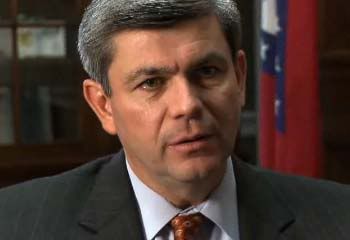
I could laugh at how a Democratic White House gloated over the defeat of organized labor’s backed candidate in Arkansas Bill Halter in favor of the pro-corporatist Blanche Lincoln. I could laugh at how former President Bill Clinton who coveted organized labor’s support during his campaigns and his wife’s, demonized those who stood up for wage earners, health care and the environment.

Then I could laugh at how Arkansas Senator Blanche Lincoln’s first vote after her primary victory was in favor of a resolution to take away the power of regulating greenhouse emissions from the Executive Branch at the behest of the energy industry and the Chamber of Commerce. Thankfully the resolution was narrowly defeated but remarkable that faux populists like Blanche Lincoln can with a straight face say their vote is not for sale. I could laugh at that too.

If only I could laugh at it all. But none of it is damn funny.

Sunday, August 30, 2009

We Must Fill the Void Ourselves

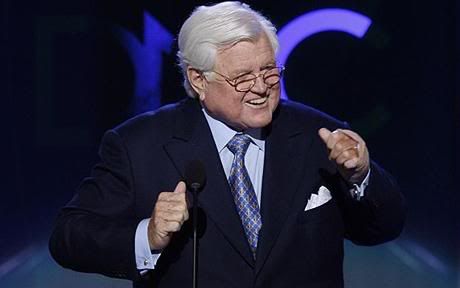
Like millions of my fellow citizens, I am reflecting after the death of Ted Kennedy. Death is an egocentric experience for the survivors. Indeed, rituals such as funerals, wakes or in the Jewish religion “sitting Shiva,” is really about nurturing the souls of those left behind. That is also true when it is a public figure or celebrity that has died. We may never have met them or knew them yet they touched us nonetheless. The Kennedy family understands this better than anyone and is well practiced in rituals that not only honor the dead but comfort the living.

President John Kennedy and Robert Kennedy were assassinated before I was born. They touched my parents, but to me they were legendary martyrs and almost mythical. In 1980 however, their very real brother delivered the first political speech that ever captured my attention at the Democratic convention. I was only a kid but inspired by Kennedy’s defiant idealism following defeat. As I grew older, I appreciated Kennedy’s quest to stand up for the voiceless as predatory conservatism systematically destroyed the hopes and dreams of society’s most vulnerable. Remarkably, Kennedy always managed to fight the good fight with a smile even as he remained true to his principles.

Kennedy’s civility and statesmanship was rightly extolled among his colleagues as ideologically diverse as Chris Dodd and Orin Hatch. And certainly there is virtue with respect to how Kennedy never looked upon his adversaries as “enemies.” Hence, Kennedy forged a record and legacy as America’s most accomplished liberal legislator. More children have health insurance because of his legislative partnership with Orin Hatch. More Americans were empowered to vote because of his crossing party lines to collaborate with Bob Dole. In 1982, Kennedy joined forces with a young conservative Senator from Indiana named Dan Quayle so more citizens would receive job training.

Kennedy’s generosity of spirit as so many conservative voices demonized him and his family is an inspiration we can all learn from. True Kennedy was a flawed man and his dishonorable and irresponsible conduct resulted in the death of Mary Jo Kopechne. If I were a member of her family I likely could never forgive. Yet I find it ironic how so many conservative critics who champion Christian values could find so little virtue in Kennedy’s personal quest for redemption. Kennedy was a flawed man with his heart in the right place who tried to do well. Alas, too many politicians are intolerant of the imperfections of others and pursue policies that cause more harm than good.

Yet as members of the establishment political class honor Kennedy’s “bipartisanship” we should never forget that his political leverage stemmed from authenticity and conviction. When other Democrats preferred triangulation Kennedy unapologetically carried the liberal banner. In 2002 and 2003, while too many Democrats cowered as the Bush administration pursued a reckless war of choice with Iraq, Kennedy unequivocally and forcefully opposed it. Ultimately, Kennedy’s strength and compassion, enhanced the stature of those who entered into principled compromises with him. With all due respect to Orin Hatch, without Ted Kennedy he was just another callous conservative.

In comparison, one’s stature simply cannot be enhanced by compromising with tools of the medical industrial complex such as senators Max Baucus and Evan Bayh. How can anyone with an ounce of common sense or deductive reasoning have any faith in any compromise forged by plastic figures like those two agents of corporatism? To be sure, many Democrats, in the House especially are unwavering in their support of the public option. Sadly though, President Obama has sent mixed signals about how staunchly he supports it and key Democrats on the Senate Finance Committee such as Max Baucus are more beholden to the insurance companies than their constituents.

Kennedy's absence from the debate has left a void that is being filled with feckless Democrats, corporate shills and homicidal right wing ideologues. It’s an enormous void that will take many figures and years to fill. Presently, I don’t see anyone on the scene, including I regret to say, President Obama, who has the political intuition and will to fill it. Kennedy understood that politics was intensely personal. As a figure who suffered great personal loss he tapped into raw emotions on behalf of the voiceless better than any Democrat since his brother Robert Kennedy.

Today, as I mourn Senator Kennedy, I am also thinking about my best friend from high school. My friend prefers to remain anonymous so I’ll refer to him as John Doe or JD. JD and I re-established contact after almost no communication for the preceding twenty plus years through online social networking. Isn’t it strange how life works that way? JD and I talked nearly every day for four years but after graduating we went our separate ways.

Anyway, I learned that three years ago, JD sustained a brain injury following a car accident and is currently disabled. Previously, JD was professionally successful and thriving. He also married and has a six year old daughter. The fates were not kind to my friend and the accident has turned his life upside down. Today, JD is desperately motivated to rehabilitate, recover and resume an active life. Sadly, the medical industrial complex is an obstacle to his getting better. Here is how JD described his most recent encounters with insurance bureaucrats:
“I should send my story to a town hall meeting to explain why health care needs to be a single payer. I went to an orthopedic for the first time today as my back is killing me. After 3 years of shots to numb the pain and non-stop pain killers I feel it is time to try and find the cause and not just numb it, which does not work.
I gave the orthopedist rep at the front desk my no fault information and expected stupidly that it would just go through without a problem. Of course that did not happen. She called No Fault and was told that my account was closed on 7/5/09 and that I was not entitled to any further payment for my injuries.
I knew this was BS as they just agreed to pay for a different doctor last week and even if this was true you would think that would have notified me.”
Already, JD’s experience is sadly familiar for too many citizens. Yet his frustration would only get worse:
“This day was the first time I was told that I was denied going to a orthopedic doctor in 2006 as I was told then I did not need it. I told the supervisor on the phone that I found this strange considering that today was the FIRST time I had even gone to an orthopedist so how could I be refused something that I have never gone to before to see if I could even get any help from them. I then said that it makes no sense because they continue to pay for my pain management doctor, which basically just gives me shots in my back and medication for pain. In other words I said to the supervisor, you will pay for me to get drugs and be numb but you won't pay to fix the problem?”
JD’s experience grew even more absurd:
“This idiot then said that if I want to challenge this ruling that I would have to send them further information proving that I have these problems in my back and neck that would warrant this care. I have gone thru that before and I could tell you stories about that. But I said, OK I could do that as I had all of that paper work in the orthopedics office now and I could fax it immediately.
He THEN said something beyond stupid. That because the IME was in 2006 there was a chance that the doctor would not be found to review the addendum to change his mind. Yet, the doctor that said I was fine would have to get the new information and than have to admit that he was wrong, which isn’t happening. To further piss me off, the supervisor tells me that even if I send in the information that if the doctor could not be found that even the new information would not change anything, they could not contact another doctor to review it and that their original opinion would stand. So I said to the guy, you are saying that if I show you proof that I have these problems you STILL may not pay for this? He said yes. I said that is BS. I then ranted on him how could I be denied seeing an orthopedic before I even TRIED to go to one before. The guy was an idiot so I said that I wanted to speak to HIS supervisor. The guy said that I can but he will say the same thing. I said I still want to talk to him. He took my number and said he did not know when he would get back to me.
I went to the doctor anyway as I was there for 2 hours, stressed out of my gord, and having the doctor submit it to No Fault, have them deny it and then go thru my medical.”
I felt helpless and angry as I read this closing paragraph from my friend:
“This is yet another stupid war I have had with these people over the last 3 years. They expect me to give up by giving me the run around and I refuse to until they give in. They push and push as most people would just give up. THIS is why we need a single payer Medicare for all so this shit won't happen. I just want to get better and these idiots are making it harder for me to do so.”
Ted Kennedy who knew tragedy and loss was on the side of people like my friend. It was often a lonely fight as he went up against the institutional strength and money of the medical industrial complex. Making the fight even harder is that too many of Kennedy’s colleagues in both parties have served as enablers of the parasitic insurance industry. Indeed, the struggle for economic and social justice must have often felt to Kennedy like he was climbing a greased hill in bare feet. Even so he continued to put every scrap of prestige and talent at his disposal in pursuit of a more prosperous and just society. The “cause” endured for him far longer than his personal ambitions. Alas, too many figures today care more about being big than doing good.

There is no single figure anymore that possesses the combination of gravitas and will to stand up for people like my friend as Ted Kennedy did throughout his career. It is therefore incumbent upon all of us to fill the void Kennedy left behind. As JD confided to me recently, until his accident he didn’t have much interest in politics. Today JD understands just how high the stakes of political discourse are. On any given day, any one of us could have their lives turned upside down just like my old friend from high school.

Ted Kennedy, who had his life turned upside down numerous times understood that better than anyone.

Sunday, August 02, 2009

The Good Fight: Taking On the Axis of Greed

Arkansa's Blue Dog Mike Ross
George W. Bush coined the phrase “Axis of Evil” during his infamous 2002 State of the Union speech in referring to Iraq, Iran and North Korea. It should be obvious to Americans by now that what really undermines our security as a people is an Axis of Greed compromised of Wall Street, fossil fuel’s Energy Industrial Complex and the Medical Industrial Complex. These are the people that confiscate assets from communities to enrich the mega rich, undermine the environment and promote wars in foreign lands for oil and make it damn hard for millions of people to get affordable healthcare for any illness more serious than a common cold.

This Axis of Greed represents an entrenched juggernaut of corporate power and moneyed interests with tentacles inside the media as well as the corridors of power in Washington and every state capital. Electing Democrats by itself was never going to be enough as the fight over health-care reform illustrates. With Republicans out of power, money that previously went to Republicans is now funneled to conservative Blue Dog Democrats. Hence, my posts earlier this year describing Senators Evan Bayh and Finance Committee Chairman Max Baucus as “Corporatist Class Warriors.”

First, let us review the good news. Yes, believe it or not, there is good news to speak of in this righteous struggle against the Axis of Greed. What has been achieved is that the battle is finally joined after four decades of predatory conservatism. Barack Obama in ‘08 and congressional majorities in ’06 and ’08 were elected with a mandate of reform and change. Many Democrats, including the president himself were supported with small donations from regular folks. Hence, there is an actual fight taking place and liberals finally have allies in the White House and congress with teeth and progressive sensibilities.

Predatory conservatism is discredited and despite a recent rough patch for President Obama, the Axis of Greed has been forced to negotiate on political terrain less favorable to them than ever before. Also, President Obama has proven an effective counter-puncher whenever his back is up against the wall and I suspect that lesson will be relearned by his adversaries during the congressional recess in August.

Remember, initially opponents of the economic stimulus package defined the terms of debate but once Obama counter-punched the Economic Recovery Act Passed – albeit at far less than liberals like me had hoped. That will likely be the end results with respect to health care reform, cap and trade legislation and attempts to reform Wall Street with a consumer protection agency – Obama’s counter-punching will salvage enough political space to advance the ball even as liberals like me are disappointed.

Unfortunately, in America, merely winning elections with large majorities is not enough when taking on the Axis of Greed and the playing field is still tilted in their favor. Enough Democrats in southern and rural districts remain obstacles to change. This poses a strategic dilemma for Democrats and liberals. Democrats need the Blue Dogs to caucus with them in order to maintain a majority.

Yet these very same Blue Dogs are opposed to core Democratic Party values such as health-care that benefits people instead of HMOs. Indeed, the Blue Dogs are more concerned with the well being of the Medical Industrial Complex and fear that a strong public option will force insurance companies to charge more reasonable prices for medication. They feel more beholden to financial contributors at Goldman Sachs, Exxon and Aetna than the hard working farmers, wage earners and small business entrepreneurs who voted for them.

The upshot is that for all the terrific organizing done the previous two election cycles and the incredible way the Internet has transformed campaign financing, the Axis of Greed still has the dollars and institutional strength to shift the end product of legislation in their favor. Through the power of advertising and their allies in the corporate media, the Axis of Greed can scare the public with myths and disinformation to undermine needed investments in infrastructure, education or making health-care affordable for the single Mom working three jobs. Blue Dog congressional Democrats who rely on the support of constituents earning less than $40,000 a year will not support tax increases on millionaires to help pay for health-care for everyone because they fear the Axis of Greed more than that those constituents they allegedly represent.

So does that mean we give up and throw in the towel? Hell no! It means we have more work to do and our struggle is just beginning. In recent years we have successfully harnessed our natural constituencies in cities and minority demographics to achieve a majority. And thanks to previous Democratic National Committee Chairman, Howard Dean, the Democratic Party is a presence in states and communities it previously wasn’t.

But there is still an organizing lag for liberals in too many rural communities. Unions are especially weak in these districts and people like Arkansas House Democrat Mike Ross for example who triumphantly boast that they “slowed down” health-care reform, need to be convinced that favoring the Axis of Greed over the people will cause him real political pain. As opensecrets.org reveals, two of Congressman Ross’s top five industry contributors in the 2009-2010 campaign cycle are health-care professionals and Pharmaceutical/Healthcare Products. Ross is merely one example of a stark reality: until he fears his constituents more than the Axis of Greed, nothing will ever change and not even the rhetorical gifts of President Obama will be enough.

Meaningful change is going to take a long time. We’re only in the first inning of an extra inning game requiring resolve, endurance, patience and resilience. President Obama will sign watered down health-care legislation and call it reform this year. He will have no choice. In a few years we will hopefully be able to revisit the issue with greater political strength.

Obama will also have no choice but to sign watered down cap and trade legislation. Given the current pace of global warming it also won’t be good enough and will have to be revisited when the political terrain is more favorable - and hopefully won't be too late too save the planet. Finally, the Wall Street economy will have some more reforms but the huge imbalances in the system will not be addressed any time soon if plutocrats such as Treasury Timothy Geithner have anything to say about it.

This is a long, tough, righteous and worthy fight. I’m in all the way for as long as it takes. We all need to be.

Sunday, July 05, 2009

Sunday Summer Musings

As regular readers of this blog have noted to me via email, I have posted infrequently in recent weeks. Although I’ve conducted podcast interviews with interesting subjects and have more scheduled over the summer, personal matters have required my attention. Hence, I haven’t been able to comment on recent events. Some of you have emailed asking if I’m doing OK. Rest assured, I am fine and this has only been a temporary respite from blogging. Like many of you, I have been following current events both nationally and internationally as well as locally in my home state. A few observations and thoughts below:
  • Curiously, the lack of coherent conservative political opposition is undermining the progressive cause and reinforcing the Washington/Wall Street axis. President Obama and much of the Democratic Party appears content to remain risk averse, hoard political capital as “Blue Dog” Democrats such as Evan Bayh and Max Caucus continue to be whores for the private insurance industry and the moneyed interests. With the Republican Party in disarray, the Obama administration has no incentive to go beyond the political fifty-yard line and transform America from a corporate national security state to a society that facilitates broad based prosperity for real entrepreneurs and wage earners. Meanwhile, the corporate press falsely portrays the national debate as between the “liberal” Obama administration and “mainstream” critics. Sadly, and it pains me to write this, enablers of America’s modern gilded age have merely hit the “reset button” with the Obama administration. I like Al Franken and I’m happy he will finally take his rightful place as Minnesota’s junior senator. But that magical sixtieth vote will not transform the landscape all that much. As Illinois Senator Dick Durbin candidly put it earlier this year, the banks “frankly own the place.”
  • In my opinion, Bernie Madoff is a scapegoat for the crimes on Wall Street. Madoff will spend the rest of his days in prison and deservedly so. I have no sympathy for him. However, the looters at Goldman Sachs, Citicorp and A.I.G. are just as guilty if not more so than Madoff. Yet they’re benefiting from billions of dollars subsidized by taxpayers as state and municipal governments barely hang on. It seems to me that Madoff as the public face of Wall Street’s crimes is enabling plutocrats in Washington and the financial services industry to avoid accountability and needed restructuring of our economy. Two decades ago, Michael Milken became the public face of Wall Street’s excess and nothing changed. If Treasury Secretary Tim Geithner and the administration’s senior economic advisor, Timothy Geithner have their way, the Wall Street/Washington axis will continue to conduct business as usual. Their so-called “reforms” are cosmetic only and will not facilitate the systemic change our economy so desperately needs.
  • Enablers of the Washington/Wall Street axis are the cozy relationship between “journalists” and the lobbyists of corporate America. The recent news about the Washington Post selling access to corporate lobbyists simply reinforces what the American people have sensed in their guts for a long time: the “truth” is purchased, packaged and sold. Americans across the political spectrum know this intuitively and that as much as anything explains the decline of traditional media in the Internet age. To some degree this is regrettable because nobody exposed local corruption better than those old time city newspapers with reporters mining sources among the worker bees at city hall. Also, the Internet and blogs are hardly a panacea of journalism. Regardless, the Washington/Wall Street access can only be broken from outside and that means we the people have to become our own journalists.
  • It seems that the real conflict in Iran is between their security forces and factions among the clerics. The valiant protesters are really pawns for the real power struggle-taking place. Even so, hopefully the people who bravely stood up and risked their lives represent a window into the future. Presently though, Iran appears poised to become more of a traditional military dictatorship and less of a theocracy. How events in Iran will transform the Middle East is hard to say but there does appear to be a thaw in American/Syrian relations. The State Department has hoped to exploit potential rifts between Iran and Syria for years even as the Bush administration behaved like a bull in a China shop and the fallout from Iran's presidential election has given the West at least a modest diplomatic opening.
  • I’m gratified American troops are finally withdrawing from Iraq and that Vice President Biden has advised the Iraqis we won’t be expending more blood and treasure to police sectarian violence. Sadly, those resources will likely be redeployed in the Afghanistan/Pakistan theater. Unless vigorous diplomacy with NATO powers or the upcoming summit in Russia can facilitate greater logistical support, an overextended American military is more vulnerable than ever to the burdens of empire maintenance in the name of national defense.
  • I can’t begin to articulate my disgust over events in Albany with the state senate. Much of my activism last year was dedicated to enabling Democrats to finally take the majority. Painfully, their political incompetence as well as Governor David Paterson’s feckless leadership has effectively ended those reformist aspirations from 2006 when Eliot Spitzer was elected New York’s chief executive. With respect to who controls the state senate there is the 2010 census at stake and that means repercussions for the House of Representatives as well the power dynamic in Albany. For the people of this state it’s not just about reform or which party controls Albany. It’s being able to earn a living wage, afford healthcare, have access to affordable housing and good public schools. Unfortunately, New York's political leadership has shown that the Big Apple is a Banana Republic. Hopefully, the chaos between Democrats and Republicans will strengthen the leverage of New York’s Workers Family Party as they represent the interests of New York’s struggling wage earners. Now more than ever Democrats need the support of the WFP and they have much work to do to earn it. As for Eliot Spitzer, tempermentally flawed as he is, I would gladly take him back and would even be willing to pay an "escort tax" to make it happen!

Sunday, June 07, 2009

Billy Graham & the Rise of the Republican South: An Interview With Historian Steven P. Miller

In the age of Barack Obama, both the Republican Party as well as the South appear marginalized and out of step with the rest of America. Yet it wasn’t so long ago that the South represented the foundation of America’s conservative hegemony. Starting with Dwight Eisenhower in 1952, the Republican Party prevailed in nine out of the next fourteen presidential elections with a reliable Southern base.

Specifically, the Republican Party exploited white Southern resentment against the cause of civil rights and integration. The "Southern strategy" as it was later called, enabled Republicans to end the Democratic Party's previous domination of the South following the Civil War. A key figure in that realignment was the renowned evangelist Billy Graham.

Historian, Steven P. Miller, first explored Billy Graham’s role in this realignment with his doctorate thesis entitled, “The Politics of Decency: Billy Graham, Evangelicalism, and the End of the Solid South, 1950-1980.” Miller later converted that thesis into his current book, Billy Graham and the Rise of the Republican South, recently published by the University of Pennsylvania Press. Miller’s book delineates how Graham allowed his iconic celebrity to be used by national politicians so they could make inroads into the South. His book also details how Graham capitalized on his leverage as a regional heavyweight to influence presidents and policy.

With President Dwight Eisenhower, Graham had an ideological soul mate as both valued “moderation” between segregationists and those who championed integration. Graham believed that racism could not be overcome through legislation and the heavy hand of federal power. Instead, he advocated changing the hearts and minds of people “one soul at a time” through his integrated “crusades” where he preached his love thy neighbor gospel.

Under the presidencies of Truman, Eisenhower, Kennedy, Johnson and Nixon, Graham straddled the fence between promoting racial tolerance and preserving local southern autonomy or “states rights.” In that regard, Graham was an intimate part of Richard Nixon's inner circle after he became president in 1968. Graham’s defenders argue that he helped the South transition from its shameful past while preserving stability. His critics claim that Graham was a cowardly apologist for white privilege who didn’t do nearly enough to advance the cause of civil rights. Personally, like many liberals, I'm partial to the latter argument.

Ross Douthat writes in his April 19th review of Miller's book in the New York Times that,
“Neither story is the whole truth, but both are true. And it’s a credit to Steven P. Miller that his ‘Billy Graham and the Rise of the Republican South,’ a study of the evangelist’s relationship to the cause of civil rights on the one hand and the cause of conservatism on the other, does justice to the tensions and complexities involved — for Graham, for the South and for the country. In Miller’s account, one of 20th-century America’s most important religious leaders emerges as a representative political actor as well, whose example is worth pondering less because he was courageous than because he often wasn’t.

The story of the civil rights era is usually told as a collision between heroes and villains: the marchers on one side and the K.K.K. on the other; the Martin Luther Kings and Lyndon Johnsons making the way straight for justice, and the George Wallaces and Bull Connors standing sneering in their way. But the movement’s successes and failures were ultimately determined by the choices of more unheroic men — men like Billy Graham.”
Miller, who earned a PH.D degree in history from Vanderbilt University and has taught at numerous institutions, including Washington University, Webster University and Goshen College, agreed to a telephone podcast interview with me about his book and our conversation was just under thirty-six minutes.

Among the topics covered is the difference between hard core fundamentalism and evangelicalism, Graham’s role in facilitating Republican inroads into the previously reliable Democratic South, whether his middle ground on civil rights was courageous or cowardly, Graham's alliance with Eisenhower, his friendship with Lyndon Johnson, the intimate collaboration with Richard Nixon and the legacy he left behind.

Please refer to the flash media player below.


This interview can also be at accessed at no cost via the Itunes Store by searching for either the “Intrepid Liberal Journal” or “Robert Ellman.”

Wednesday, June 03, 2009

Obama & the Mideast

President Obama is beginning his much-anticipated Mideast trip today in Saudi Arabia that includes a heavily promoted address to the Muslim world in Cairo, Egypt tomorrow. This trip coincides with President Obama and his Secretary of State, Hillary Clinton, making news criticizing Israel's settlment policy in the occuppied territories. With respect to the criticism, Israel's settlement policy is both illegal and immoral.

Obama's willingness to criticize Israel for it is certainly a change in rhetoric from standard American practice in recent years. The real test however will come as the Netenyahu government continues to defy the world and build within existing settlements. Will there be any consequences? I doubt it.

At this point there is no organized counterweight to the American Israeli Public Affairs Committee ("APAC"). As a Jewish American who cares about Israel, I once again express my regret that an effective counterweight to APAC does not exist. Without one, Israel will continue down a dark and perilious path and eventually reap a catastrophic whirlwind. In the meantime, blood is being shed.

I suspect Obama's Israeli criticism is partly calculated to enhance his credibility prior to engaging the leadership of the Muslim world. Translation: "I'm being honest with Israel and not coddling them. So I'm going to be honest with you too and say, Israel has legitimate security concerns that need to be addressed." That won't be enough.

In fairness to Obama, I don't see how any president can resolve the Israeli-Palestinian crisis. Netanyahu, even if he wanted too, can't deliver diplomatic breakthroughs without fracturing his fragile coalition or provoking civil war with Israeli settlers. The Palestinian leadership under Abbas is even less capable of coming through with what is known in the world of diplomacy as "deliverables." With Hamas shut out, the Palestinian Authority has no credibility with its own people as it struggles to survive.

Both Israeli and Palestinian societies are dysfunctional. After forty years of a brutal occupation, the Palestinians don't have the institutions or an established civil culture to govern itself as a peaceful neighbor. That won't change unless Palestinian society can have a transition period without the heavy yoke of occupation. The Palestinian young have known nothing but struggle, hardship and violence. They are jaded and easy prey to do the terrorist bidding of demagogues.

Meanwhile, Israeli society has been morally corrupted as an occupier and the extremist settler movement further ties their government’s hands. Even worse, there is no effective political left in Israel serving as an opposition. The onetime proud Labor Party is serving in Netanyahu's coalition and the opposition Kadima Party is not much better than Netanyahu's Likud government. Curiously, the Israeli press is far more critical of the occupation than the American press. Nonetheless, no viable center-left opposition party capable of challenging Israel’s posture towards the Palestinians exists.

It's heartbreaking but the cycle of violence appears unbreakable.

Sunday, May 17, 2009

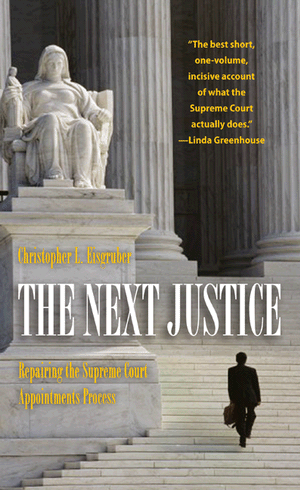
The Next Justice: An Interview With Legal Scholar Christopher L. Eisgruber

President Obama will soon announce his nominee to replace retiring Justice David Souter on the Supreme Court. It’s a critical nomination with long-term ramifications for civil liberties, executive power, management-labor relations, the environment and consumer rights. Hence, it is vital the public know whether the judicial philosophy and ideology of any prospective nominee to the court is compatible with their sensibilities and values. Ideally, all nominees would be forthcoming about their philosophy as the senate either confirms or rejects them with full knowledge of the sort of justice they’re likely to be.

Regrettably, that hasn’t occurred since the 1987 Senate confirmation hearings for Robert Bork. At the time, Bork scared the hell out of me and I’m grateful his nomination was not approved. Even so, I always respected how Bork was upfront about his ideology and judicial philosophy. Bork didn’t hide what he was and the American public and the Senate had a clear picture of what sort of justice he would be.

Sadly, since the Bork nomination fight, our Supreme Court appointments process has become a Kabuki dance existing in an alternate reality. Nominees are conditioned to reveal as little as possible about their judicial philosophies or even avoid acknowledging they have one. A pitiful example is Chief Justice John Roberts who famously compared Supreme Court justices with baseball umpires during his 2005 Senate confirmation hearings:
“Judges are like umpires. Umpires don't make the rules; they apply them. The role of an umpire and a judge is critical. They make sure everybody plays by the rules. But it is a limited role. Nobody ever went to a ballgame to see the umpire.”
Contrary to John Roberts’ testimony, a Supreme Court justice has a unique and expansive role in our society. The Constitution contains too many abstract references and clauses for any justice to merely adhere to the rules based on a strict interpretation of the text. An example is the Constitution’s Equal Protection Clause. As the highly regarded legal scholar, Christopher L. Eisgruber, observes in his 2007 book, The Next Justice: Repairing the Supreme Court Appointments Process (Princeton University Press) the Equal Protection Clause reads,
“’No state shall deny to any person within its jurisdiction the equal protection of the laws.’

How should judges interpret this clause? Presumably, they must ask what it means for the laws to protect people equally. Yet that question takes judges straight to the nerve center of American ideological controversy. Liberals and conservatives disagree passionately about what it means for the laws to protect groups equally and about when it is appropriate for the laws to treat one group better than another.”
Overall, Eisgruber argues that due to the Constitution’s many vague abstractions, a Supreme Court justice is disproportionately influenced by their individual values and ideology in determining when it’s appropriate for the court to intervene and even overrule our country’s prior laws. How could it be otherwise when the Constitution’s text is frequently subject to broad interpretation as with the Equal Opportunity Clause? Hence, it is imperative the senate determines if the judicial philosophy of a Supreme Court nominee is representative of the country.

Some legal scholars such as Yale law professor Stephen Carter have argued that nominees to the Supreme Court should simply stay home because their testimony has ceased to contribute anything substantive. There is definitely merit to Carter’s point of view. Nominees since Robert Bork typically speak only in vague platitudes about practicing “judicial restraint” and are ultimately voted up or down based upon their reassuring television appeal.

Eisgruber however argues in his book that the senate should ask more open-ended questions of prospective nominees about their judicial philosophies. Too often senators attempt to trap nominees with “gotcha” questions or ask about specific issues such as abortion that that can easily be deflected to “preserve their integrity” prior to joining the Supreme Court. Ultimately, little is learned and unless opposition interest groups get any traction or a scandal emerges, the nominee is likely to sail through without defending or explaining their ideology.

One example of the sort of question Eisgruber suggests asking is,
“The late Chief Justice William Rehinquist wrote that ‘manifold provisions of the Constitution with which judges must deal are by no means crystal clear in their import, and reasonable minds may differ as to which interpretation is proper.’ Could you tell us something about the values and purposes that will guide you when you interpret provisions like the Equal Protection Clause? How do those values and purposes distinguish your approach from those taken by other justices?”
Eisgruber contends this approach has a better chance of determining the sort of justice a nominee is likely to be. He also argues that it will facilitate more moderate nominees and discourage stealth extremists.

Eisgruber, who previously clerked for U.S. Court of Appeals Judge Patrick E. Higginbortham (a conservative) and Supreme Court Justice John Paul Stevens (a liberal), agreed to a podcast interview with me over the telephone about his book. Among the topics discussed were the insights he gained clerking for two ideologically different judges, the importance of justice’s philosophy about judicial review, President Obama’s desire for a justice with “empathy” and whether we might have a justice who did not serve in the appellate courts. I also asked him numerous questions from my liberal perspective, including whether ideological balance on the court would be better served by appointing assertive liberals instead of moderates.

Please refer to the flash media player below.


This interview can also be accessed at no cost via the Itunes store by searching for either the “Intrepid Liberal Journal” or “Robert Ellman.”

Saturday, May 09, 2009

Saturday Night Ramblings

I’ve taken a needed break from blogging these past few days. Rather than post a topic oriented essay this evening I just have a few random thoughts rattling in my head:
  • President Obama used his bully pulpit today to promote credit card reform legislation currently making its way through congress. Obama’s YouTube fireside chat contained echoes of Vice President Biden’s Chief Economist Jared Bernstein. How I wish Bernstein had more influence than Tim Geithner and Larry Summers.
  • I concur with New York Times columnist Bob Herbert’s response to the so-called good news of “only” losing half a million jobs in April. I very much fear the corporate media and body politic will become complacent as long as the stock market continues to rally. Obama is too politically savvy to declare “mission accomplished” but his administration is kidding itself if they believe we have turned the corner.
  • Obama’s rhetoric is spot on but his deeds remain Wall Street centric. I have no faith in these so-called stress tests for the banks. My hunch is that the Obama administration is hoping to produce another “bubble” by restoring faith in our financial institutions with fuzzy math. Perhaps Obama is rationalizing that he would use a future bubble responsibly and invest in programs with long term returns for the public such as education, energy, health care and infrastructure. There are two risks with this approach. Risk number one is that the markets expose the fuzzy math just as they revealed the banks balance sheets as phony last year. Should that occur, as Paul Krugman noted in his recent column, Obama’s credibility will be vaporized and so will his ambitious agenda. Risk number two is that the Geithner/Summers plutocratic juggernaut successfully create their phony bubble, we become complacent and have another epic crash.
  • As New Yorkers know by now, Governor David Paterson and Senate Democrats finally agreed to a deal that bails out the MTA without draconian cuts in service and massive far hikes. This was achieved without any Republican votes. In the short term this good for New Yorkers struggling to keep their heads above water in this economy. Long term however there still is no viable plan to reform the MTA’s corrupt cronyism and culture of looting that New Yorkers always end up subsidizing.
  • As for Governor Paterson, he is sadly not ready for prime time. Paterson is reactive and constantly shifting his positions. His hapless performance is taking its toll as polls now show that voters prefer Eliot Spitzer who resigned in disgrace last year. Whereas Paterson navigates Albany’s tough terrain like a baby seal, Spitzer often seemed as if his sphincter muscle was on fire. Paterson is bullied and Spitzer tried to be a bully. Neither demonstrated leadership ability as New York 's chief executive. Hence, not enough has been accomplished since the Democrats retook the governor’s mansion in November 2006. Paterson still has time to turn things around but like most New York Democrats I’m hoping for a primary challenge. I’ve never been a fan of Attorney General Andrew Cuomo but as of now would support him over Paterson.
  • America owes a debt of gratitude to Supreme Court Justice David Souter for not retiring under President George W. Bush. I vividly recall when Souter was nominated by the first President Bush to replace Justice William Brennan in 1990. It was my senior year in college and one of my friends compared him to Robert Bork. Instead Souter turned out to be judicious and sensible. Conservatives chafed that Souter betrayed their cause. In my opinion, Souter presided as a traditional conservative jurist who respected precedent and didn’t overreact to the passions of the moment. Simply put, Souter didn’t betray conservatism. Conservatism’s metamorphosis to radicalism betrayed people like Souter. They wanted Souter to be a radical right wing activist and he opted to respect the Constitution instead.
  • I first became aware of Speaker Nancy Pelosi over a decade ago because of her diligent support of human rights in China over corporate interests. I appreciated her stolid advocacy of human rights in China and have long admired her staunch unapologetic liberalism.
  • Today, the Washington Post reported that a top Pelosi aide attended a briefing in 2003 in which it was made clear that waterboarding and other harsh techniques were used. In recent weeks there have been numerous leaks to the press about what Pelosi knew with respect to "enhanced interrogation" techniques or torture as decent people refer to it. The CIA has apparently targeted Pelosi for damaging leaks just as they previously went after the Bush Administration during the Valerie Plame controversy as well as the who knew what about WMDs in Iraq infighting. One has to wonder if this contributed to Pelosi’s early declaration in 2006 not to investigate the Bush administration, initiate impeachment hearings and her holding back of House Judiciary Chairman John Conyers. Obviously, the Bush administration had plenty of enablers in the Democratic Party for their crimes. If Pelosi was among them she should be held accountable along with other Democratic enablers and we liberal Democrats must insist upon it.
  • Happy Mother's Day to all tomorrow!

Wednesday, April 29, 2009

Our Shallow & Vapid Corporate Media

As usual, President Obama was poised and coherent during his third prime time press conference (click here for a transcript) this evening. After eight years of George W. Bush the way Obama presents himself still makes me proud. For damn sure I would not have been reassured if Bush were on that podium asking questions about the Swine Flu pandemic.

But so what? The real story to me this evening was our pathetic corporate media.

Why didn't any reporter ask if President Obama is receiving too much council from Wall Street centric economic advisers? Jeff Zelny of the New York Times actually asked what "surprised," "enchanted," "troubled" and "humbled" President Obama during his first 100 days! Yet his newspaper recently published a profile of Treasury Timothy Geithner's close relationships with the very people he was supposed to be overseeing while leading New York's Federal Reserve Bank. The New York Times also recently reported about bonuses in the banking industry returning to 2007 levels. Alas, Zelny opted to waist his prime time moment with vapid nonsense instead of asking questions the very newspaper he works for recently provoked!

There was some worthy give and take as Obama spoke eloquently of Winston Churchill who rejected torture while Great Britain was bombed by Nazi Germany in World War Two. So why didn't any reporter engage President Obama about investigating Bush administration officials who designed the criminal "enhanced interrogation techniques" policies? How come there were no questions challenging President Obama why he won't appoint a 9/11 type commission to investigate this horrific chapter in our history?

There were interesting questions and answers with respect to immigration reform and why Obama supported the Bush administration's policies regarding state secrets in court cases. I thought the press let President Obama off the hook too easily with respect to our increasing involvement in a Pakistan civil war. The President delivered reassuring platitudes regarding Pakistan's nuclear arsenal and dodged further inquiry with the cliche about not answering "hypothetical questions."

Overall, I didn't learn much this evening because the corporate media seldom asks questions that illicit revealing answers. I admire President Obama. I'm glad he's president instead of John McCain. But I don't give a damn whether anything in the White House "enchants" him. Neither do the millions of people absorbing the brunt of our economic calamity or our soldiers in Iraq and Afghanistan. Hence, tonight's press conference is a reminder of why we need the blogosphere.

Sunday, April 26, 2009

That 100 Days Leadership Thing

A charismatic president assumes power in a time of unprecedented turmoil after his hapless predecessor becomes a hated symbol of inertia. Financial institutions previously trusted for their forbearance are exposed as reckless stewards while the global economy implodes and regular folks who did nothing wrong are ruined. As job losses mount, unscrupulous demagogues at home and abroad exploit the chaos for nefarious objectives.

Discredited conservatives accuse the new president of socialism while anarchists under the guise of populism are determined to expropriate and redistribute private capital’s wealth no matter what the consequences. Yet the nation rallies to the new president even as progress is slow, uneven and plagued with setbacks. Critics on the left, including his wife, believe the new president is overly cautious while conservatives view him as akin to the anti-Christ.

The public discourse is volatile as the new president confounds his critics and towers over the body politic. Sound familiar? Generation-Y liberals may assume I’m referring to President Barack Obama’s first 100 days that we’ll be reading about next week. I am of course referring to President Franklin Delano Roosevelt, who first established the 100 days benchmark in 1933. FDR’s first 100 days were the foundation of twenty-years of Democratic Roosevelt/Truman administrations that forever changed American society and its place in the world.

FDR himself was brilliant and flawed as he navigated the country through perilous waters domestically and internationally. His leadership enabled America and its allies to prevail in World War Two and establish an enduring middle class. Yet there was also a dark side to the FDR years as the “imperial presidency” was launched and Japanese civilians were “relocated.” The imperial presidency later metastasized during the cold war following the 1947 National Security Act under Harry Truman.

Ultimately, the FDR years, like any presidency was a product of its time. Skirmishes between labor and business were violent. The gap between rich and poor was grotesque. Much of rural America didn’t have electricity and whites routinely murdered their black neighbors. Anti-Semitic demagogues such as Father Charles Coughlin polluted the airwaves. Industrial leaders like Henry Ford as well as national hero, aviator Charles Limburg, openly expressed their admiration for Adolph Hitler.

Capitalism as well as the concept of democracy itself seemed to be retreating as Hitler in Germany, Josef Stalin in Soviet Russia and Italy’s Benito Mussolini maneuvered for global domination. The Japanese Empire brutally worked to establish their “Asian Co-Prosperity Sphere and carved up the Chinese mainland in the 1930s. Americans hoped to avoid foreign wars and FDR promised to keep us out as he plotted behind the scenes to save civilization.

In any era, leadership is not for the meek or faint of heart. FDR projected jaunty confidence and empathy for the downtrodden as he defined America’s center of political gravity on his terms. His leadership style was one of calculated confrontation and FDR skillfully utilized his political capital to take on conservative agents of the status quo at home while inspiring an international alliance against implacable enemies abroad. Seventy-five years after his first inauguration many historians regard him as America’s greatest president.

Photobucket

President Obama’s current challenges and leadership style is understandably compared to FDR – especially has we approach his 100 day benchmark. His support remains notably impressive in spite of the plutocratic dynamic duo of Larry Summers and Timothy Geithner or his waffling with respect to prosecuting crimes committed by the Bush Administration.

Every week we set new records for unemployment claims and the Wall Street bailouts continue. Yet the public continues to believe in his leadership. I do too even as I fret over Obama’s handling of the banking crisis and worry his presidency will be consumed by efforts to stabilize Afghanistan and Pakistan.

My interpretation of President Obama’s political standing is that his support is partly attributed to a conservative minority that is bereft of ideas and maturity. There is the faux populist outrage of “tea parties” to the sniveling temper tantrums of conservatives when Obama shakes hands with Hugo Chavez. Newt Gingrich and Rush Limbaugh look like fools as they critique Obama’s handling of the Somali Pirates hostage crisis while the administration initiates a successful rescue operation. Republicans in Texas and Georgia speak openly of secession while a more sophisticated majority wants to come together and solve problems.

The public face of conservatism is angry, xenophobic, homophobic, shrill and insipid and no longer taken seriously. It's not just that conservative ideology is thorougly discredited as it was in 1933. Sarah Palin, Rush Limbaugh, John Boehner and Newt Gingrich are almost cartoonish in their political opposition. Hence, the real debate with respect to public policy about issues ranging from the potential fall of Pakistan, engaging Iran, addressing global warming, strengthening public education, rebuilding infrastucture, renewable energy and health care is between the center and the left. The center of political gravity is being redefined by Barack Obama because Republicans don't belong at the grownups table.

On the left, people like me critique the administration so he will seize the moment and push the envelope further. We want accountability for the Bush Administration’s crimes, a swift reversal of the Wall Street centric economy that has placed millions of Americans on the abyss of destitution and a public option for health care. The end result of impatient liberal/left critics and America’s puerile conservatives is that President Obama owns the political center just as FDR did.

Whether Obama takes full advantage of his unique stature will take far longer than 100 days to know. This is only the end of the beginning.

Wednesday, April 15, 2009

Wednesday Musings

I’m home sick today with a brutal cough/cold combination sapping my energy. Even so, I must get my blogging fix and muse about current events:
  • Tax day has me thinking of my grandfather. As I’ve shared previously on this blog, my grandfather came to the United States just prior to Nazi Germany’s occupation of Poland along with his six brothers. Years ago my Mom told me the story of when she teased my grandfather as he did the annoying grownup chore of completing his tax returns. My grandfather rebuked her and said, “I’m proud to pay my taxes in this country.” He genuinely believed it was his patriotic duty to contribute and he was not wealthy. I wonder what he would think of these “tea bagging” conservatives, especially the wealthy ones, who are so contemptuous of their civic obligations even as they claim superior patriotism to everyone else.
  • I too am opposed to the continued bailouts of fraudulent financial institutions. Indeed, outrage over the bailouts is something both liberals and conservatives share these days. Nonetheless, it is the conservatives who are promoting tax rebellions that engineered the very “starve the beast” deregulating crusade that facilitated our current economic calamity. With the private sector on life support after Wall Street’s transgressions it makes little sense to starve the only entity capable of stimulating the economy on a wide scale: our federal government.
  • Understandably, we Americans are fixated on our new young president. Yet, there is something rather egocentric about our obsession and I am as guilty of that as anyone. It is especially easy for Americans to forget that not everything in this world is about our politics, policies, priorities or perceptions. For example, Thailand has been rocked by anti-government protests in recent days. Today, Thailand’s government announced it has revoked the passport of former Prime Minister Thaksin Shinawatra after accusing him of encouraging the United Front for Democracy Against Dictatorship. Shinawatra was recently convicted of corruption and has been abroad since his 2006 deposition. Shinawatra has recently asked the United Front to practice nonviolence. Hopefully, a just resolution can be achieved in that troubled country with no more loss of life.
  • Regrettably, the daring rescue of Captain Richard Phillips by Navy Seals has not served as a deterrent as Somali pirates attacked another American cargo ship today. This particular ship was delivering needed food aid and far more than American ships are being targeted in this vast territory of maritime commerce. The Obama administration’s posture with respect to piracy has been firm yet measured. That will frustrate some but it's far better than exploiting the situation to irrationally escalate the “war on terror.”
  • The Obama administration is putting considerable diplomatic and military muscle to reinforce Pakistan against militant Islam. The conventional wisdom within America’s foreign policy establishment is that Pakistan is too important to fail. Yet it's the Pakistani government that appeased the Taliban and al Quaeda by allowing Sharia law to be imposed in the Swat Valley. American and NATO can only do so much to shape events there. If Pakistan’s government does fall to Islamic radicals what then? Would India occupy Pakistan with Washington’s blessing? How would China or India respond to that development?
  • Much of the diplomatic chatter with respect to an American-Iranian rapprochement is really about addressing common strategic interests along the Afghanistan-Pakistani corridor. The Bush administration failed to exploit Iranian misgivings about the Taliban and al Quaeda. President Obama is hoping to make up for lost time but time is running out. Ultimately, success is not contingent upon a military surge but the current diplomatic activity taking place. When factoring in the nuclear arsenals of Pakistan and India as well as the Chinese, Iranian and Russian interests at work, the Palestinian-Israeli conflict seems almost trivial.

Sunday, April 12, 2009

The Democracy Index: An Interview With Law Professor Heather Gerken

On January 1, 2007, Yale Law School professor Heather Gerken published a widely read article in the LegalTimes entitled, “How Does Your State Rank on The Democracy Index.” Gerken argued that just as the Environmental Performance Index (“EPI”) shamed countries such as Belgium to upgrade their environmental practices, a “Democracy Index” would embarrass state and localities into reforming their electoral administration through competition.

Since Bush vs. Gore in 2000, the debate about electoral reform has been dominated by anecdotes and overheated abstractions. Liberals like me have long suspected that states such as Ohio and Florida were deliberately disenfranchising minority voters sympathetic to Democratic candidates. Conservatives complained that voter fraud and urban political machines were allowing ineligible voters to cast ballots at the expense of Republican candidates. With her article, Gerken contended that a Democracy Index would replace a debate dominated by shouting with data driven arguments instead:
“This index should take what Ohio State University law professor Daniel Tokaji calls a ‘moneyball approach.’ The word ‘moneyball,’ of course, refers to Michael Lewis’ book of the same name about the success of the Oakland A’s after management substituted hard numbers and empirical research for the gut-level judgments of baseball scouts in making hiring decisions.

Similarly, the Democracy Index could change the terms of the debate by giving voters something new: moneyball politics. It would offer cold, hard numbers and comparative data in place of atmospherics and anecdotes. It would provide bottom-line results in place of subjective judgments. It would let reformers talk like corporate executives, not starry-eyed idealists. And, most important, it would enable the voters to hold election officials accountable for their missteps.

In the end, a ranking system would work for a simple reason: No one wants to be at the bottom of the list.”
Gerken further described her Democracy Index proposal and identified the major obstacles to good election practices with her new book, The Democracy Index: Why Our Election System Is Failing and How To Fix It (Princeton University Press). Her book is an accessible 181 pages and postulates that we need more facts about our election practices and that a ranking metric is our best hope to facilitate accountability and reform. Gerken also contends that our broken electoral system has less to do with intended malice than “deferred maintenance,” a term typically applied to failed infrastructure such as broken bridges.

Shortly after Gerken’s LegalTimes article was published, Both Barack Obama and Hillary Clinton, put her concept into proposed legislation and within a year, Congress set aside $10 million to fund model data collection programs in five states and the Pew Center. Other foundations also sponsored conferences and initial research. On March 1, 2007, Obama referred to these initiatives on the Senate floor as,
“an important first step toward improving the health of our democracy. We are all familiar with the problems that have recently plagued our elections: Long lines, lost ballots, voters improperly turned away from the polls. These are basic failures of process. Until we fix them, we run the risk in every election that we will once again experience the kind of chaos and uncertainty that paralyzed the nation in 2000. We can do better. We must do better. But to do better, we need more than anecdotal information. We need better, nonpartisan, objective information.”
Hence, Gerken's efforts illustrated at least the potential for action from the body politic to facilitate electoral reform but obviously, more needs to be done.

With respect to electoral law, Gerken is among the most authoritative voices in the country. In 2006, Gerken joined the Yale Law School faculty where she teaches election and constitutional law. Previously, Gerken clerked for Supreme Court Justice David Souter and was an assistant professor at Harvard Law School, where she was granted tenure and won the Sachs-Freund teaching award. She has also written for the New Republic, Roll Call, and Legal Affairs and has been a frequent media commentator.

Gerken was among several commentators who appeared on Charlie Rose’s program the very evening the Supreme Court rendered its fateful decision in Bush vs. Gore. During the 2008 presidential election, Gerken served on Barack Obama’s election protection team.

Gerken agreed to a podcast interview with me over the telephone about her book and proposal for a Democracy index. Our conversation was just over seventeen minutes and can be accessed via the flash media player below.


This interview can also be accessed at no cost via the Itunes Store by searching for either “Intrepid Liberal Journal” or “Robert Ellman.”

Saturday, April 11, 2009

The Slow Pivot


I am preparing for a podcast interview tomorrow afternoon and family obligations during Passover prevented me from posting more frequently this week.

In the meantime though, President Obama's weekly address is an opportunity to note that at least rhetorically, he's attempting to condition the American people for today’s new world order. Yet at the same time, Obama is also trying to be reassuring with religious references to Passover and Easter as well as reiterating that American "leadership" is the key to meeting today's global challenges.

It's a tough balancing act as most Americans grew up in a world in which we were respected and feared and enjoyed enduring prosperity. After World War Two, the global financial system that emerged known as Bretton Woods, was exceptionally favorable to the United States. Furthermore, America was the number one super power in a bipolar world. For damn sure nobody used the term "existential threat" with respect to nation states such as Iran.

Today however, both China and India are emerging superpowers, Russia has become a petro state on steroids, globalization is depressing American wages, Pakistan and its nuclear arsenal is on the verge of becoming a failed state, addressing global warming requires difficult consensus and stateless terrorist actors are consumers in the nuclear proliferation market. Even worse, greed and insipid American leadership ruined the same financial system we created and we find ourselves at the mercy of other countries forbearance as a result.

Hence, while America remains powerful, we must pivot from an empire culture to a more cooperative posture. Yet simultaneously, America must remain vigilant in a dangerous world in which conflict and brutality remain humanity's default state in too many places. So, President Obama preaches cooperation and diplomacy while requesting congress appropriate $83 billion for war.

People like me are pushing Obama to pivot from empire to cooperation more aggressively. Personally, while I acknowledge the world is certainly dangerous, I believe Obama's foreign policy is still too unilateral. Politically however, I suspect Obama is straddling the same fence most Americans are sitting on: many feel isolated after George W. Bush, ashamed at the immorality of our foreign policy transgressions, but also don’t want to relinquish our status as a superpower and leader.

Today’s weekly address illustrates the challenge confronting Obama as he gently nudges Americans to leave the perks of an empire behind while retaining his political viability. I wish him well in that endeavor but believe he will eventually have to cook up a new omelet by breaking a few eggs. A slow pivot may not be fast enough.

Tuesday, April 07, 2009

A Statesman ... I Hope

One of my favorite movies is “A Very British Coup” which adapted Chris Mullin’s 1982 novel for television. The story takes place during the Cold War, as left wing working class politician Harry Perkins becomes Prime Minister. Perkins does well for a while but the entrenched forces of the status quo conspire against him. One scene to me that summed up the entire movie is when Perkins asks one of his conservative antagonists why he’s so feared. And the rather dry response Perkins received was and I am quoting from memory here, “You’re showing an alarming trend of becoming a statesman.” Hence, Mr. Perkins had to be taken down.

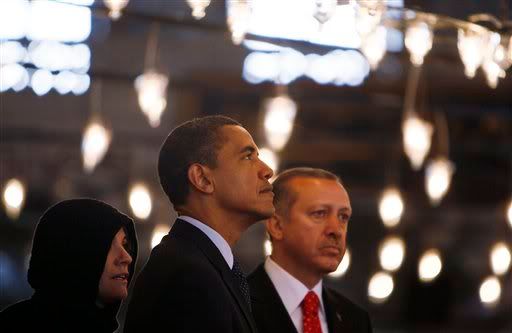
President Obama’s support remains high and his performance on the international stage is cementing his image as a statesman. I was enormously proud of my President yesterday when he spoke before the Turkish parliament and said,
“America’s relationship with the Muslim community, the Muslim World, cannot and will not just be based upon opposition to terrorism. We seek broader engagement based upon mutual interest and mutual respect.”
After eight years of George W. Bush’s insipid indecency combined with the sophomoric Republican opposition, Obama’s stature is on steroids. I disagree strongly with his endorsement of the Larry Summers/Timothy Geithner approach to the banking crisis and also believe his foreign policy is overly hawkish. Yet I remain an enthusiastic supporter of Obama’s otherwise liberal initiatives as outlined in his budget proposal that the Blue Dog status quo forces are carving up. Obama is also the first President in my lifetime that I genuinely like from either party. The country and the world need Obama’s presidency to be successful.

Alas, I can’t help but worry. First and foremost is that pesky thing called reality If America has learned anything from the George W. Bush era is that we ignore reality at our peril. Eventually, it catches up and closes in. Obama’s fraudulent handling of the banking crisis (see my “Placebo Economics” post) is a ticking time bomb. I hope the plutocratic dynamic duo of Larry Summers and Timothy Geithner knows what they’re doing. I suspect however, that their criminal complicity with the A.I.G. bailouts and fetish like devotion to hyper-sized financial institutions will doom Obama’s otherwise good intentions.

My other concern is that predatory conservatives and Blue Dog Democrats like Evan Bayh regard Obama’s support the same way British Tories perceived Harry Perkins popularity. They never believed Perkins to be legitimate and determined he should not be allowed to become a statesman. Perkins lost his day of reckoning. Obama’s day of reckoning with those forces opposed to his good intentions is fast approaching. I hope to hell he wins.

Saturday, April 04, 2009

Placebo Economics

How many of you read the financial investor’s blog Seeking Alpha? Well, their March 30th post entitled “Exclusive: Big Banks' Recent Profitability Due to AIG Scam?,” is a must read that ought to embarrass the hell out Senate banking chairman Chris Dodd and his House counterpart, Barney Frank.

Here is how Seeking Alpha summarized what they learned from an anonymous inside trader they call "Lou" in laymen terms:
“AIG, knowing it would need to ask for much more capital from the Treasury imminently, decided to throw in the towel, and gifted major bank counter-parties with trades which were egregiously profitable to the banks, and even more egregiously money losing to the U.S. taxpayers, who had to dump more and more cash into AIG, without having the U.S. Treasury Secretary Tim Geithner disclose the real extent of this - for lack of a better word - fraudulent scam.

In simple terms, think of it as an auto dealer which knows that U.S. taxpayers will provide an infinite amount of money to fund its ongoing sales of horrendous vehicles (think Pontiac Azteks): the company decides to sell all the cars currently in contract, to lessors at far below the amortized market value, thereby generating huge profits for these lessors, as these turn around and sell the cars at a major profit, funded exclusively by U.S. taxpayers (readers should feel free to provide more gripping allegories).

What this all means is that the statements by major banks, i.e. JP Morgan Chase (JPM), Citi (C), and BofA (BAC), regarding abnormal profitability in January and February were true, however these profits were a) one-time in nature due to wholesale unwinds of AIG portfolios, b) entirely at the expense of AIG, and thus taxpayers, c) executed with Tim Geithner's (and thus the administration's) full knowledge and intent, d) were basically a transfer of money from taxpayers to banks (in yet another form) using AIG as an intermediary.”
Is any of this true? If so, the implications are frightening and suggest economist and New York Times columnist Paul Krugman is correct in warning that banks are insolvent and the administration’s plan to stabilize financial institutions nothing but smoke and mirrors. For damn sure I find this report far more believable than the recent stock market bump reflecting the profit statements of these fraudulent institutions.

Congress has a duty to provide vigorous oversight on the public’s behalf. Specifically, Senator Chris Dodd and Representative Barney Frank need to utilize their subpoena power as well as demand that Treasury Secretary Tim Geithner come clean with what he knew and when he knew it. If their investigation proves that Geithner knowingly endorsed the scheme then at minimum he needs to be replaced immediately. If President Obama refuses to fire him than Eric Holder’s Justice Department should read Geithner his rights.

Click here to contact Senator Dodd’s office and here for Representative Barney Frank’s and demand that they do their jobs. Lax oversight of the executive branch was supposed to end in 2006.

Placebo economics will not rescue either America or the world from this depression. Accounting gimmicks will not sugarcoat the dislocation, pain and yes poverty people worldwide are experiencing because of the reckless conduct of financial institutions allowed to run amok. It is incumbent upon our leaders that today’s pain results in a better socio-economic paradigm tomorrow. Enabling banks to inflate their quarterly statements for a good day on the stock exchange is precisely how we got into this mess in the first place.

Yet again I insist that hyper-sized financial institutions be nationalized or as William Black suggests, put into a receivership as the law mandated following the 1980s Savings & Loans crisis. That should be followed by comprehensive anti-trust legislation that permanently ends the chokehold these large institutions have on our economy. And we as citizens need to think globally by banking locally.

I support the administration’s bold initiatives with respect to their budget and am more than willing to help them as an activist take on Blue Dog Democrats such as Senator Evan Bayh, who double cross their constituents for campaign contributions under the false guise of “fiscal responsibility.” Also, I believe, Obama has the makings of a magnificent international statesman.

But the administration’s approach to the banking crisis is inadequate at best and perhaps criminal at worst. Unless Obama takes charge and gets realistic about the banking crisis, none of the good intentions outlined in his budget proposal will come to fruition.

Secretary Geithner's approach is a metastasizing cancer on the administration. And certainly not change I can believe in.

Obama Abroad


My own view of President Obama's diplomatic performance this week is that he excelled as a statesman and represented America with a humble and honorable face. That is no small thing following President Bush who effectively alienated human civilization. Obama continues to dwarf political adversaries at home while slowly restoring America's reputation abroad. Most Europeans I believe prefer a cooperative relationship with America absent the rancor of recent years. President Obama's presence on the global scene is making it less fashionable for Europeans and hopefully other nations to scapegoat America for all that plagues the world. Realistically, Obama did as well as possible.

Unfortunately, that is not good enough. Although not entirely Obama's fault, as well as possible but not good enough is the reality of the moment. Hopefully, that will not prove to be the epitaph of his presidency.

The Europeans with their established social safety net are less inclined to add more stimulus spending. Both the administration and Europeans agree robust regulation is necessary but neither side of the Atlantic is ready to diminish the power of hyper-sized financial institutions and empower local banks instead. Unless both sides of the Atlantic eventually agree to completely restructure the global financial system, this week's "progress" with respect to the International Monetary Fund and agreeing in principle to increase banking regulation will be insufficient.

Also, there is that bleeding sore called Afghanistan and the increasing possibility Pakistan may become a failed nuclear state unable to control its borders or prevent any collusion among their military and intelligence services with terrorists. Click here to review a gruesome video of the Taliban recently beating a teenage girl in public in Pakistan's Swat Valley. As President Obama himself noted, his merely succeeding George W. Bush has not made this sort of barbarism disappear.

Neither the Obama administration nor the Europeans are joined at the hip with a common strategy to address the al Quaida/Taliban threat in Afghanistan or Pakistan. All the diplomatic symbolism aside, Obama owns the Afghanistan quagmire and is treating Pakistan like a corporation that is too big to fail.

One can understand the Europeans reluctance to add more of their own blood and treasure to Afghanistan. Trying to disable and destroy al Quaida and the Taliban has been a treadmill resulting in massive civilian casualties without progress. It's curious that the American political left isn't as mobolized against the Afghanistan conflict as it is with Iraq.

Personally, I believe our surge in Afghanistan is strategically misguided. Even so I hope it succeeds for young women like the one shown in the video. But unless the administration's diplomatic initiatives with Iran bear fruit and the Europeans are persuaded to do more, this week's pomp and circumstance will merely be another chapter in America's senseless global war on terror.

Tuesday, March 31, 2009

Tuesday Morning Ponderings

  • Understandably, many on the left have questioned why GM’s Rich Wagoner was tossed underneath the bus while financial sector executives are permitted to carry on. Yet I wonder if the Obama administration has instead achieved the equivalent of Godfather like leverage with recipients of TARP money: they know he’s making them an offer that can’t be refused. I hope so because up until now the financial sector has been like bank robbers threatening to drop more bags of nitroglycerin on the economy.
  • I remain convinced that among the reforms needed is comprehensive anti-trust legislation to break up mega-sized financial institutions and empower local community banks. Is it too much to hope that congressional conservatives and liberals opposed to the TARP money will eventually collaborate on such reforms? There is a crying need for it and the country would likely support it.
  • Today’s G-20 summit (which is really about thirty nations) is perhaps the most important international gathering since FDR, Churchill and Stalin met at Yalta in February 1945. Six decades ago the post-war world was being shaped with America as the preeminent power in an emerging cold war competition. Today’s geopolitics is multi-polar and President Obama must navigate in an arena in which America’s leverage and credibility are severely diminished. Nonetheless, the global economy as well as challenges such as global warming and terrorism can’t be effectively addressed without American cooperation. My hunch is that President Obama will excel in this arena requiring high caliber statesmanship.
  • Is today’s special election in New York State’s congressional 20th district a bellwether? Typically, voters in the New York 20th are Republicans. Nonetheless, Democrat Kirsten Gillibrand prevailed in 2006 and her appointment as Hillary Clinton’s replacement has resulted in today’s spirited contest between Democrat Scott Murphy and Republican State Assembly leader Jim Tedisco. The Obama administration has enlarged the importance of the race by putting its political muscle behind Murphy. If Murphy loses Republicans will claim the country is turning against the administration’s ambitious agenda. If Murphy prevails, Democrats will hopefully be emboldened to push ahead on progressive initiatives such as health care. Turn out in special elections are always mysterious so this race is hard to predict.
  • New York State Governor David Paterson and Senate Majority Leader Malcolm Smith are so hapless, that Sheldon Silver has emerged as Albany’s dominant power center. Silver, the longtime Assembly leader and adversary of transparent open government has easily rolled both Paterson and the novice Smith in budget negotiations. Appropriately, today’s New York Times has an article entitled, “Albany’s Big 3 Is Cut to One.” As I and many reform minded New Yorkers feared, the window of opportunity to reform Albany’s government ended with Spitzer’s resignation last year. What a shame.