As regular readers of this blog have noted to me via email, I have posted infrequently in recent weeks. Although I’ve conducted podcast interviews with interesting subjects and have more scheduled over the summer, personal matters have required my attention. Hence, I haven’t been able to comment on recent events. Some of you have emailed asking if I’m doing OK. Rest assured, I am fine and this has only been a temporary respite from blogging. Like many of you, I have been following current events both nationally and internationally as well as locally in my home state. A few observations and thoughts below:
Curiously, the lack of coherent conservative political opposition is undermining the progressive cause and reinforcing the Washington/Wall Street axis. President Obama and much of the Democratic Party appears content to remain risk averse, hoard political capital as “Blue Dog” Democrats such as Evan Bayh and Max Caucus continue to be whores for the private insurance industry and the moneyed interests. With the Republican Party in disarray, the Obama administration has no incentive to go beyond the political fifty-yard line and transform America from a corporate national security state to a society that facilitates broad based prosperity for real entrepreneurs and wage earners. Meanwhile, the corporate press falsely portrays the national debate as between the “liberal” Obama administration and “mainstream” critics. Sadly, and it pains me to write this, enablers of America’s modern gilded age have merely hit the “reset button” with the Obama administration. I like Al Franken and I’m happy he will finally take his rightful place as Minnesota’s junior senator. But that magical sixtieth vote will not transform the landscape all that much. As Illinois Senator Dick Durbin candidly put it earlier this year, the banks “frankly own the place.”
In my opinion, Bernie Madoff is a scapegoat for the crimes on Wall Street. Madoff will spend the rest of his days in prison and deservedly so. I have no sympathy for him. However, the looters at Goldman Sachs, Citicorp and A.I.G. are just as guilty if not more so than Madoff. Yet they’re benefiting from billions of dollars subsidized by taxpayers as state and municipal governments barely hang on. It seems to me that Madoff as the public face of Wall Street’s crimes is enabling plutocrats in Washington and the financial services industry to avoid accountability and needed restructuring of our economy. Two decades ago, Michael Milken became the public face of Wall Street’s excess and nothing changed. If Treasury Secretary Tim Geithner and the administration’s senior economic advisor, Timothy Geithner have their way, the Wall Street/Washington axis will continue to conduct business as usual. Their so-called “reforms” are cosmetic only and will not facilitate the systemic change our economy so desperately needs.
Enablers of the Washington/Wall Street axis are the cozy relationship between “journalists” and the lobbyists of corporate America. The recent news about the Washington Post selling access to corporate lobbyists simply reinforces what the American people have sensed in their guts for a long time: the “truth” is purchased, packaged and sold. Americans across the political spectrum know this intuitively and that as much as anything explains the decline of traditional media in the Internet age. To some degree this is regrettable because nobody exposed local corruption better than those old time city newspapers with reporters mining sources among the worker bees at city hall. Also, the Internet and blogs are hardly a panacea of journalism. Regardless, the Washington/Wall Street access can only be broken from outside and that means we the people have to become our own journalists.
It seems that the real conflict in Iran is between their security forces and factions among the clerics. The valiant protesters are really pawns for the real power struggle-taking place. Even so, hopefully the people who bravely stood up and risked their lives represent a window into the future. Presently though, Iran appears poised to become more of a traditional military dictatorship and less of a theocracy. How events in Iran will transform the Middle East is hard to say but there does appear to be a thaw in American/Syrian relations. The State Department has hoped to exploit potential rifts between Iran and Syria for years even as the Bush administration behaved like a bull in a China shop and the fallout from Iran's presidential election has given the West at least a modest diplomatic opening.
I’m gratified American troops are finally withdrawing from Iraq and that Vice President Biden has advised the Iraqis we won’t be expending more blood and treasure to police sectarian violence. Sadly, those resources will likely be redeployed in the Afghanistan/Pakistan theater. Unless vigorous diplomacy with NATO powers or the upcoming summit in Russia can facilitate greater logistical support, an overextended American military is more vulnerable than ever to the burdens of empire maintenance in the name of national defense.
I can’t begin to articulate my disgust over events in Albany with the state senate. Much of my activism last year was dedicated to enabling Democrats to finally take the majority. Painfully, their political incompetence as well as Governor David Paterson’s feckless leadership has effectively ended those reformist aspirations from 2006 when Eliot Spitzer was elected New York’s chief executive. With respect to who controls the state senate there is the 2010 census at stake and that means repercussions for the House of Representatives as well the power dynamic in Albany. For the people of this state it’s not just about reform or which party controls Albany. It’s being able to earn a living wage, afford healthcare, have access to affordable housing and good public schools. Unfortunately, New York's political leadership has shown that the Big Apple is a Banana Republic. Hopefully, the chaos between Democrats and Republicans will strengthen the leverage of New York’s Workers Family Party as they represent the interests of New York’s struggling wage earners. Now more than ever Democrats need the support of the WFP and they have much work to do to earn it. As for Eliot Spitzer, tempermentally flawed as he is, I would gladly take him back and would even be willing to pay an "escort tax" to make it happen!
I am preparing for a podcast interview tomorrow afternoon and family obligations during Passover prevented me from posting more frequently this week.
In the meantime though, President Obama's weekly address is an opportunity to note that at least rhetorically, he's attempting to condition the American people for today’s new world order. Yet at the same time, Obama is also trying to be reassuring with religious references to Passover and Easter as well as reiterating that American "leadership" is the key to meeting today's global challenges.
It's a tough balancing act as most Americans grew up in a world in which we were respected and feared and enjoyed enduring prosperity. After World War Two, the global financial system that emerged known as Bretton Woods, was exceptionally favorable to the United States. Furthermore, America was the number one super power in a bipolar world. For damn sure nobody used the term "existential threat" with respect to nation states such as Iran.
Today however, both China and India are emerging superpowers, Russia has become a petro state on steroids, globalization is depressing American wages, Pakistan and its nuclear arsenal is on the verge of becoming a failed state, addressing global warming requires difficult consensus and stateless terrorist actors are consumers in the nuclear proliferation market. Even worse, greed and insipid American leadership ruined the same financial system we created and we find ourselves at the mercy of other countries forbearance as a result.
Hence, while America remains powerful, we must pivot from an empire culture to a more cooperative posture. Yet simultaneously, America must remain vigilant in a dangerous world in which conflict and brutality remain humanity's default state in too many places. So, President Obama preaches cooperation and diplomacy while requesting congress appropriate $83 billion for war.
People like me are pushing Obama to pivot from empire to cooperation more aggressively. Personally, while I acknowledge the world is certainly dangerous, I believe Obama's foreign policy is still too unilateral. Politically however, I suspect Obama is straddling the same fence most Americans are sitting on: many feel isolated after George W. Bush, ashamed at the immorality of our foreign policy transgressions, but also don’t want to relinquish our status as a superpower and leader.
Today’s weekly address illustrates the challenge confronting Obama as he gently nudges Americans to leave the perks of an empire behind while retaining his political viability. I wish him well in that endeavor but believe he will eventually have to cook up a new omelet by breaking a few eggs. A slow pivot may not be fast enough.
Building consensus within America’s body politic and national security establishment for a new way forward with Muslims worldwide is a formidable challenge. Many Americans still don’t appreciate the complex nuances of Muslim society and remain stubbornly Islamophobic almost seven and half years after 9/11. Equally formidable is earning the goodwill of Muslims worldwide following the Iraq War as well as American atrocities perpetrated upon Islamic detainees at Guantanamo Bay and Abu Ghraib. Hopefully, President Obama’s historic election has finally opened a path for constructive conversation about how America can most effectively engage the Muslim world.
The CIA’s former point man on Islam, Emile Nakahleh, has vigorously entered this conversation with his new book, A Necessary Engagement: Reinventing America’s Relations With the Muslim World (Princeton University Press). From 1991 to 2006, Nakahleh served as the director of the Political Islam Strategic Analysis Program in the Directorate of Intelligence at the CIA. He holds a PhD in international relations and is a member of the Council on Foreign Relations.
Nakhleh’s book combines a revealing memoir with in-depth analysis and proposals for the future. Ever since his retirement from the CIA in 2006, Nakhleh has been a vociferous critic of the Bush Administration’s legacy with respect to American-Muslim relations. Indeed, in September 2006, Nakhleh told Harper’s Magazine that because of Bush’s policies,
“We've lost a generation of goodwill in the Muslim world.”
Nakhleh's proposals for improving American-Muslim relations stems from his conversations with Muslim "interlocutors" spanning three decades. These conversations include government ministers, Islamic activists, academics and radicals. Nakhleh also examined and analyzed considerable polling data of Muslims worldwide.
Overall, Nakhleh contends that the vast majority of Muslims and America have common interests and values. His blueprint includes robust dialogue with mainstream Islamic political parties as well as a tangible commitment towards democracy in the Muslim world, even if we don’t always like the short-term electoral results. His book is an accessible 160 pages and divided into four chapters: (Chapter 1) Political Islam and Islamization, (Chapter 2) Intelligence, Political Islam, and Policymakers, (Chapter 3) Public Diplomacy: Issues and Attitudes and (Chapter 4) Public Diplomacy: A Blueprint.
Nakhleh was born in Galilee, north of Nazareth in Palestine and raised a Greek Catholic. He emigrated from Israel to the United States approximately 50 years ago and attended a Benedictine university in Minnesota for his B.A., a Jesuit university in Washington, D.C., for an M.A. and was awarded a Ph.D. from the American University in Washington, D.C. Prior to joining the CIA he taught at a catholic college in Maryland for 26 years.
Nakhleh agreed to a telephone interview with me in podcast format. Among the topics we discussed was whether he believes the surge in Iraq worked, the proxy war between Saudi Arabia and Iran inside Iraq, President Obama’s new strategy in Afghanistan, Hamas and America’s role in resolving the Israeli-Palestinian conflict and his argument that American commitment to democracy in the Muslim world is imperative to our long term interests.
Some of Nakhleh’s answers and views may surprise many listeners. Our conversation was just over 47 minutes. Please refer to the flash media player below.
Either searching for the “Intrepid Liberal Journal” or “Robert Ellman” can also access this interview at no cost via the Itunes Store.
Update: I erred in the introduction in the podcast when I said Emile Nakhleh worked for the CIA between 1991-1996. I meant to say he worked with the CIA between 1991-2006. Also, my apologies for the echo sound on Emile's side. Sometimes technology has its limits.
I've always had mixed feelings about Delaware Senator Joe Biden. On domestic issues his support of the bankruptcy bill undermined both wage earners and small business entrepreneurs. However, his home state relies on the financial services industry for jobs so I understood.
In October 2002, Biden showed poor judgment in supporting the resolution to go to war against Iraq. Overall though he's been an articulate voice on foreign policy. I thought his presidential campaign was an honorable attempt at substance over show biz and deserved more attention from the media.
Today, Biden effectively responded to President Bush's disgraceful fear mongering before the Israeli Knesset. Bush was specifically targeting American Jewish voters on behalf of McCain. Jewish voters typically vote for Democrats about seventy percent of the time. Obama has a perceived weakness among that constituency. As an American Jew I was offended by Bush's pandering through fear mongering and appreciate Biden's forceful response.
Iran is a complex and layered society. To learn more about the Iranian people and their system of government, click here to listen to an interview I conducted with Mideast expert Barbara Slavin last year. Slavin's informative book, Bitter Friends, Bosom Enemies: Iran, the U.S., and the Twisted Path to Confrontation had just been published when the interview took place.
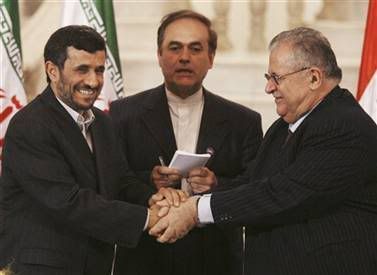
A picture is worth a thousand words. This is Iranian President Mahmoud Ahmadinejad and his Iraqi counterpart Jalal Talabani together in Baghdad, today. Americans are fighting, suffering post traumatic stress disorder, permanent injuries, dying and killing innocent civilians to help establish an Islamic Shiite fundamentalist axis in the Gulf. Likely Republican nominee John McCain promises more of the same. Hillary Clinton enabled President Bush and John McCain to pursue this strategic calamity out of sheer political expediency. Yet Clinton has the temerity to suggest she has superior credentials to be commander and chief? Both Clinton and McCain represent more of the same. It's time for a change. Enough said.
Barbara Slavin, a guest writer here at the Intrepid Liberal Journal, just published an important article in the National Interest entitled "Inside Track: Off the Warpath?" Both the National Interest and Barbara Slavin have graciously granted their permission for her article to be posted here.
Barbara Slavin is a senior diplomatic reporter for USA Today on leave as a Jennings Randolph fellow at the U.S. Institute of Peace and the author of Bitter Friends, Bosom Enemies: Iran, the U.S. and the Twisted Path to Confrontation. I interviewed Barbara Slavin about her book and U.S./Iranian relations on October 21st. You can listen to that interview by clicking here.
The smiles on the faces of several U.S. military personnel at a previously scheduled Washington think tank session on Iran’s “bomb” said it all Tuesday: The United States is not going to start a third Middle East war anytime soon.
Monday’s new National Intelligence Estimate (NIE) stating “with high confidence that in fall 2003, Tehran halted its nuclear weapons program” dropped the big one on those in Washington and elsewhere who have been urging the Bush Administration to strike Iran “before it is too late.”
Despite President Bush’s efforts at his press conference to act as though nothing has changed, everything has. Chuck Frelich, a former Israeli deputy national security adviser, called the news “an earthquake” that “gives us more time to explore the diplomatic route.” The Nixon Center’s Geoffrey Kemp, appearing on the same panel at The Washington Institute for Near East Policy, agreed. The NIE “changes the political dynamics in this town”, he said. “The out of the blue pre-emptive strike . . . is a long way off.”
There are still many questions about the new estimate and its origins. The intelligence community, in its eagerness not to promise another “slam dunk”, may have erred on the side of caution. Iran has accelerated its overt enrichment program since 2005 and could produce enough fissile material for a bomb in as little as two years, more plausibly by 2015, the estimate said.
But a key conclusion of the NIE is that a negotiated solution is possible. Iran, it turns out, is not a nation of mad mullahs but a country whose “decisions are guided by a cost-benefit approach.” Its leaders are susceptible to pressure and worried about Iran’s international posture. Iran shut down the weapons program in 2003 because it had been caught cheating and in a post-9/11 environment, was worried about the consequences. At the same time it started negotiations with Great Britain, France and Germany—negotiations that it thought would be quickly joined by the United States.
That did not happen. President Bush, at his news conference, misspoke when he said that the United States “facilitated” the European talks with Iran in 2003. In fact, then–under secretary of state John Bolton did nothing to help. He actively tried to sabotage the talks with leaks about threatening Iranian remarks to the Europeans. Bush also misspoke when he said that “at that point in time” (2003) his administration said it would stop blocking Iran’s application to join the World Trade Organization and provide spare parts for civilian airliners if Iran halted its program. Those carrots were not put on the table until 2005, shortly before Iranian presidential elections replaced Mohammad Khatami with the more belligerent Mahmoud Ahmadinejad. The United States did not offer to actually join the negotiations until May 2006—and only then if Iran suspended its uranium program.
Will Bush now pursue a diplomatic option more strenuously? New sanctions will be harder to achieve but it will be easier to justify talks with Tehran. At the very least, Bush will not bomb Iran before he leaves office. And that is something for which everyone around the world—not just the overstretched U.S. military—should be grateful.
Editor's Note: This is Barbara Slavin'sfirst post with the Intrepid Liberal Journal. She is a senior fellow at the U.S. Institute of Peace and author of "Bitter Friends, Bosom Enemies: Iran, the U.S. and the Twisted Path to Confrontation." Barbara has also covered the Middle East for over twenty-years as a reporter, most recently as a senior diplomatic corresspondent with USA Today. I'm most gratified at Barbara's willingness to share her unique perspective. The views expressed here are her own.
Bush administration officials often say they don't understand the Iranian government. They have proven this time and time again by undermining those mostly likely to negotiate crucial differences with the United States. Now the administration appears to have lost yet another opportunity to slow Iran's march to nuclear power and its efforts to play the spoiler in the Middle East.
The loss this time involves Ali Larijani, a red-bearded intellectual who styles himself Iran's Henry Kissinger. A conservative who ran for president and lost to Mahmoud Ahmadinejad in 2005, Larijani got the consolation prize of chief nuclear negotiator and secretary of Iran's national security council. This weekend, Larijani resigned from the negotiator post. His replacement: an obscure deputy foreign minister, Saeed Jalili, who is said to be an ally of Ahmadinejad.
Despite a reputation as a hardliner, Larijani began reaching out to the United States soon after Iranian elections in 2005. In an interview he gave me in Tehran in February 2006, Larijani praised his U.S. counterpart, Stephen Hadley, as a "logical thinker" and said "there is no limitation on our side" to negotiations with the United States.
Larijani authorized a deputy, Mohammad Javad Jaffari, to ask for backchannel talks with Hadley or a designated emissary. When the White House did not respond, Larijani publicly on March 16, 2006, accepted a prior U.S. offer for talks limited to the situation in Iraq. A week later, supreme leader Ayatollah Ali Khamenei endorsed the proposal -- a dramatic step for someone who had up until then threatened those who publicly advocated talks with the United States as traitors. An Iranian website close to the conservative leadership, Baztab, announced that the Iranians had put together a high-level delegation and that talks would begin in Baghdad on April 9. But the Bush administration got cold feet. Its refusal to meet undermined Larijani within the Iranian power structure and humiliated Khamenei. The chief beneficiary was Ahmadinejad.
The United States finally agreed to enter nuclear negotiations at the end of May 2006 but only if Iran would suspend its efforts to enrich uranium and as part of talks including Britain, Germany, France and the European Union. (Larijani did take part in a half dozen subsequent meetings with EU foreign policy chief Javier Solana but without success.) Direct U.S.-Iran talks about Iraq did not take place until May of this year. Delay on both fronts has been costly: Despite a U.S.-driven campaign of pressure and sanctions, Iran-backed attacks on U.S. forces in Iraq have escalated and Iran is much closer to the ability to make nuclear bombs. President Bush said last week an Iran with nuclear weapons would usher in "World War III."
A U.S. decision to talk to Iran unconditionally in 2006 might not have stemmed this escalation. But it is impossible to know -- just as it is impossible to say what would have happened had the Bush administration not put Iran on an "axis of evil" in 2002 or accepted an offer for comprehensive negotiations with the government of Ahmadinejad's predecessor, Mohammad Khatami, in May 2003.
Administration officials argue that U.N. and other sanctions are exacerbating divisions within the Iranian regime and that Iran will eventually knuckle under to pressure. Divisions certainly are increasing in Tehran but the "reasonable people," as Secretary of State Condoleezza Rice likes to call them, are still not getting their way. The victors so far are those like Ahmadinejad who argue that the best way to earn U.S. respect and recognition is to confront Americans in Iraq and elsewhere and gain the capacity to build nuclear bombs as soon as possible.
Barbara Slavin, senior diplomatic correspondent for USA Today since 1996 and author of the recently published book, Bitter Friends, Bosom Enemies: Iran, the U.S., and the Twisted Path to Confrontation (St. Martin’s Press), writes that,
“Iran and the United States are like a once happily married couple that has gone through a bitter divorce. Harsh words have been exchanged – husband and wife have come to blows and employed others to inflict more punishment. Apologizing is hard and changing behavior even harder. This relationship is unequal, with one side or the other feeling more vulnerable at any given time and afraid the other will take advantage of concessions.”
Currently, the public faces of both nations, presidents George W. Bush and Mahmoud Ahmadinejad, have been content to throw rhetorical bombs and raise the diplomatic temperature – increasing the likelihood of war. Indeed, at times it appears that conservative hardliners in both countries are eager for conflict as a means to maintain their respective grips on power.
The journey from the CIA backed coup that overthrew Iran’s democratically elected leader Mossadeq in 1953 and replaced him with the Shah, to the Islamic Revolution of 1979 and current tensions is replete with ill conceived schemes that damaged both nations. Slavin, using her extensive contacts among the powerful inside Iran and the United States, documents missed opportunities for reconciliation between both countries during the administrations of the first President Bush as well as Bill Clinton and George W. Bush.
The combination of her remarkable access to people such as Madeline Albright, Condelezza Rice, Iranian reformers like former President Mohammad Khatami, longtime establishment figures such as Ali Rafsanjani, as well as dissidents like Akbar Ganji and everyday citizens, allows Slavin to shed sunlight on a nation most Americans know very little about. She is also the first newspaper reporter from the United States to interview Iranian President Ahmadinejad.
Slavin has accompanied three secretaries of State on their official travels and reported from Iran, Libya, Israel, Egypt, North Korea, Russia, China, Saudi Arabia and Syria. She is also a regular commentator for U.S. foreign policy on National Public Radio, the Public Broadcasting System's Washington Week In Review and C-Span. This month, she joined the U.S. Institute of Peace as a Jennings Randolph fellow, to continue her research on Iran. Slavin also serves as a member of the Council on Foreign Relations.
Prior to joining USA Today, Slavin was a Washington-based writer for The Economistand the Los Angeles Times, covering domestic and foreign policy issues, including the 1991-93 Middle East peace talks in Washington. From 1985-89, she was The Economist's correspondent in Cairo. During her career, Slavin has traveled widely in the Middle East, covering the Iran-Iraq war, the 1986 U.S. bombing of Libya, the political evolution of the Palestine Liberation Organization and the resurgence of Islamic fundamentalism. Earlier in the 1980s, Slavin also served as The Economist's correspondent in Beijing and reported from Japan and South Korea.
Prior to moving abroad, she worked as a writer and editor for The New York Times Week in Review section and a reporter and editor for United Press International in New York City.
Slavin agreed to a podcast interview with me about her book, Iran and their turbulent relationship with the United States. Please refer to the media player below. Our conversation is just under thirty minutes. This interview can also be accessed via the Itunes Store by searching for “Intrepid Liberal Journal.”
Trying to make sense of tribal politics in the Middle East can’t be done with simple bumper sticker slogans. The history, entangling relationships, religious dimension, shifting alliances, geography and multiple cultures are a Byzantine maze of complexity. Specifically, the Muslim world is often regarded by people in the west, especially Americans, as a large bowl of alphabet soup. As a result, policy makers who look for quick and easy fixes by force in the region overreach and miscalculate.
One tragic example of miscalculation and overreach is Lebanon. Once regarded as the “jewel” of the Middle East, Lebanon endured a brutal civil from 1975 to 1990. Surrounded by the Mediterranean Sea, Syria and Israel, this small country the size of Connecticut has flummoxed leaders in Jerusalem and Washington for two decades.
In 1982, Israel attempted to drive out the PLO from Lebanon and establish a government friendly to their interests. At the time, Yassir Arafat’s PLO had established a “state within a state” in southern Lebanon and exploited the territory as base of operations against Israel. President Ronald Reagan deployed the U.S. Marines to provide “stability” as part of a Multinational Force. A suicide bomber killed 220 marines in October 1983 and they were “redeployed’ in early 1984. Meanwhile, Israel’s occupation of Lebanon resembled America’s failure in Vietnam as well as the Soviet Union’s experience in Afghanistan and they finally withdrew in the spring of 2000.
Prior to Lebanon’s civil war ending in 1990 the country was a magnet for terrorism and kidnappings by militant Islamic groups coordinating with Iran. These activities helped contribute to the Iran-Contra scandal that plagued the final years of the Reagan Administration. Since then Lebanon has been a hotbed for proxy fights and political intrigue among Syria, Iran, Israel and the United States.
In the early eighties, a resistance movement of Shiite Muslims called Hezbollah, meaning “Party of God” was formed. With the backing of Iran as well as Syria in later years, Hezbollah helped make the price of Israel’s occupation of southern Lebanon too costly and forced their withdrawal seven years ago.
Last summer, Hezbollah infiltrated Israeli territory and kidnapped two of their soldiers - provoking a brutal war resulting in heavy civilian casualties. The kidnapping was an escalation of the tit for tat engagement that had been taking place between Israel and Hezbollah since Israel’s withdraw from southern Lebanon in 2000 otherwise known as "the rules of the game." Israel however opted to use the kidnapping as a pre-text to wipe out Hezbollah and in the process deliver a strategic blow to Iran. Afterwards, Hezbollah’s prestige was enhanced from going toe to toe with Israel.
Yet most policy makers in the United States and Israel simply regard Hezbollah as a terrorist entity and nothing more. However, Augustus Richard Norton writes in his new book, Hezbollah: A Short History (Princeton University Press) that Hezbollah is a sophisticated organization combining the functions of a militia, a social services and public works provider and a political party. He postulates that as Hezbollah’s war with Israel last summer illustrates, they’re far too entrenched in Lebanese society to disappear through the use of force.
Norton, is a Boston University professor of international relations and anthropology, as well as a member of the Council on Foreign Relations. An expert on Shiite political movements, including Hezbollah, Norton was also a military observer for the United Nations in southern Lebanon when Hezbollah and rival Shiite parties were forming there in the early 1980s. A former U.S. Army officer and West Point professor, Norton has conducted research in Lebanon for nearly thirty years. His previous book, Amal and the Shi'a: Struggle for the Soul of Lebanon is widely considered to be a classic account of the political mobilization of Lebanon’s Shiite Muslims.
Lee Hamilton, Vice Chair of the 9/11 Commission and Co-Chair of the Iraq Study Group said,
“Hezbollah is a timely and landmark work. Richard Norton draws on his extensive expertise to offer a comprehensive history that will be of interest to anyone who seeks a better understanding of Hezbollah, Lebanon, or current developments in the Middle East.”
Norton agreed to a podcast interview with me about his book, Lebanon and Hezbollah. Among the topics covered during our conversation was Lebanon’s civil war, Israel’s invasion of Lebanon in 1982, Hezbollah’s origins, their relationship with Syria and Iran, the aftermath of the 2006 war with Israel, how the Hamas takeover of Gaza will impact Hezbollah and Lebanon and the current situation with the militant group Fatah al Islam. Please refer to the media player below.
This interview can also be accessed via the Itunes store by searching for Intrepid Liberal Journal.
Foreign Affairs published a sobering article by Bruce Riedel in their May/June issue entitled, “al Qaeda Strikes Back.” Riedel, a Senior Fellow at the Saban Center for Middle East Policy at the Brookings Institution retired last year after 29 years with the CIA.
Essentially, Riedel outlines al Qaeda’s resurgence while the Bush Administration has undermined our geopolitical position with their foolish war in Iraq. Hardly a dove, Riedel believes it is essential to our national security for al Qaeda to be “decapitated.” I agree with him. al Qaeda is a clear and present danger as a manifestation of radical Islam.
Among the failings of the Bush Administration is how their incessant fear mongering has jaded Americans about the very real dangers of terrorism that still exist. What’s required is tough minded, realistic leadership that neither exaggerates dangers for political gain nor ignores threats as President Bush did in August 2001. The last thing this country should do is hand our enemies what they want: war with Iran. Riedel issues the following warning:
“The biggest danger is that al Qaeda will deliberately provoke a war with a ‘false-flag’ operation, say, a terrorist attack carried out in a way that would make it appear as though it were Iran's doing. The United States should be extremely wary of such deception. In the event of an attack, accurately assigning blame will require very careful intelligence work. It may require months, or even years, of patient investigating to identify the plotters behind well-planned and well-executed operations, as it did for the 1988 bombing of Pan Am flight 103 over Lockerbie, Scotland, and the 1996 attacks on the U.S. barracks at the Khobar Towers in Saudi Arabia. Presidents George H. W. Bush and Bill Clinton were wise to be patient in both those cases; Washington would be well advised to do the same in the event of a similar attack in the future. In the meantime, it should, of course, continue do its utmost to prevent Iran from acquiring nuclear weapons and from fomenting violence and terrorism in the Middle East by using tough diplomacy and targeted sanctions. And it should not consider a military operation against Iran, as doing so would only strengthen al Qaeda's hand -- much as the U.S. invasion and occupation of Iraq have.”
I have a different take on Riedel’s warning. To be blunt, the Bush Administration will not be “deceived” by a “false flag” from al Qaeda. Rather, Bush and Cheney are hoping for a pretext to avoid a humiliating withdrawal from Iraq. With Republicans ready to jettison the Bush Administration’s Iraq policy in September, a war with Iran would be quite timely and convenient.
Another false flag may be weapons smuggling into Iraq through Iran by operatives sympathetic to al Qaeda. Either way it is important to remember the antipathy that exists between Iran and al Qaeda. Iran has sponsored al Qaeda’s rival Hezbollah in Lebanon. After 9/11, Iran cooperated with Washington against al Qaeda and the Taliban in Afghanistan out of their strategic self-interest. They view al Qaeda as a threat to their hegemony as well as potential catalysts to instability on their borders.
Tragically, the world is at the mercy of an unholy triangle as the motivations of Iran’s President, Mahmoud Ahmadinejad, the Bush Administration and al Qaeda are converging. Ahmandinejad is besieged with problems. He’s terrified of dissent as domestic dissatisfaction with his regime intensifies. A war with the “Great Satan” would be a welcome distraction, as Iranians will surely rally to him if attacked.
al Qaeda of course thrives on instability, chaos and any act that reinforces America’s image as an imperialist at war with the Islamic people. They’re laying in the high weeds to capitalize on instability in Gaza and Lebanon as well as exploit vulnerabilities in Afghanistan.
Meanwhile, the Bush Administration is sucking wind and hemorrhaging support. The Republican Party is poised to pull the plug on Iraq in September. Bush and Cheney are desperate to avoid withdrawal and defeat in Iraq on their watch. A war with Iran would make extricating ourselves from Iraq nearly impossible. Of course our military, stretched to their limit in Afghanistan and Iraq is in no shape to prosecute any war with Iran. But the Bush Administration may be thinking that a controlled air war can be managed and strengthen their political position.
As we’ve also seen, the Bush Administration is not overly concerned with details such as blowback, the fog of war and the heavy lifting of managing the aftermath once hostilities are initiated. Perhaps they’re also hoping war with Iran will distract from the publicity surrounding their scandals. These people are eminently capable of deluding themselves that a controlled air war is viable and just the tonic for their problems.
Ultimately what I’m wondering is this: is America stupid enough to allow it? At this point I have little faith in the Democratic Party’s congressional leadership. It also doesn’t appear that the frontrunners for their party’s 2008 presidential nomination, Hillary Clinton nor Barak Obama possess the intestinal fortitude to stand up to aggression against Iran. They’ll sit back and see which the way the wind blows.
I don’t like cynicism and believe it’s important to work for a truly progressive majority that is sensible and mature. I will not abandon my efforts as an activist to accomplish the ideals I believe in. However, as much as I prefer optimism, we’re on a collision course with calamity. It’s like watching a pile up happening in slow motion on the freeway while George Bush, Mahmoud Ahmadinejad and Bin Laden crash their cars after binge drinking at an all night keg party.
Democratic Party strategists must be salivating. An ABC News-Washington Post survey reports 8 out of 10 Americans favor changing the U.S. mission in Iraq from direct combat to training Iraqi troops and significant majorities prefer withdrawing nearly all troops by 2008. The ABC/WAPO Survey also indicates increased support for diplomatic initiatives with Iran and Syria.
Since the Bush Administration has opted to essentially reject the Iraq Study Group’s bipartisan recommendations, Democrats have received an early Christmas present: they can embrace the report to appear responsible and allow Iraq to continue dragging down the Republican Party heading into 2008.
All very nice except for one minor detail: blood is being shed every day. Too many of our soldiers are wounded or dying in this lost and immoral cause. Consequently, it is immoral for the Democratic Party to sit on its hands while Iraq burns.
I consider myself a progressive pragmatist. There are times when it makes sense to let the other party simply stew in its failures. On issues ranging from healthcare to entitlements it probably makes sense for Democrats to use their new majority as a platform to educate voters, push for complete victory in 2008 and implement a genuine progressive program with a Democratic White House and congress.
However, war requires a different standard of leadership. It would be irresponsible for Democrats to simply say,
“Hey we support the Baker-Hamilton report. It’s Bush that doesn’t. And he’s the commander and chief so what can we do? Instead we’ll just sit back while Iraq deteriorates more, public support goes even lower and beat up on John McCain.”
Not good enough. Democrats are obliged to use their power to reverse Bush’s criminal policies. As I have previously written, that means contemplating one of three options: 1) impeach and remove President Bush and Dick Cheney; 2) invoke the War Powers Act; 3) cut off funding for the Iraq war. Regular readers of my blog may find me to be a broken record but this message must be reiterated. Now is not the time for Democrats to be guided by their strategists. Instead we need principled leadership that is ready, willing and able to fulfill their moral and Constitutional responsibilities.
I am not a wealthy contributor or a person of influence. I am merely a concerned citizen who contributed some money to candidates and phone banked on behalf of the Democratic Party this election cycle. So perhaps the Democratic Party believes my convictions can be overlooked. Nevertheless, I will be monitoring what my party does and doesn’t do very closely. ******************************************************************************** ADDENDUM: Thanks to Maryscott O'Connor for frontpaging my cross posting of the above topic on My Left Wing.