 President Obama will soon announce his nominee to replace retiring Justice David Souter on the Supreme Court. It’s a critical nomination with long-term ramifications for civil liberties, executive power, management-labor relations, the environment and consumer rights. Hence, it is vital the public know whether the judicial philosophy and ideology of any prospective nominee to the court is compatible with their sensibilities and values. Ideally, all nominees would be forthcoming about their philosophy as the senate either confirms or rejects them with full knowledge of the sort of justice they’re likely to be.
Regrettably, that hasn’t occurred since the 1987 Senate confirmation hearings for Robert Bork. At the time, Bork scared the hell out of me and I’m grateful his nomination was not approved. Even so, I always respected how Bork was upfront about his ideology and judicial philosophy. Bork didn’t hide what he was and the American public and the Senate had a clear picture of what sort of justice he would be.
Sadly, since the Bork nomination fight, our Supreme Court appointments process has become a Kabuki dance existing in an alternate reality. Nominees are conditioned to reveal as little as possible about their judicial philosophies or even avoid acknowledging they have one. A pitiful example is Chief Justice John Roberts who famously compared Supreme Court justices with baseball umpires during his 2005 Senate confirmation hearings:
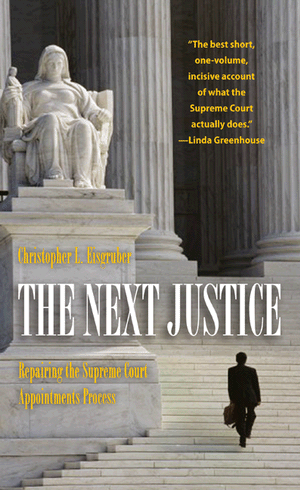
“Judges are like umpires. Umpires don't make the rules; they apply them. The role of an umpire and a judge is critical. They make sure everybody plays by the rules. But it is a limited role. Nobody ever went to a ballgame to see the umpire.”Contrary to John Roberts’ testimony, a Supreme Court justice has a unique and expansive role in our society. The Constitution contains too many abstract references and clauses for any justice to merely adhere to the rules based on a strict interpretation of the text. An example is the Constitution’s Equal Protection Clause. As the highly regarded legal scholar, Christopher L. Eisgruber, observes in his 2007 book, The Next Justice: Repairing the Supreme Court Appointments Process (Princeton University Press) the Equal Protection Clause reads,
“’No state shall deny to any person within its jurisdiction the equal protection of the laws.’Overall, Eisgruber argues that due to the Constitution’s many vague abstractions, a Supreme Court justice is disproportionately influenced by their individual values and ideology in determining when it’s appropriate for the court to intervene and even overrule our country’s prior laws. How could it be otherwise when the Constitution’s text is frequently subject to broad interpretation as with the Equal Opportunity Clause? Hence, it is imperative the senate determines if the judicial philosophy of a Supreme Court nominee is representative of the country.
How should judges interpret this clause? Presumably, they must ask what it means for the laws to protect people equally. Yet that question takes judges straight to the nerve center of American ideological controversy. Liberals and conservatives disagree passionately about what it means for the laws to protect groups equally and about when it is appropriate for the laws to treat one group better than another.”
Some legal scholars such as Yale law professor Stephen Carter have argued that nominees to the Supreme Court should simply stay home because their testimony has ceased to contribute anything substantive. There is definitely merit to Carter’s point of view. Nominees since Robert Bork typically speak only in vague platitudes about practicing “judicial restraint” and are ultimately voted up or down based upon their reassuring television appeal.
Eisgruber however argues in his book that the senate should ask more open-ended questions of prospective nominees about their judicial philosophies. Too often senators attempt to trap nominees with “gotcha” questions or ask about specific issues such as abortion that that can easily be deflected to “preserve their integrity” prior to joining the Supreme Court. Ultimately, little is learned and unless opposition interest groups get any traction or a scandal emerges, the nominee is likely to sail through without defending or explaining their ideology.
One example of the sort of question Eisgruber suggests asking is,
“The late Chief Justice William Rehinquist wrote that ‘manifold provisions of the Constitution with which judges must deal are by no means crystal clear in their import, and reasonable minds may differ as to which interpretation is proper.’ Could you tell us something about the values and purposes that will guide you when you interpret provisions like the Equal Protection Clause? How do those values and purposes distinguish your approach from those taken by other justices?”Eisgruber contends this approach has a better chance of determining the sort of justice a nominee is likely to be. He also argues that it will facilitate more moderate nominees and discourage stealth extremists.
Eisgruber, who previously clerked for U.S. Court of Appeals Judge Patrick E. Higginbortham (a conservative) and Supreme Court Justice John Paul Stevens (a liberal), agreed to a podcast interview with me over the telephone about his book. Among the topics discussed were the insights he gained clerking for two ideologically different judges, the importance of justice’s philosophy about judicial review, President Obama’s desire for a justice with “empathy” and whether we might have a justice who did not serve in the appellate courts. I also asked him numerous questions from my liberal perspective, including whether ideological balance on the court would be better served by appointing assertive liberals instead of moderates.
Please refer to the flash media player below.
This interview can also be accessed at no cost via the Itunes store by searching for either the “Intrepid Liberal Journal” or “Robert Ellman.”