Showing posts with label Robert Bork. Show all posts

Sunday, May 17, 2009

The Next Justice: An Interview With Legal Scholar Christopher L. Eisgruber

President Obama will soon announce his nominee to replace retiring Justice David Souter on the Supreme Court. It’s a critical nomination with long-term ramifications for civil liberties, executive power, management-labor relations, the environment and consumer rights. Hence, it is vital the public know whether the judicial philosophy and ideology of any prospective nominee to the court is compatible with their sensibilities and values. Ideally, all nominees would be forthcoming about their philosophy as the senate either confirms or rejects them with full knowledge of the sort of justice they’re likely to be.

Regrettably, that hasn’t occurred since the 1987 Senate confirmation hearings for Robert Bork. At the time, Bork scared the hell out of me and I’m grateful his nomination was not approved. Even so, I always respected how Bork was upfront about his ideology and judicial philosophy. Bork didn’t hide what he was and the American public and the Senate had a clear picture of what sort of justice he would be.

Sadly, since the Bork nomination fight, our Supreme Court appointments process has become a Kabuki dance existing in an alternate reality. Nominees are conditioned to reveal as little as possible about their judicial philosophies or even avoid acknowledging they have one. A pitiful example is Chief Justice John Roberts who famously compared Supreme Court justices with baseball umpires during his 2005 Senate confirmation hearings:
“Judges are like umpires. Umpires don't make the rules; they apply them. The role of an umpire and a judge is critical. They make sure everybody plays by the rules. But it is a limited role. Nobody ever went to a ballgame to see the umpire.”
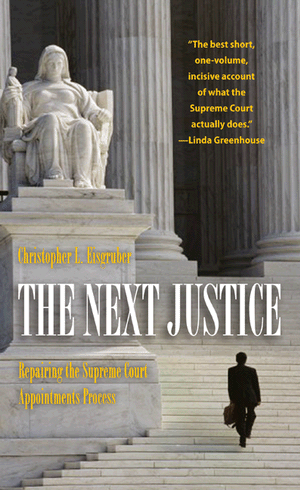
Contrary to John Roberts’ testimony, a Supreme Court justice has a unique and expansive role in our society. The Constitution contains too many abstract references and clauses for any justice to merely adhere to the rules based on a strict interpretation of the text. An example is the Constitution’s Equal Protection Clause. As the highly regarded legal scholar, Christopher L. Eisgruber, observes in his 2007 book, The Next Justice: Repairing the Supreme Court Appointments Process (Princeton University Press) the Equal Protection Clause reads,
“’No state shall deny to any person within its jurisdiction the equal protection of the laws.’

How should judges interpret this clause? Presumably, they must ask what it means for the laws to protect people equally. Yet that question takes judges straight to the nerve center of American ideological controversy. Liberals and conservatives disagree passionately about what it means for the laws to protect groups equally and about when it is appropriate for the laws to treat one group better than another.”
Overall, Eisgruber argues that due to the Constitution’s many vague abstractions, a Supreme Court justice is disproportionately influenced by their individual values and ideology in determining when it’s appropriate for the court to intervene and even overrule our country’s prior laws. How could it be otherwise when the Constitution’s text is frequently subject to broad interpretation as with the Equal Opportunity Clause? Hence, it is imperative the senate determines if the judicial philosophy of a Supreme Court nominee is representative of the country.

Some legal scholars such as Yale law professor Stephen Carter have argued that nominees to the Supreme Court should simply stay home because their testimony has ceased to contribute anything substantive. There is definitely merit to Carter’s point of view. Nominees since Robert Bork typically speak only in vague platitudes about practicing “judicial restraint” and are ultimately voted up or down based upon their reassuring television appeal.

Eisgruber however argues in his book that the senate should ask more open-ended questions of prospective nominees about their judicial philosophies. Too often senators attempt to trap nominees with “gotcha” questions or ask about specific issues such as abortion that that can easily be deflected to “preserve their integrity” prior to joining the Supreme Court. Ultimately, little is learned and unless opposition interest groups get any traction or a scandal emerges, the nominee is likely to sail through without defending or explaining their ideology.

One example of the sort of question Eisgruber suggests asking is,
“The late Chief Justice William Rehinquist wrote that ‘manifold provisions of the Constitution with which judges must deal are by no means crystal clear in their import, and reasonable minds may differ as to which interpretation is proper.’ Could you tell us something about the values and purposes that will guide you when you interpret provisions like the Equal Protection Clause? How do those values and purposes distinguish your approach from those taken by other justices?”
Eisgruber contends this approach has a better chance of determining the sort of justice a nominee is likely to be. He also argues that it will facilitate more moderate nominees and discourage stealth extremists.

Eisgruber, who previously clerked for U.S. Court of Appeals Judge Patrick E. Higginbortham (a conservative) and Supreme Court Justice John Paul Stevens (a liberal), agreed to a podcast interview with me over the telephone about his book. Among the topics discussed were the insights he gained clerking for two ideologically different judges, the importance of justice’s philosophy about judicial review, President Obama’s desire for a justice with “empathy” and whether we might have a justice who did not serve in the appellate courts. I also asked him numerous questions from my liberal perspective, including whether ideological balance on the court would be better served by appointing assertive liberals instead of moderates.

Please refer to the flash media player below.


This interview can also be accessed at no cost via the Itunes store by searching for either the “Intrepid Liberal Journal” or “Robert Ellman.”

Tuesday, April 28, 2009

As The Specter Turns

When an office colleague told me this afternoon that Republican Senator Arlen Specter defected to the Democratic Party, I had a flashback. In the fall of 1987, I was a freshman at Sarah Lawrence College. One of my professors assigned us a paper regarding the confirmation hearings for Supreme Court nominee Robert Bork. A few days of research (research without the Internet!) were sufficient to turn me off to Bork’s strict constructionist perspective as well as his advocacy for excessive executive power.

One afternoon, I watched the televised Senate confirmation hearings inside our campus TV room near Charlie’s Place or “The Pub” as we called it with one of my classmates. I was especially interested to assess the performance of Senators Joe Biden and Ted Kennedy. Biden, the Chairmen of the Senate Judiciary Committee at the time had just abandoned his presidential campaign following allegations of speech plagiarism. How would Biden conduct himself after this disappointment? Meanwhile, Kennedy was an especially assertive critic of Bork’s record and making headlines.

Yet it was Pennsylvania’s Arlen Specter that captured my attention. I had never heard of Specter before. Bork and Specter engaged in a riveting intellectual repartee about the “original intent” of the Constitution, the right to privacy as well as executive power. Bork was a terrifying and brilliant advocate for the warped view of federalism that metastasized in the Reagan years and influenced future Supreme Court justices John Roberts and Samuel Alito.

Watching those hearings it seemed to me that Republican Arlen Specter was the Judiciary Committee’s most persuasive critic of Bork’s reactionary dogma. Later that evening I called my Dad, who to this day remains the wisest voice about politics I know. We discussed the hearings and I complained that Specter belonged in the Democratic Party. My Dad sagely responded that it’s good for the country if Republicans have “moderate” voices such as Specter and he noted it enhanced the opposition’s credibility against reactionary figures such as Bork. Well, that seemed reasonable enough to me at the time.

Four years later I was bitterly disappointed when Specter supported Clarence Thomas's nomination to the Supreme Court and contributed to the Republican lies about his former colleague, Anita Hill. Hill had accused Thomas of sexual harassment. At the time, Senator Ted Kennedy’s nephew was a defendant in a rape trial. As a result, Kennedy wasn’t comfortable aggressively challenging Thomas’s refutations of Hill’s testimony. Many liberals at the time were hoping that Specter would once again rise to the occasion and take the fight to Thomas as he did with Bork. Instead, Specter turned his fire on Anita Hill and Clarence Thomas’s nomination was approved.

To the detriment of consumers and wage earners, Arlen Specter was an enabler for Clarence Thomas to become a guaranteed supporter of reactionary activism on the Supreme Court. Following the 1987 Bork hearings, Specter became a favorite target of Republican conservatives and he was desperate to appease them with the Clarence Thomas hearings. Hence, Clarence Thomas is just as much a part of Specter’s legacy as Robert Bork.

Since the 1991 Thomas hearings, a pitiful template for Specter’s performance as Senator was established: for the next eighteen years he simultaneously appeased and disappointed the radical right that demanded purity. Meanwhile, moderates and liberals were continuously let down when Specter talked the talk with respect to civil liberties under President George W. Bush but failed to walk the walk.

Twenty-two years ago I would have been thrilled if Arlen Specter had joined the Democratic Party. Today, my perspective is rather cold. Yes, I acknowledge that once Al Franken of Minnesota is seated the Democratic caucus will have a filibuster proof majority on paper. And to the extent activist progressive oriented legislation is enacted as result of Specter’s defection, i.e., health care reform, that’s all to the good. Also, I’m enjoying the Republican Party’s humiliation after years of watching southern Democrats defect. Perhaps, Specter’s defection will be the start of a trend.

Specter himself however is likely to be a Joe Lieberman like presence in the caucus. He’s pro-corporatist/pro Wall Street and opposes the Employee Free Choice Act. Specter is also hawkish, pro-war and very much representative of the establishment's flawed national security mindset that created the mess we’re currently in. Had Specter remained in the Republican Party, we had an outstanding opportunity to elect a genuine liberal from Pennsylvania in 2010.

Only radical crazies remain in Pennsylvania’s Republican Party. Pennsylvania’s Democratic Party now boasts 200,000 additional voters and Democrats could easily defeat Specter’s conservative antagonist, Pat Toomey who is Exhibit A of the far right’s psychosis. Had Specter somehow prevailed in his Republican primary fight, a liberal Democrat would have likely defeated him in the general election.

Hopefully, a credible and organized liberal will challenge Specter in the 2010 primary. A credible challenger for example might force Specter to flip flop on the Employment Free Choice Act and support worker rights. Specter has already demonstrated malleability to ensure his political survival whenever he appeased the far right.

Like a lot of politicians, expediency matters more to Arlen Specter than principle. Now that Specter’s a member of the Democratic caucus, we liberals need to aggressively persuade him that’s in his best interests to support our issues. A credible primary challenge is the best way to do just that.

Tuesday, January 09, 2007

Elections Have Consequences

So why did liberals such as myself work so hard putting Democrats in congress this November? Why did we get out the vote through phone banking and canvassing? Why did we even raise and contribute money for pro-life Senatorial candidates such as Bob Casey of Pennsylvania? Well, as the Washington Post reports,

“The Bush administration officially withdrew four of its most controversial nominations to the federal appellate bench yesterday, bowing to the political reality of a Senate Judiciary Committee under the control of Democrats who show no inclination to confirm them.”


First Republican senators obstructed President Clinton’s moderate judicial nominations. Then they threatened to invoke the “nuclear option” and eliminate the filibuster to put counter culture reactionaries on the federal bench. Most recently we had to swallow a corporatist in Chief Justice John Roberts and the father of the unitary executive with Associate Justice Samuel Alito.


Republicans considered this payback because Democrats prevented Robert Bork from being nominated to the Supreme Court in 1987. Bork believed the state had the right to infringe upon a husband and wife's privacy and not allow couples to use contraception in the privacy of their own home. In the bizarre logic of Bork and other "strict constructionists" since the Constitution doesn't mention Trojans one has no legitimate expectation their rights to use them are protected.


Compared to the damage done to our judicial system and Constitution in recent years this is a minor victory. But I’ll take it. Hopefully, electing a Democratic President in 2008 will help restore rationality to the judiciary and we can detoxify our country from the strict constructionists. For too long we've allowed jurists dedicated to reversing social progress and eliminating economic justice established over the past sixty years to pollute the federal bench. The first step to restoring decency in America is proper respect for civil liberties, individual rights and the law. The withdrawal of Bush’s nominees is small step in the right direction.