Remember the pride Americans felt in its military following the first Gulf War in 1991? Prior to that conflict we had the “Vietnam Syndrome” tainting our military with the stench of defeat and shameful atrocities such as the
My Lai massacre. Supposedly, a reformed military culture debunked the legacy of Vietnam, liberated Kuwait with honor while safeguarding America’s interests in Saudi Arabia.
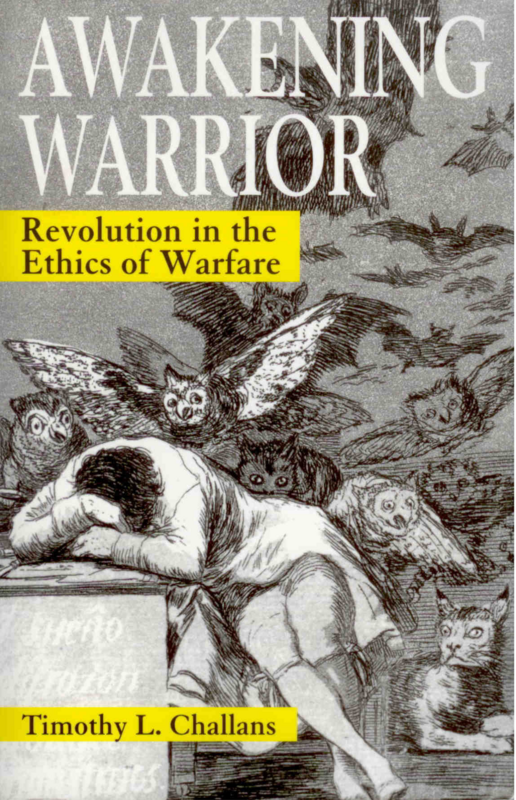
Among those who initially embraced that myth is Timothy Challans, who served in the Army as a career infantry officer and retired in 2002 as a lieutenant colonel. Challans writes in his new book,
Awakening Warrior: A Revolution In the Ethics of Warfare (
State University of New York Press) that,
“For years after Desert Storm I wanted to believe, like many Americans, that the U.S. military had completed a moral transformation. Those of us who had been duped by our own propaganda wanted to believe that the indiscriminate killing in Vietnam had been replaced by precision munitions in Desert Storm and beyond, that the repugnant crimes of war so prevalent in the degenerate destructive fighting in Indochina had been replaced by consciously clean conventional fighting in the Gulf, and also that the psychotic psychologies of a bankrupt former generation had been swept away by a reformed professional military that fought with moral clarity and certainty. But the progress that I and many others had imagined was a myth.”
Challans completed the manuscript for much of his book in the summer of 2001, before most Americans had ever heard of Osama Bin Laden or al Quaeda. Prior to the abuses of the Bush/Cheney Administration, Challans diagnosed the ills of what he describes as the “warrior ethos” and the “American War Machine” which encompasses those political and military institutions that engage the world with physical force.
In a thoughtful book that blends philosophy and history, Challans focuses on the systemic, institutional level of morality rather than bemoaning the moral shortcomings of individuals. And he poses the following questions for the American War Machine: What are the limits of an individual moral agency? What kind of responsibility do individuals have when considering institutional moral error? How is that neutral or benign moral actions performed by individuals can have such catastrophic morally negative effects from a systemic perspective?
In addressing those questions, Challans postulates that “America’s War Machine” creates more conflict than it prevents and endangers the citizens it’s supposed to protect. He therefore argues that America’s survival is contingent upon replacing the current warrior ethos with a new paradigm guided by ethics.
Challans, a native of Colorado, is a West Point graduate and earned masters and doctorate degrees in philosophy at the The Johns Hopkins University. For more than ten years he taught over a thousand military students from the rank of cadet to colonel, at West Point (USMA), the Command and General Staff College (CGSC), and the School for Advanced Military Studies (SAMS). He has spoken widely and presented numerous papers pertaining to the ethics of warfare. Challans was the principal author for the Army’s 1999 doctrinal manual leadership,
FM 22-100, Army Leadership. His troop experience includes the 172nd Infantry Brigade at Ft. Richardson, Alaska and the 10th Mountain Division at Ft. Cambell, Kentucky.
Challans agreed to a telephone interview with me about his book and unique perspective. Our conversation is transcribed below.
*********************************************************************************ILJ: Timothy, the first thing that grabbed my attention about your book was the title itself, Awakening Warrior. For the benefit of those reading this who did not read your book, why did you choose that title and what do you hope to accomplish with this book?
Challans:
I was looking at Francisco De Goya’s etching entitled the “Sleep of Reason” as I was writing this book and I wanted to entitle it “The Sleep of Reason.” I thought that was a little bit too negative because while I think that we’ve been asleep in terms of our moral consciousness as we engage in conflict, I think some of us are waking up and the time is ripe for some critical evaluation of what we’ve done and where we can go. And so I wanted to give a positive note that some warriors are waking up and are the vanguard of a revolution in the ethics of warfare for the good. ILJ: I suspect many reading this who are like me, liberal and largely anti-war, are confused about the concept of integrating ethics and warfare. Tim is it really possible to wage the brutality of war ethically and why does that matter?
Challans:
I think that’s a very good question. And whenever we do go to war that’s a huge failure when our politicians are not successful at diplomacy. We have engaged in a tremendous ethical failure. But the reality is at times we will have to fight. And so while I think that ethically fighting and war is going to have some very bad things about it … that we have two questions that people in this business think about: The first one is, when should we go to war? And the second one is how should we fight it once we’re in it? And these two questions, once we think about them are important ethical questions that we have to explore in order to minimize the horror. I am not a pacifist myself although I am largely antiwar. I think we’ve been involved in far too many wars, more than we should. And that the leadership, both political and military doesn’t know how to engage in this kind of moral dialogue and we need to get a lot better at it. ILJ: A reoccurring theme in your book is that for the military means become ends. Yet I can’t help but wonder how it could be otherwise for the military mind. Shouldn’t thinking about the bigger picture, consequences and morality be in the bailiwick of civilian leadership while the military focuses on tactics and winning?
Challans:
That is the traditional division. That the politicians answer that first question, when do we go to war? And then the military is supposed to answer the second question, how should we fight it? The reality of this over the last several decades and actually the last several centuries, is that the division between political and military thought has merged. There was a medieval distinction, that of invincible ignorance that is pretty much the idea that the soldier can go to war with a clear conscience and doesn’t have to worry about the political decisions. But the reality is our political leaders depend on our military leaders for advice and especially at the highest levels. Especially the Chairman of the Joint Chiefs. And the Chairman of the Joint Chiefs and his staff and every other headquarters and command where there is political/military interface there should be a dialogue between both groups of people: military and political as far as the morality of warfare given its gravity, potential destruction and the cost in terms of money and lives.So, going back to your questions about means and ends, my book is primarily a challenge to the traditional structures and methods of thinking of ethics – and the way we think about means and ends, the very structure of reasoning about means and ends needs to be re-evaluated. For a very long time it has been inadequate for the military to think only about victory, winning the nation’s wars. ILJ: In the second chapter of your book, you argue that the promotion of religion is undermining the ethics of our military and you even write that army chaplains
“should get out of the ethics business in the military.” Why do you regard religion as a dangerous influence to the military’s moral compass?
Challans:
If we’re looking at the three main religions in the world: Judaism, Islam and Christianity, the sacred texts for these religions really offer us very little if nothing when we go to answer these two questions, 1) When should we go to war? 2) And how should we fight it once we’re in it? So I think the background that chaplains bring with them does not really help us in thinking about the moral questions that are at stake. And particularly the Bible is uninformative in this way. It tells us “Thou shall not kill.” OK, what do you do with that? What does the soldier do with that when he finds himself in war? Additionally, since we’re working with the rest of the world now, I think we need some kind of ethical interoperability with the rest of the world. The rest of the world, the rest of the Western World … Europe, for example does not think of ethics in these terms. So if we’re going to be able to have a common conception of ethics, in a profession that is part of governmental structure in a democratic republic then it may be enough to think in terms that are not religious and that there are plenty of ideas out there where you don’t have to go to religion to understand respect for persons, rule of law and ethical ideas such as those.My book also controversially challenges the Just War Tradition, the just war thinking that thinkers from Augustine to Michael Walzer defend. I believe we need a totally new conception, one reason being that our Just War Tradition has developed hand-in-hand with theological thought. For example, what good does it do to say the “legitimate authority” is a just war principle? Has there ever been a case in history when the leaders of any nation would say that they did have legitimate authority to go to war? Moral authority, especially religious moral authority, is one of the root problems of our muddled thinking about the ethics of warfare. I offer an original set of ethical principles of war, reasoned from some of the most profound ethical theories. ILJ: Your book poses many important philosophical questions challenging what you describe as the “warrior ethos.” Yet for me, the nitty gritty of your book comes down to these two sentences in Chapter Four. You write,
“The great paradox is that America goes to war against forces that it plays a large role in creating, and each war spawns new threats of largely its own creation.” That’s a harsh assessment. Do you really believe American militarism is responsible for the rise of radical Islam for example?
Challans:
It may not be directly responsible if we’re thinking in the direct cause and effect relationship that you would see on a billiard table, one pool ball running into the next. But things connect up in a systemic way. And these forces are at work in ways that we really don’t sit back and reflect about. So yes our approaches in solving problems at certain times will create the conditions for future problems. Just as in medicine today’s cures for certain diseases create tomorrow’s diseases. So, yes I do think there is this concept of blowback that the way we go about not only militarization but our economic expansion has tremendous systemic effects. An invisible hand kind of interaction where nobody is consciously intending or making something bad happen. But all these forces are at work, they’re at play in ways we don’t really think about and actually do create worse conditions making the world more dangerous year after year. ILJ: In making your case for an ethics revolution in military culture, you challenge America’s moral standing over some of its proudest moments in history. One of them being, America’s victory over Japan in World War Two. Specifically, you accuse America of unjustifiably dropping atomic bombs on Japan when the war was essentially over. Growing up I was taught that even though the outcome was not in doubt, diehard Japanese soldiers would’ve kept fighting and taken many more American lives had President Truman not given the OK to bomb Hiroshima and Nagasaki. Couldn’t one argue that using atomic weapons was ethical because it minimized American casualties?
Challans:
Here is a great example of how the military pursuit of victory – at any cost, by the way created more dangerous conditions. Our policy of unconditional surrender—an American invention in the annals of warfare beginning with Grant in the Civil War— put the Japanese Empire on notice that we were the ones who were not going to give up and accept a defeat. And here is the problem with the warrior ethos. It sounds good to us when we espouse the notion that we will never give up. But what happens when others take the same stance? It is precisely the warrior ethos existing on both sides in that war that escalated the brutality in the Pacific theater. The warrior ethos challenges the conventions of winning and losing. What does victory even mean is our enemy will never accept defeat? This is such a deep question at such a fundamental level that it does not even register in the minds of most warriors. And for a long time now it is not just the soldiery that refuses defeat but whole populations. The talk of victory in the current war against terror is nonsensical given that people won’t let another power achieve victory.I mention in the book the irony of ending the war by attacking the Japanese population at large in order to bring about a military victory. And I juxtapose that against Japan’s entry into the war that was the attacking of an American military base in Hawaii at a time before Hawaii was a state. That should symbolize our presence in the Pacific and our interference with Asia’s designs in their own region. So this goes back to your further question how our actions can create more dangerous situations. When we talk about setting the example for the world and then engage in wholesale destruction of a population, I think that while we may want to justify that for ourselves I don’t think we would want the rest of the world kind of picking up that example. And I’ll just mention Ramzi Yousef, the ’93 bomber of the World Trade Center who wanted to exact revenge on the World Trade Center symbolically for the destruction we brought against Japan at the end of World War Two. Now, many sources will define terrorism as the threat or use of force against non-combatants for some kind of political objective. It’s inconsistent for us to use that definition when we want to define terrorists who are attacking us but we will not allow that definition the way we describe what we do. Now if we go so far as to say well, all of the Japanese citizens were combatants – then the problem with that is if everyone is being consistent about that, I think that’s pretty much what the attackers on 9/11 said about the occupants of the World Trade Center. Consistency is important here. And we need to think these things through very clearly.
ILJ: In fairness to President Truman though, wasn’t he being told by his military advisors we’re going to shed a lot more American blood unless we use these weapons? Occupying the Japanese mainland would’ve been a very tough proposition. And given the war weary American population at that point, did Truman really have another choice at that moment in time?
Challans:
That’s a very interesting question because that’s not just a single choice at that point in time but things had degraded over time. So it’s really a series of decisions that take place over time. And so as we go back we can sympathize with Truman in terms of the choices he made on successive days. For example, why would they think atomic weapons were that much worse than the fire bombing of sixty other cities in Japan by that time? It may have seemed like a difference in degree but not a difference in kind. In retrospect we can see that more clearly. But this should give us even greater pause in trying to think through the choices we make. As a series of decisions over time where we can potentially make thinks more dangerous than they need be. ILJ: You also cite dropping the atomic bomb as the start of the cold war as an example of American military excess creating more conflict for it to fight. In fairness to America, Stalin brutally consolidated his Iron Curtain over Eastern Europe and since the Soviets were developing atomic weapons themselves, wasn’t the Cold War inevitable?
Challans:
Well, yes. In some ways it had unfolded, maybe yes. And this goes back to my previous comment – that something like the Cold War unfolded as a result of thousands of decisions and hundreds of things that were happening. And many historians will now say we dropped the bombs more to keep Russia out of sharing a victory with us in Japan than the traditional rationale. But this may also be reason to think that we if reword McArthur’s most famous line, we should think about the role of diplomacy. Maybe its more important to say there is no substitute for diplomacy. ILJ: Another proud moment in American history was the first Gulf War in 1991, when a supposedly new professional military liberated Kuwait, kept the Iraqis out of oil rich Saudi Arabia and conducted itself with honor – debunking the Vietnam syndrome. You reference two very serious allegations in your book however about the First Gulf War. The first is that independent satellite photos do not show the buildup of the Iraqi Army at the Saudi Arabian border before Operation Desert Shield was implemented in 1990. As a source you cite John MacArthur’s 1993 book, Second Front: Censorship and Propaganda In the Gulf War. If MacArthur’s right, why did King Fahd of Saudi Arabia allow the American military to set up shop in their country and anger Islamic radicals such as Osama Bin Laden? It doesn’t make any sense.
Challans:
We’ve been involved in Saudi Arabia since the late thirties. There was certainly much more of an American military presence throughout the eighties in the Middle East. So the entry and the buildup of American forces in Saudi Arabia I think is a natural consequence of this relationship we’ve had with certain countries in the Middle East. Yes the buildup I think was exaggerated and this may help explain why the war only took 100 hours … that the forces that were reported to be there may not have actually been there. Now this is a serious allegation and I would love to see more exploration here but I really doubt the military is going to open itself up for this kind of investigation. ILJ: Is there anything that civilians can do to explore these allegations, pressure politicians, especially in light of the past six years? Maybe people will want to dig further back into the history of our entire involvement in the Gulf.
Challans:
I think that’s a great suggestion. The two conflicts are not separate. There needs to be some exploration and some interpretations that include Dessert Storm and Operation Iraqi Freedom. And I think that would be a fascinating topic to look at the whole thing rather than just the first part and the second part separately.ILJ: The second allegation you reference is against Major General Barry McCaffrey. McCaffrey would later serve as President Clinton’s drug czar and he’s been a television commentator for NBC in recent years. You write that two days after the shooting stopped in March 1991, McCaffrey had his 24th Division completely destroy an entire Iraqi Republican Guard Unit after falsely claiming he responded to an antimissile attack – and you cite the reporting of Seymour Hersch, a credible reporter as a source – he’s very credible in my opinion. Do you believe McCaffrey acted looking for glory? Or was he cooperating with higher ups that wanted a pretext to wipe out another a division of Saddamn’s elite Republican Guards?
Challans:
I would go with A. That this was primarily McCaffrey’s action. I think that from General Schzwartkopf and higher that the action was pretty much over. This was a cease fire. Cease fires have very technical legal strictures which are greater than say armistices. So this is a much more serious incident … and it’s an incident we let go because of McCaffrey’s stature and later political appointment — I think this was kind of ignored. But this would be part of that overall story that I think we need to go back and look at more seriously. ILJ: I’d like to get your thoughts on two recent developments. One, what do you make of the federal appeals court in Washington that on Friday, ordered the government to turn over all information on Guantanamo detainees who are challenging their detention?
Challans:
I think this is a move in a positive direction because I have never thought that any of the talk of detention and talk of tribunals had anything to do with bringing anybody to trial but that it always had everything to do with interrogation and getting information. There was never any procedural or substantive law that had been developed to deal with the detainees, especially in this bogus category of enemy combatants. We are operating somewhere in limbo between a war paradigm and a crime paradigm, legally. And I think this is a case of the courts imposing itself to force the White House to show its hand. There are virtually no substantive charges against the vast majority of detainees. The one they stick on everybody, which is really a false charge, is that of conspiracy. Conspiracy while a crime in terms of criminal law is not a war crime. So to try to charge all these detainees with the war crime of conspiracy is just not going to work. I think this is part of the oversight that the judicial system should have over the executive branch. And this really is good news in my view. It’s democracy at work.ILJ: Do you think it might cause chaos if all these detainees are able to challenge their detention?
Challans:
I think it will be chaotic. And there may not be any good answers once all this is exposed. Even so I don’t think the potential chaos is a reason not to do it. Nor would it be a reason to justify what’s been done. It may be that we have to face the very painful consequence of exposing something that is really bad news for America. It’s bad news because we used bad reasoning in terms of means and ends, using questionable means to achieve certain ends. ILJ: And what do you think about the White House announcing on Friday that it had given the CIA approval to resume its use of some severe interrogation methods for questioning terrorism suspects in secret prisons overseas?
Challans:
This is the executive branch trying to flex its muscle back at the judicial system. I think that is not a good idea. All of those heavy-handed measures have turned out to backfire in the past. For a long time I didn’t understand why the White House would be acting this way. But I’ve come to understand that there is a school of law out there, the John Yoo and Alberto Gonzales school of law which is to push the limits, to do something that is perhaps illegal. And if that sticks then they’ve actually succeeded in changing the law. And I really think that’s what they’re up to. This is particularly troubling to me for public servants take an oath to support and defend the Constitution. It is an outright contradiction to violate the very document that public officials have taken an oath to preserve. ILJ: Timothy your book largely deals with reforming the ethics of the institutions of what you call America’s “war machine.” However, increasingly operations of America’s war machine are outsourced to private contractors such as Blackwater who essentially have their own army in Iraq and are not beholden to any government standards. Is it possible to have an ethical war machine if private contractors aren’t reformed as well and how can that be done if they’re not under the chain of command?
Challans:
This is a huge problem and perhaps the greatest challenge that we’ll have in the future. As Smedley Butler, the Marine back in the early 20th century told us: “war is a racket,” war is business. And there are business forces at work that if the average American understood how profits are made off of people being killed I think they would be appalled. The rise of Blackwater, and the contractor force being the second largest army in the Middle East right now, is a tremendously problematic, not only because they can operate outside the law but they also operate outside of any consciousness of morality or ethical code that a military would have. So I think this issue of contractors on the battlefield is one we need to rethink seriously about. ILJ: Do you think it’s possible assuming the military can reform its own ethical standards they can then mandate if you want to get any contract work from us, this what you have to adhere to? Is that a reasonable objective?
Challans:
That could be a way to help solve the immediate problem. I think that’s a good idea actually. But it’s a world that’s really hard to control, unaccountable. Far more so then the blackest operation in our black ops world. ILJ: Timothy you’ve been very generous with your time, a final question if I may. What sort of feedback, if any, have you received from the military establishment about your ideas in this book?
Challans:
The feedback has been positive, from students and colleagues. Nobody has approached me to challenge me on anything I've said. I think the time is right for a moral dialogue of the sort I'm trying to carry out, one that can be critical enough to help us better understand where we've been, what we're doing, and where we're going.
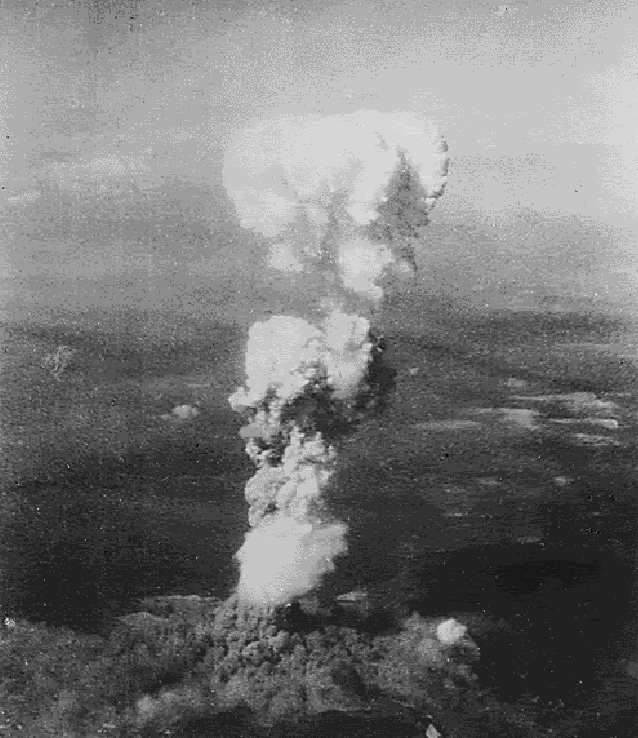 The Liberal Journal (no relation to my site) has an important post about the anniversary of our dropping an atomic bomb on Hiroshima sixty-two years ago today. Growing up I was fed a steady diet of justification and rationalization for the destruction my country unleashed at the end of World War Two. Although I remain an admirer of President Harry Truman and can understand why he justified the decision, it was wrong. I’ve come to that point of view reluctantly. Too reluctantly and I’m not proud of it. As the Liberal Journal appropriately points out, we ought to study and examine the real horror we inflicted when casually discussing the use of nuclear weapons in Iran, Pakistan or anywhere else on this planet.