Wednesday, March 14, 2007

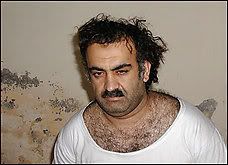
The Khalid Sheikh Mohammed Shuffle

The Washington Post, reports this evening that Khalid Sheikh Mohammed confessed to masterminding al-Quaida's terrorist attack on 9/11. According to the article,

“Mohammed claimed responsibility for planning, financing and training others for attacks ranging from the 1993 truck bombing of the World Trade Center to the attempt by would-be shoe bomber Richard Reid to blow up a trans-Atlantic flight with explosives hidden in his shoes. And he also claimed that he was tortured by the CIA after his capture in 2003.”
Mohamed certainly deserves a special place in hell for the blood on his hands. I am curious about this conversation described by the Washington Post:

“During an exchange with Mohammed, the military colonel who heads the three-member panel asked about allegations that the al-Qaida leader was tortured by the CIA.

‘Is any statement that you made, was it because of this treatment, to use your word, you claim torture,’ the colonel asked. ‘Do you make any statements because of that?’

Portions of Mohammed's response were deleted from the transcript, and his answer was unclear. He later said that his lengthy confession to the Guantanamo hearing was given without any pressure, threats or duress. The colonel said that Mohammed's torture allegations would be ‘reported for any investigation that may be appropriate’ and also would be taken into account in consideration of his enemy combatant status.”
Does anyone with an IQ over 80 believe a word of that? And didn't the entire world already know Mohammed "masterminded" these attacks? It’s diversion time at the White House again. A transparent and sophmoric attempt to knock embattled Attorney General Alberto Gonzales off the front page. Where’s Tom Ridge and his pathetic color coding scheme when you need him?

Tuesday, March 13, 2007

Homeless Advocate Rev. Chuck Currie

Aaron Krager of Faithfully Liberal interviewed homeless advocate, Rev. Chuck Currie for his blog today. Currie is a member of the Public Policy Committee for Ecumenical Ministries of Oregon. The Los Angeles Times praised Currie's blog about religion and social issues for "top-tier editorial writing."

During the interview, Currie discusses his advocacy work, offers advice on how individuals can make a difference and ponders the blending of faith and politics.

Personally, I'm secular but I applaud Currie's activism on behalf of his community and we can all learn from his example. This is Currie's take about the moral crisis of homelessness in America:

"Homelessness is both a political and a spiritual crisis. 'Truly I tell you, just as you did it to one of the least of these who are members of my family, you did it to me,' reads Matthew 25 (NRSV). This is one of the most familiar phrases in Scripture. How we treat the least of these is akin to how we treat God. So when we walk past men, women and children living on our streets we are literally walking past our God. And when we can do that without even thinking about it a political crisis develops where it becomes ok to cut programs that feed those who are hungry or programs that care for those who are sick. The president is proposing this year to cut food assistance for nearly half a million senior citizens and giving new tax cuts to millionaires. Confronting this crisis will require action on many fronts. We have to acknowledge our common humanity and see the face of God in one another. Without doing that there is little hope. But we also have to act on a political front. We have to oppose economic policies that benefit the wealthiest Americans at the expense of the poor and at the same time support legislative efforts that work toward the goal of ending homelessness. So volunteer with local programs that make a difference and that build relationships - shelters, medical centers, soup kitchens. But we also need to become activists working for social change."
It's a good interview. Please give a read.

Monday, March 12, 2007

James Webb: A Statesman

Yesterday, Virginia Senator James Webb appeared on ABC's This Week With George Stephanopolous. Primarily, Webb's interview covered Iraq, diplomacy with Iran and Syria and the Walter Reed scandal. However, it was his response to Stephanoplonous's final question that caught my attention.

Webb was asked if he has any interest in becoming the Democrat's nominee for Vice President in 2008. Stephanopolous specifically noted the blogosphere was championing Webb as an ideal number two for the Democratic Party next year. Initially, Webb's response was predictable about his desire to remain in the Senate.

But Webb also added he wanted to address problems not typically mentioned in political campaigns. What sort of issues does Webb have in mind? Webb actually wants to understand why two million people are incarcerated in the United States. He notes this is an issue "tearing apart" the country. In a post last week I asked if anyone cared about America's prison industrial complex. How gratifying to learn we have at least one Senator taking an interest.

CLICK HERE TO WATCH THE VIDEO OF SENATOR WEBB'S APPEARANCE ON ABC.

Saturday, March 10, 2007

Stop the Criminalization of Mental Illness

Several days ago, I wrote about the prison industrial complex in America that is driven largely by profit motive rather than improving society through rehabilitation or crime reduction. One component of America’s incarceration industry is the criminalization of the mentally ill.

An example of this callous ineptitude is former Massachusetts Governor and presidential candidate Mitt Romney. The November 27th, 2006 edition of the Worcester Business Journal, reported that the Massachusetts Department of Mental Health refused to admit any more patients to its hospitals or units. The drastic action was the direct result of cuts Romney imposed on the agency. Perhaps he did so to burnish his credentials as a fiscal conservate prior to announcing his candidacy for the Republican presidential nomination.

As Pam Belluck reported in the New York Times on March 8th (subscription required), 13 prison inmates have committed suicide in Massachusetts since November 2004. Yet even with troubling figures like these, Romney still forced this agency to stop admitting additional mentally ill patients. Those are people who can wind up in prison. Society pays a high price when aspiring presidents such as Mitt Romney care so little for the citizens they're suppossed to serve.

Universal health care has gained considerable traction as a political issue. Polls even show Americans are ready to pay higher taxes to end the crisis of affordable healthcare in America. It is imperative that any universal healthcare plan also expands treatment for the mentally ill. Perhaps I’m naïve but I believe Americans may be agreeable to accepting a substantial investment in coverage for the mentally ill as part of any package.

Celebrities have helped legitimized advocacy on behalf of mental health. Television’s Rosie O’Donnell has candidly acknowledged her personal struggles. Tipper Gore, the wife of former Vice President Al Gore was honest about suffering from depression and the importance of treatment. So has legendary journalist Mike Wallace. Credit should also be given to former First Lady, Betty Ford who shared her addiction problems with America and opened her own treatment clinic.

One Republican I’ve always had a soft spot for is New Mexico’s Republican Senator Pete Domenici. Domenici has a schizophrenic daughter and his perspective as a father helped him become a powerful advocate for the mentally ill. Yes, Domenici is a conservative and I oppose virtually everything his career stands for. True, Domenici was also recently exposed in the metastasizing scandal regarding the partisan dismissal of U.S. Attorneys by the Justice Department and should be held accountable for any laws it’s determined he violated.

Nonetheless, my soft spot for the man remains. Mental illness is an issue my family has coped with. I also have friends with mental illness in their families and appreciate anyone who has used their influence on behalf of the mentally ill. Domenici’s personal stake in the issue facilitated an unlikely friendship with the late liberal icon, Minnesota Senator Paul Wellstone. Both collaborated on the Mental Health and Treatment Act of 2001.

Sadly, while mental illness has gained acceptance as a legitimate health concern rather than a stigma to be ridiculed, our society hasn’t progressed far enough in providing treatment to those who need it most. Remarkable, because mental illness is something that cuts across all demographics of race and class in society. Pete Domenici is a powerful conservative member of the Senate Finance Committee. I am a liberal blogger. Yet we both have this in common. Many of you reading this have mental illness in your families or perhaps suffer from it yourselves.

So many of us have loved ones with the inability to function without proper treatment or medication. We care about them and yet the effort can erode one’s spirit and will. For too many families, finding appropriate treatment, obtaining and paying for medication and fighting to prevent our loved ones from slipping through society’s cracks is a losing battle. As a result, the mentally ill often become a danger to themselves and society. The criminalization of the mentally ill has certainly contributed to the swelled populations of prisons.

Mentally ill people don’t belong in prison but when not properly treated that’s where they often wind up. An otherwise gentle soul with schizophrenia or depression that is not properly medicated may commit a violent crime. There is also the tragic case of Timothy Souders. As reported several weeks ago by Sixty Minutes, Mr. Souders suffered from manic depression and committed the crime of shop lifting. It's not uncommon for people who suffer from manic depression to get into this kind of trouble.

Sadly, the Michigan Department of Corrections was ill equipped to manage Mr. Souders special needs and he was put in solitary confinement. As the prison video featured in the Sixty Minutes broadcast showed, Mr. Sounders died from mistreatment. What happened to Mr. Souders is not an aberration. We citizens must ask ourselves, was prison really the best solution for a mentally ill person guilty of shop lifting?

How many more Timothy Souders are waiting to happen? One year ago the New York Times (subscription required) reported how the prescription drug law pushed by the Bush Administration and Republican controlled congress, contributed to a crisis in many states. Beneficiaries of Medicare who are mentally ill experienced massive delays in obtaining the medication they needed to function. Ironically, one of those supporters of this legislation was Senator Domenici.

How many of these people I wonder hurt themselves, or others and wound up in prison? Once incarcerated, as the Timothy Souders tragedy exposed, a prison is typically unable to treat mentally ill inmates effectively and many die in solitary. Some by mistreatment like Timothy Souders. Others kill themselves.

This is not a popular poll tested issue. But it’s a damn important one. Addressing it properly is not only the compassionate thing to do but pragmatic as well. As I see it, the only way is through single payer healthcare that incorporates comprehensive coverage for the mentally ill, renewed investment of mental health clinics as well as research and development into treatments and medication. Otherwise the criminalization of the mentally ill will continue unabated.

When writing about the prison industrial complex I asked if anyone cared. Today I’ll simply ask, what can we do to mobilize action against the criminalization of mental illness? Because the next person imprisoned with mental illness could be your brother.
******************************************************************************
ADDENDUM: My thanks to Mike Finnigan for linking the above topic on his most recent blogroundup at Crooks and Liars. This is an important issue and I appreciate any exposure for it. Also, my thanks to "Patriot Daily" of the Daily Kos diary rescue team for resuscitating my crosspost with that community.
Friday, March 09, 2007

"Hyperpartisanship"

Partisanship in politics is healthy. Robust and rigorous debate is the engine of democracy. There is a line however between principled partisan and "hyperpartisanship” which seeks to avoid competition and destroy any political opposition.

E.J. Dionne of the Washington Post adroitly explains the distinction in his column today:

“Hand-wringing over extreme partisanship has become a popular cause among learned analysts. They operate from Olympian heights and strain for evenhandedness by issuing tut-tuts to all sides, Democrats and Republicans, liberals and conservatives.

But the evidence of recent days should settle the case: This administration has operated on the basis of a hyperpartisanship not seen in decades. Worse, the destroy-the-opposition, our-team-vs.-their-team approach has infected large parts of the conservative movement and the Republican Party. That's a shame, since there are plenty of good people in both. Still, the tendency to subordinate principles to win short-term victories and cover up for the administration is, alas, rampant on the right.”
At one time the American conservative movement was based upon principled partisanship and the engagement of ideas. No ideology should go unchecked and both the New Deal and Great Society programs deserved criticism for overreach and excesses. That’s fine. Criticism is how we improve and the public is best served when our politics is an intense competition in the market place of ideas.

As Dionne notes in his column however, Republicans have taken partisanship to another level. Truthfully, the GOP engaged in hyperpartisanship long before George W. Bush was on the scene. Their power was contingent upon destroying America’s faith in government to legitimize crony capitalism under the guise of privatization. They successfully exploited racial divisions and persuaded working class whites to vote against their economic interests for a generation.

In recent years, conservatives issued dire warnings about the “homosexual agenda” and “secularists” as their instrument of fear and diversion. And for good measure, questioned the patriotism of anyone who disagreed with their failed national security policies.

Meanwhile, the hyperpartisans in the Republican Party were empowered by “bipartisan” Democrats such as Joe Lieberman who legitimized their corporatist war mongering. Has the bough finally broken on the era of conservative hyperpartisanship?

Democrats will use congressional hearings to expose how the Justice Department terminated six United States Attorneys for not aggressively prosecuting cases in line with Republican Party interests. The scandal appears to be gaining traction in the mainstream media and even some Republican legislators have expressed outrage about the Justice Department’s conduct. Perhaps President Bush will even sacrifice Attorney General Alberto Gonzalez the same way Defense Secretary Donald Rumsfeld was shown the door following the November elections.

My guess however is that right wing hyperpartisans will merely be temporarily slowed. The zealots in the Republican Party remind me of the Bolsheviks. Vladimir Lenin surrendered territory to the Germans with the “Brest Peace” in 1918 to purchase breathing room and space. But he hadn’t given up on exporting revolution.

Similarly, Gonzalez will be sacrificed to buy time. But the neocons and conservative hyperpartisans will never give up on their quest to destroy unions, consumer protections and the fabric of social justice. Greed and hate is simply too much a part of their DNA.

Wednesday, March 07, 2007

A Vietnam Vet Rants About the Walter Reed Scandal

Bob Higgins is one of my favorite people. A former marine and Vietnam veteran, Bob is a terrific blogger who combines poignancy with irreverence. Today, Bob delivered a beautiful heartfelt rant about the scandal at Walter Reed Army Medical Center on his Worldwide Sawdust community blog. In typical Bob Higgins style, the post is titled, "Walter Reed, Who Expected More From A Government On the Take?"

My favorite passage is this one:

"When I watched Cheney (who avoided the draft with five deferments during the Vietnam war) addressing this issue yesterday I felt the urge to vomit. Cheney assured his audience that he, with the help of his smirking little sidekick and the rest of the hapless gang that gave us Iraq would fix the problem.

Bullshit. (there I go again) They caused the problem. They are the problem."
As someone who has relied on the care and treatment of veterans hospitals, Bob's experience is worth paying attention to. I urge everyone to read his poweful post.

Tuesday, March 06, 2007

Scooter Libby Is Collateral Damage

Sentient beings across the four corners of the world learned today that I. “Scooter” Libby, former Chief of Staff to Vice President Cheney, was found guilty of obstruction of justice, perjury and making a false statement. Libby faces a maximum sentence of 25 years in prison and a fine of $1 million. Much of the blogosphere is in a joyful tizzy about Libby’s fate.

However, I can’t muster much enthusiasm over it. As far as I’m concerned, one of the jurors named Dennis Collins had the best perspective about it. According to CNN, Collins said:

"It was just very hard to believe how he could remember it on a Tuesday and forget it on a Thursday and then remember it two days later," Collins told reporters outside U.S. District Court. "Having said that, I will say that there was a tremendous amount of sympathy for Mr. Libby on the jury."

"It was said a number of times, 'What are we doing with this guy here? Where's [Karl] Rove ... where are these other guys?'

"We're not saying we didn't think Mr. Libby was guilty of the things we found him guilty of, but it seemed like ... he was the fall guy."
Mind you, I don’t have any sympathy for Mr. Libby. He willfully did the bidding for a warmongering cabal of corporatist gangsters. However, the man is nothing more than acceptable collateral damage for the neocons. They managed to prevent any exposure about the Plame affair from costing Bush re-election in 2004. Furthermore, the Bush Administration’s cover-up successfully prevented anyone from being prosecuted for outing Valerie Plame or lying about the Iraq War. Libby was the instrument used to perpetuate a cover-up about a cover-up and protect the President.

It’s doubtful Mr. Libby will spend even one hour in jail. He’ll play the system through the appeal process or President Bush will simply pardon him. Meanwhile, the war goes on. More blood is spilled. Sociopaths Bush and Cheney continue to avoid accountability. We’re losing Afghanistan too. Al Quaeda is winning. So, forgive me if I don’t feel like celebrating this verdict.

Saturday, March 03, 2007

Does Anyone Care About America's Prison Industrial Complex?

Citizens across the political spectrum are preoccupied by numerous high stakes issues such as Iraq, Afghanistan, corruption, corporatist greed, genocide, global warming and healthcare to name a few. There is also the ongoing rule of an administration subverting the Constitution and undermining our democracy. As a result, some topics of importance have dropped off our radar screens. One subject meriting renewed scrutiny is the prison industrial complex.

The prison industrial complex are entities or organizations that have a stake in construction of correctional facilities, such as prison guard unions, construction companies and vendors specializing in surveillance technology. Just as sectors in the military industrial complex are more concerned with profit than national security, players inside the prison industrial complex are more concerned about making money than actually rehabilitating criminals or reducing crime rates.

It should also be noted that some prisons supply free or low cost labor for state and municipal governments as well as jobs for organized labor. The building and maintenance of America’s prison system on both the federal and state level is a multi-billion dollar industry benefiting private industry, lobbyists and politicians who have the power to award contracts.

In December 1998, Eric Schlosser wrote perhaps the definitive article on the topic for The Atlantic Monthly (subscription required) and observed,

"The prison-industrial complex is not only a set of interest groups and institutions. It is also a state of mind. The lure of big money is corrupting the nation's criminal-justice system, replacing notions of safety and public service with a drive for higher profits. The eagerness of elected officials to pass tough-on-crime legislation — combined with their unwillingness to disclose the external and social costs of these laws — has encouraged all sorts of financial improprieties."
Ultimately, the incarceration industry helped keep much of American society, especially young black men, in a cycle of despair. For example, my home state of New York operated under the Rockefeller Drug laws for over thirty plus years and incarcerated non-violent offenders of drug possession for ridiculously long sentences. Meanwhile, more violent criminals were paroled and their recidivism rates were high.

Sadly, in New York the issue remained largely un-addressed as Governor Mario Cuomo fed the correctional facilities construction beast with more money and contracts. His successor, George Pataki promised to repeal the Rockefeller laws when he took office in 1994 but he didn’t deliver until 2004.

The issue seemed to peak politically during the last years of the Clinton Administration as Schlosser’s article helped garner coverage for public figures who spoke about it such as the Reverend Jesse Jackson. Since then some organized opposition emerged. A political interest group called Critical Resistance formed to raise public awareness about moral failures in the corrections industry and,

“build an international movement to end the Prison Industrial Complex by challenging the belief that caging and controlling people makes us safe. We believe that basic necessities such as food, shelter, and freedom are what really make our communities secure.”
Two states worth watching are California and New York. On February 19th, Neal Peirce of the Hampshire Gazette profiled both states in his article, “Growth of the US Prison Industry.” His article was posted in the The Real Cost of Prisons Weblog.

Peirce reports that Governor Eliot Spitzer wants a commission to consider the merits of closing some of New York State’s dozens of prisons. This was also covered on February 5th in the New York Times (subscription required). New York's prison population peaked at 71,000 inmates in 1999 but has dropped by 8,000 the past eight years.

Crime reduction in New York City is the major cause as well as reform efforts to find treatment for non-violent offenders. No doubt the corrections industry will lobby Albany hard to maintain the status quo but Spitzer has demonstrated his fondness for picking fights.

Meanwhile, Governor Arnold Schwarzenegger is pressing for $11 billion in bonds to add 78,000 beds to California's expanding prison population. Currently, California has 173,000 inmates costing the Sunshine state $8 billion. Peirce quotes a California senior prison official warning that overcrowding and threats of riots are,

"an imminent and substantial threat to the public.''
Peirce also notes that,

“Thirty years ago California's prison system was hailed as America's best, providing education and psychotherapy for offenders.”
Critical Resistance posted the following about California on their website in January:

”Dear Friends,

Last year, we helped defeat plans to build 140,000 new prison and jail cells. While we have collectively made it very difficult for the state to build entirely new large state prisons, the Governor has responded by couching prison expansion in the guise of prison reform. But, we know that expansion is NOT reform. We know that reform lies in reducing the number of people in prison. So, we are back. This time fighting the Governor's plan to build 78,000 new prison, jail and juvenile detention beds and once again, we need you.

The more we make expansion impossible, the closer we get to real moves to reduce the number of people in prison!”
New York of course endured the shameful Attica prison riot of 1971 that resulted in the aforementioned Rockefeller drug laws. The legacy of those laws, widely replicated in other states, were expanding prison populations for possessing or selling even small amounts of narcotics.

Thankfully, Governor Spitzer appears determined to aggressively reform New York’s correction system. However, many communities have an economic interest in preserving the status quo. As State Sen. Elizabeth Little, whose Adirondacks district includes 12 prisons told the New York Times,

"There are over 5,000 corrections officers living in my district. In most of these communities, the prisons are the biggest employer.''
Left unsaid by too many legislators such as State Senator Little and other politicians, is that white constituents are benefiting from union jobs while minorities are incarcerated with punishments not appropriate to the crimes or offenses committed. This is not justice and reflects badly on our national character. One governor, even in a state as large as New York isn't enough. This issue merits activism among civil libertarians across the political spectrum. Does anybody care?
*********************************************************************************
ADDENDUM: A crossposting of the above topic made the recommended list on Daily Kos. Click here to review comments from that community. Also, my thanks to Blue Gal for linking this post in the Crooks & Liars blog roundup.