Showing posts with label Pete Domenici. Show all posts

Wednesday, June 25, 2008

Renegade Justice: An Interview With Former U.S. Attorney David Iglesias

David Iglesias is the prototype twenty first century Republican: charismatic, Hispanic, an evangelical Christian and a captain in the Navy Reserve who served for many years in the Navy’s Judge Advocate General Corps (“JAG”). In 1998, Iglesias campaigned to become Attorney General of New Mexico against the heavily favored Patricia Madrid. He nearly pulled off an upset and the Republican Party took notice. In 2000, Iglesias paid his party dues and worked for George W. Bush’s election.

As a reward, President Bush nominated Iglesias in 2001 to be the United States Attorney from the District of New Mexico. His sponsor was longtime Republican Senator Pete Domenici. The position of U.S. Attorney has served as a springboard for many political careers and Iglesias appeared to be on the fast track. Highly regarded by his peers, Iglesias served as chairman of a committee of U.S. Attorneys that advised former Attorney General John Ashcroft about border and Immigration issues. The Justice Department had also given his office high marks for performance.

However, as the first installment of the just released Department of Justice Inspector General report illustrates, professionalism took a back seat to political prerogatives when it came to personnel decisions. A pervasive culture of hyper-partisanship at the Justice Department ultimately cost David Iglesias and nine other U.S. Attorneys their jobs last year. It also resulted in a metastasizing scandal that forced Bush loyalist Alberto Gonazles to resign as Attorney General.

David Iglesias became persona non grata in the Republican Party when he resisted political pressure while carrying out the responsibilities of his office. One example was his cautious evidenced based approach while prosecuting voter fraud. Specifically, Republicans feared that the votes of minorities and the poor in New Mexico could adversely affect their candidates in what had become a polarized state. Al Gore defeated George Bush in New Mexico by a mere 366 votes in 2000. Hence, Republicans viewed prosecuting voter fraud as a means of suppressing Democratic turnout in elections that could be decided on the margins. Iglesias dutifully investigated voter fraud and found virtually nothing to prosecute, angering the White House.

Another example involved a public corruption investigation against powerful Democratic New Mexico state legislator Manny Aragon. In 2006, while Iglesias took a measured evidenced based approach to investigating Aragon; Republican Congresswoman Heather Wilson was in a tough re-election fight against New Mexico’s Democratic Attorney General, Patricia Madrid. The same candidate Iglesias lost to in 1998. Republicans hoped that an indictment filed against Aragon prior to Election Day would make Madrid appear professionally lax as New Mexico’s Attorney General. However, Iglesias didn’t believe the case was ready and didn’t want to undermine the investigation or chances of conviction by filing an indictment prematurely.

The events that followed are well known. Both Representative Wilson and Senator Domenici inappropriately telephoned Iglesias hoping to persuade him to indict Aragon. Iglesias didn’t budge and he was asked to resign on December 7, 2006. Six of his colleagues with similar experiences were also asked to resign on the same day and a political firestorm engulfed the Bush Administration, his Attorney General and the entire Republican Party. Domenici, his reputation and legacy forever tarnished opted not to seek re-election this year because of poor health. Congressman Wilson hoped to replace Domenici in the Senate but she lost the Republican primary on June 3rd.

Iglesias memorialized his experience with his new book, In Justice: Inside The Scandal That Rocked The Bush Administration (Wiley & Sons). Former Ambassador Joseph Wilson had the following praise for Iglesias’s book:
“In justice is a chilling tale of the subversion of the Constitution for political purposes. What was done to David Iglesias and his colleagues constitutes complete and utter disregard for the role of law that underpins our great republic. Americas will rightly be appalled and Republicans ashamed at this abuse of power.”
Iglesias agreed to podcast interview with me over the telephone about his book and the scandal that made him an important historical figure. Our conversation was just over sixteen minutes. Please refer to the flash media player below.


This interview can also be accessed at no cost via the Itunes store by searching for the Intrepid Liberal Journal. Also, I apologize for my voice coming in on the low side. I was using a new headphones/microphone set and it underperformed. Thankfully, David's voice comes through loud and clear. But you may have to turn up the volume some to hear my questions.

Saturday, March 10, 2007

Stop the Criminalization of Mental Illness

Several days ago, I wrote about the prison industrial complex in America that is driven largely by profit motive rather than improving society through rehabilitation or crime reduction. One component of America’s incarceration industry is the criminalization of the mentally ill.

An example of this callous ineptitude is former Massachusetts Governor and presidential candidate Mitt Romney. The November 27th, 2006 edition of the Worcester Business Journal, reported that the Massachusetts Department of Mental Health refused to admit any more patients to its hospitals or units. The drastic action was the direct result of cuts Romney imposed on the agency. Perhaps he did so to burnish his credentials as a fiscal conservate prior to announcing his candidacy for the Republican presidential nomination.

As Pam Belluck reported in the New York Times on March 8th (subscription required), 13 prison inmates have committed suicide in Massachusetts since November 2004. Yet even with troubling figures like these, Romney still forced this agency to stop admitting additional mentally ill patients. Those are people who can wind up in prison. Society pays a high price when aspiring presidents such as Mitt Romney care so little for the citizens they're suppossed to serve.

Universal health care has gained considerable traction as a political issue. Polls even show Americans are ready to pay higher taxes to end the crisis of affordable healthcare in America. It is imperative that any universal healthcare plan also expands treatment for the mentally ill. Perhaps I’m naïve but I believe Americans may be agreeable to accepting a substantial investment in coverage for the mentally ill as part of any package.

Celebrities have helped legitimized advocacy on behalf of mental health. Television’s Rosie O’Donnell has candidly acknowledged her personal struggles. Tipper Gore, the wife of former Vice President Al Gore was honest about suffering from depression and the importance of treatment. So has legendary journalist Mike Wallace. Credit should also be given to former First Lady, Betty Ford who shared her addiction problems with America and opened her own treatment clinic.

One Republican I’ve always had a soft spot for is New Mexico’s Republican Senator Pete Domenici. Domenici has a schizophrenic daughter and his perspective as a father helped him become a powerful advocate for the mentally ill. Yes, Domenici is a conservative and I oppose virtually everything his career stands for. True, Domenici was also recently exposed in the metastasizing scandal regarding the partisan dismissal of U.S. Attorneys by the Justice Department and should be held accountable for any laws it’s determined he violated.

Nonetheless, my soft spot for the man remains. Mental illness is an issue my family has coped with. I also have friends with mental illness in their families and appreciate anyone who has used their influence on behalf of the mentally ill. Domenici’s personal stake in the issue facilitated an unlikely friendship with the late liberal icon, Minnesota Senator Paul Wellstone. Both collaborated on the Mental Health and Treatment Act of 2001.

Sadly, while mental illness has gained acceptance as a legitimate health concern rather than a stigma to be ridiculed, our society hasn’t progressed far enough in providing treatment to those who need it most. Remarkable, because mental illness is something that cuts across all demographics of race and class in society. Pete Domenici is a powerful conservative member of the Senate Finance Committee. I am a liberal blogger. Yet we both have this in common. Many of you reading this have mental illness in your families or perhaps suffer from it yourselves.

So many of us have loved ones with the inability to function without proper treatment or medication. We care about them and yet the effort can erode one’s spirit and will. For too many families, finding appropriate treatment, obtaining and paying for medication and fighting to prevent our loved ones from slipping through society’s cracks is a losing battle. As a result, the mentally ill often become a danger to themselves and society. The criminalization of the mentally ill has certainly contributed to the swelled populations of prisons.

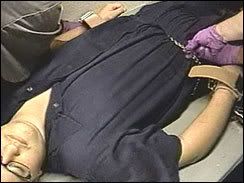
Mentally ill people don’t belong in prison but when not properly treated that’s where they often wind up. An otherwise gentle soul with schizophrenia or depression that is not properly medicated may commit a violent crime. There is also the tragic case of Timothy Souders. As reported several weeks ago by Sixty Minutes, Mr. Souders suffered from manic depression and committed the crime of shop lifting. It's not uncommon for people who suffer from manic depression to get into this kind of trouble.

Sadly, the Michigan Department of Corrections was ill equipped to manage Mr. Souders special needs and he was put in solitary confinement. As the prison video featured in the Sixty Minutes broadcast showed, Mr. Sounders died from mistreatment. What happened to Mr. Souders is not an aberration. We citizens must ask ourselves, was prison really the best solution for a mentally ill person guilty of shop lifting?

How many more Timothy Souders are waiting to happen? One year ago the New York Times (subscription required) reported how the prescription drug law pushed by the Bush Administration and Republican controlled congress, contributed to a crisis in many states. Beneficiaries of Medicare who are mentally ill experienced massive delays in obtaining the medication they needed to function. Ironically, one of those supporters of this legislation was Senator Domenici.

How many of these people I wonder hurt themselves, or others and wound up in prison? Once incarcerated, as the Timothy Souders tragedy exposed, a prison is typically unable to treat mentally ill inmates effectively and many die in solitary. Some by mistreatment like Timothy Souders. Others kill themselves.

This is not a popular poll tested issue. But it’s a damn important one. Addressing it properly is not only the compassionate thing to do but pragmatic as well. As I see it, the only way is through single payer healthcare that incorporates comprehensive coverage for the mentally ill, renewed investment of mental health clinics as well as research and development into treatments and medication. Otherwise the criminalization of the mentally ill will continue unabated.

When writing about the prison industrial complex I asked if anyone cared. Today I’ll simply ask, what can we do to mobilize action against the criminalization of mental illness? Because the next person imprisoned with mental illness could be your brother.
******************************************************************************
ADDENDUM: My thanks to Mike Finnigan for linking the above topic on his most recent blogroundup at Crooks and Liars. This is an important issue and I appreciate any exposure for it. Also, my thanks to "Patriot Daily" of the Daily Kos diary rescue team for resuscitating my crosspost with that community.