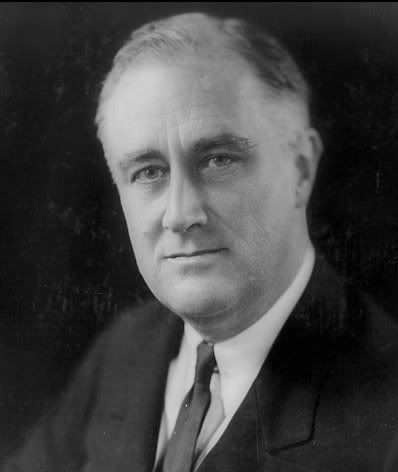
A charismatic president assumes power in a time of unprecedented turmoil after his hapless predecessor becomes a hated symbol of inertia. Financial institutions previously trusted for their forbearance are exposed as reckless stewards while the global economy implodes and regular folks who did nothing wrong are ruined. As job losses mount, unscrupulous demagogues at home and abroad exploit the chaos for nefarious objectives.
Discredited conservatives accuse the new president of socialism while anarchists under the guise of populism are determined to expropriate and redistribute private capital’s wealth no matter what the consequences. Yet the nation rallies to the new president even as progress is slow, uneven and plagued with setbacks. Critics on the left, including his wife, believe the new president is overly cautious while conservatives view him as akin to the anti-Christ.
The public discourse is volatile as the new president confounds his critics and towers over the body politic. Sound familiar? Generation-Y liberals may assume I’m referring to President Barack Obama’s first 100 days that we’ll be reading about next week. I am of course referring to President Franklin Delano Roosevelt, who first established the 100 days benchmark in 1933. FDR’s first 100 days were the foundation of twenty-years of Democratic Roosevelt/Truman administrations that forever changed American society and its place in the world.
FDR himself was brilliant and flawed as he navigated the country through perilous waters domestically and internationally. His leadership enabled America and its allies to prevail in World War Two and establish an enduring middle class. Yet there was also a dark side to the FDR years as the “imperial presidency” was launched and Japanese civilians were “relocated.” The imperial presidency later metastasized during the cold war following the 1947 National Security Act under Harry Truman.
Ultimately, the FDR years, like any presidency was a product of its time. Skirmishes between labor and business were violent. The gap between rich and poor was grotesque. Much of rural America didn’t have electricity and whites routinely murdered their black neighbors. Anti-Semitic demagogues such as Father Charles Coughlin polluted the airwaves. Industrial leaders like Henry Ford as well as national hero, aviator Charles Limburg, openly expressed their admiration for Adolph Hitler.
Capitalism as well as the concept of democracy itself seemed to be retreating as Hitler in Germany, Josef Stalin in Soviet Russia and Italy’s Benito Mussolini maneuvered for global domination. The Japanese Empire brutally worked to establish their “Asian Co-Prosperity Sphere and carved up the Chinese mainland in the 1930s. Americans hoped to avoid foreign wars and FDR promised to keep us out as he plotted behind the scenes to save civilization.
In any era, leadership is not for the meek or faint of heart. FDR projected jaunty confidence and empathy for the downtrodden as he defined America’s center of political gravity on his terms. His leadership style was one of calculated confrontation and FDR skillfully utilized his political capital to take on conservative agents of the status quo at home while inspiring an international alliance against implacable enemies abroad. Seventy-five years after his first inauguration many historians regard him as America’s greatest president.

President Obama’s current challenges and leadership style is understandably compared to FDR – especially has we approach his 100 day benchmark. His support remains notably impressive in spite of the plutocratic dynamic duo of Larry Summers and Timothy Geithner or his waffling with respect to prosecuting crimes committed by the Bush Administration.
Every week we set new records for unemployment claims and the Wall Street bailouts continue. Yet the public continues to believe in his leadership. I do too even as I fret over Obama’s handling of the banking crisis and worry his presidency will be consumed by efforts to stabilize Afghanistan and Pakistan.
My interpretation of President Obama’s political standing is that his support is partly attributed to a conservative minority that is bereft of ideas and maturity. There is the faux populist outrage of “tea parties” to the sniveling temper tantrums of conservatives when Obama shakes hands with Hugo Chavez. Newt Gingrich and Rush Limbaugh look like fools as they critique Obama’s handling of the Somali Pirates hostage crisis while the administration initiates a successful rescue operation. Republicans in Texas and Georgia speak openly of secession while a more sophisticated majority wants to come together and solve problems.
The public face of conservatism is angry, xenophobic, homophobic, shrill and insipid and no longer taken seriously. It's not just that conservative ideology is thorougly discredited as it was in 1933. Sarah Palin, Rush Limbaugh, John Boehner and Newt Gingrich are almost cartoonish in their political opposition. Hence, the real debate with respect to public policy about issues ranging from the potential fall of Pakistan, engaging Iran, addressing global warming, strengthening public education, rebuilding infrastucture, renewable energy and health care is between the center and the left. The center of political gravity is being redefined by Barack Obama because Republicans don't belong at the grownups table.
On the left, people like me critique the administration so he will seize the moment and push the envelope further. We want accountability for the Bush Administration’s crimes, a swift reversal of the Wall Street centric economy that has placed millions of Americans on the abyss of destitution and a public option for health care. The end result of impatient liberal/left critics and America’s puerile conservatives is that President Obama owns the political center just as FDR did.
Whether Obama takes full advantage of his unique stature will take far longer than 100 days to know. This is only the end of the beginning.