Saturday, October 07, 2006

Full Circle: From Jim Wright To Dennis Hastert

Seventeen years ago Democrats jettisoned the remnants of their eroding spine and House Speaker Jim Wright went down in flames. Wright’s fall was a seminal moment for Democrats as well as our national politics. Already on the defensive following defeats in three consecutive presidential elections Democrats crawled into a fetal position and became a self-gelding machine of ineptitude. Corporate militarism and Christian radicalism bagged a trophy and were on the march.

Wright was a complicated, vain and arrogant man imbued with a sense of self-importance. In his line of work narcissism goes with the territory and Wright had plenty to spare. But there was more to him than that. Some politicians merely want to be big and others want to do big things. Born in Fort Worth, Texas in 1922 he was a product of the Depression. Wright both understood and empathized with those in poverty and was committed to policies that benefited working people and the poor. He enjoyed power and he also believed in using it for causes bigger than himself.

As Speaker Tip O’Neill’s second in command Wright stewed impatiently when Democrats failed to challenge President Reagan’s program of class warfare against working people. O’Neill did lead a Democratic rebound in the 1982 mid-term elections but Wright wanted to do more. John Barry described one scene in his brilliant 1989 book, The Ambition and the Power: The Fall of Jim Wright : A True Story of Washington in which O’Neill patted Wright on the knee and told him to wait for a Democratic president. According to Barry, O’Neill believed Democrats were fighting a “rearguard” action.

That wasn’t good enough for Wright and after O’Neill retired in 1987 he utilized the Speaker’s chair to push back against the weakened Reagan Administration. Wright smelled blood as Reagan was besieged by Iran-Contra and appeared to be an ineffective lame duck.

He asserted that congress was a “co-equal” branch on foreign policy and negotiated with Daniel Ortega of Nicaragua. Not content to merely oppose Reagan’s criminally immoral policies in Central America, Wright was determined to formulate a peace policy independent of the White House. He also attempted to override a Reagan veto regarding trade policy in 1987 and failed.

Yet even in failure Wright demonstrated toughness. He wanted to seize the initiative and was not shy about using power to achieve progressive objectives. Republicans regarded Wright as overly partisan and some Democrats such as Ways and Means Chairman Dan Rostenkowski were threatened by his vast accumulation of power. Another old bull, Energy and Commerce Committee Chairmen John Dingell also felt threatened.

Unlike O’Neill, Wright was not inclined to respect the prerorogatives of committee chairmen such as Rostenkowski’s and Dingell. He believed the interests of the Democratic Party were bigger than individual fiefdoms. Wright also preferred to concentrate power in his hands and his ruthlessness was off putting to senior colleagues.

A young Republican firebrand named Newt Gingrich also believed Wright was a threat. He speculated that if Wright wasn’t stopped he might become the most successful speaker since Henry Clay and Gingrich’s dreams of a Republican majority would wither on the vine.

Gingrich filed a complaint with the House Ethics Committee about matters that seem rather pedestrian today. Ostensibly, Wright was accused of using bulk purchases of his book, Reflections of a Public Man to earn speaking fees in excess of the allowed maximum. The report issued by the House Ethics Committee also charged that Wright’s wife, Betty, was given a job and perks to avoid the limit on gifts.

Gingrich skillfully exploited the media to stoke outrage and promote both Wright and Democrats as representing a culture of corruption. Among those who supported Gingrich’s public relations offensive against Wright was a Republican Minority Whip from Wyoming named Dick Cheney prior to becoming George Bush’s Secretary of Defense.

Democrats initially rallied to their Speaker but their resolve disintegrated and he was forced to resign on May 31, 1989. Wright’s demise was a precursor to the wipe out in 1994 that made Newt Gingrich speaker and transformed our politics. Ironically, Wright’s rival for power Dan Rostenkowski also stepped into scandal with the House post office controversy and he served time in prison.

Even with Bill Clinton in the White House Democrats fought a defensive rearguard action against a conservative iron triangle comprised of the media, think tanks and K-Street lobbyists. Republican hubris metastasized over the next decade as they impeached President Clinton for having sex with an intern and proceeded to steal two consecutive presidential elections in 2000 and 2004.

Whereas Democratic politicians exploited their offices for garden variety corruption: speaking fees, postage stamps, patronage and questionable book deals the GOP envisioned government as their personal candy store. In the past twelve years government has been stripped bare and even basic functions such as military transport and security is being outsourced to private corporations who over bill tax payers and torture detainees. Remarkably the government is doing less and spending more.

We’ve seen the result as a cabal of plutocrats enriched themselves and our national security, education and access to health care have eroded to pitiful levels. Other functions of a Democratic society such as reliable vote counting and access to polling stations regardless of race or wealth are regarded as an inconvenience to be brushed aside.

And of course the GOP exploited 9/11 to wage war against a country that didn’t attack us, wasn’t a threat but offered the promise of brown gold. On the periphery of failure these past dozen years was the collegial Dennis Hastert.

Hastert is as an enabler for the GOP’s reign of indecency. Initially a soldier in Tom DeLay’s whip organization he became the amiable and forgettable public face as Republicans compromised national security, condemned poor people to death in New Orleans, bashed homosexuals while consorting with pedophiles and obliterated our fiscal solvency.

Hastert is the ultimate chucklehead crony with a title but no interest in management because he’s always been the puppet of others. His role was to look the other way while his masters broke the law and run interference as required.

Interference appears to have included covering for Mark Foley as he satisfied his perverse lust with vulnerable teenage boys. Republicans claim they are the party who wants to protect America from harm but their Speaker didn’t care about protecting children under his charge.

Seventeen years ago Jim Wright was forced to resign because his party was cowardly and weak. In 2006 Dennis Hastert is fighting to stay in power because he and his party have no shame. We’ve come full circle.
************************************************************************************
ADDENDUM:
The topic above was cross posted and front paged on the community blog Swords Crossed. Click here to review their comments. A cross posting in Daily Kos was "rescued" by Susan G and their comments can be reviewed by clicking here.

Monday, October 02, 2006

Wanted: A National Pension Plan For Working People

Several years ago I was a telemarketer in Sheepshead Bay Brooklyn for a wholesale ophthalmic lens company. We sold lenses to small independent mom and pop stores you might purchase a pair of glasses from and our profit margin was thin.

My co-workers were predominantly uneducated and older than forty. Several of my colleagues labored for years on their feet as “lens pickers” with little compensation. Trust me it’s far more grueling then it sounds. Sometimes during a busy crunch I helped out on the lens floor and was exhausted after a couple hours. Typically, the lens pickers toiled from 7:00AM to 7:00PM when we packed up at night for messenger pick up.

Most earned hourly salaries not far above minimum wage. As with any small business working in close quarters facilitates bonding and reduces barriers. It was also in my own self-interest to maintain a positive relationship with co-workers because I wanted my customers taken care of.

So I listened and talked with them about everything and anything: our personal lives, sports and television. We had our unique inside jokes and off color humor. We played practical jokes on each other. Several of them enjoyed giving me dating advice. We also discussed politics.

Culturally, I found them to be conservative, very religious and proudly patriotic. Politically most didn’t vote at all and the few that did typically pulled the lever for Republicans. All resented politicians who talked a good game but didn’t do anything for “working people.” They found my passion and interest in politics quirky and strange.

It’s largely because of them I ponder the subject of pension reform for employees of small businesses. How many Americans are just like my former colleagues in Sheepshead Bay Brooklyn: working hard for little pay with no union to stand up for them, limited prospects for the future, virtually nothing saved for retirement and no light at the end of the tunnel?

One colleague I often think about is over sixty and has bad knees. I recently learned he suffered a heart attack. What will he do once he is physically unable to perform his job anymore? He can’t afford to retire and conservative lectures about a high skill economy don’t do him any good. No doubt the insipid David Brooks would write he should’ve just learned computer programming and networked more efficiently with people.

How many workers are younger than my former colleague but on the same downward spiral, existing in an economy that for them is all risk and little reward? What can and should be done for them?

It seems to me the federal government must underwrite a pension plan for small businesses as a supplement to Social Security. Workers such as my former colleagues are living paycheck to paycheck with no savings or wealth being generated on their behalf.

Is it possible to design a policy that enables small businesses to establish 401k style pensions for unskilled laborers such as my former colleagues in Sheepshead Bay Brooklyn? Might it also be possible that such a plan allows employers to match any contributions made by employees – encouraging savings and facilitating long-term wealth generation?

My current job has a 401K plan but I work for a small firm and employee contributions are not matched. Matching contributions is how true wealth can be created. My former colleagues in Sheepshead Bay Brooklyn don’t even have a 401K plan without matching contributions.

Some interesting work has been done on the subject. In June I interviewed progressive economist Jared Bernstein and asked him about this topic. He referred me to the work of Ray Boshara of The New American Foundation as well as the Hamilton Project.

Last night Kid Oakland turned my attention to an interesting piece published in the New Yorker by Malcolm Gladwell when I exchanged comments with him about his fine diary in Daily Kos on good government.

All helpful reading yet I still believe this topic is not being sufficiently deliberated and considered. This issue is a potential silver bullet in 2008 along with health care. If I were a prospective presidential candidate I would definitely reach out to minds such as Jared Bernstein and Gene Sperling and ask them to crunch some numbers about how this can practically be done.

Naturally we can expect a conservative screech about proposing something so ambitious requiring heavy government funding. Nonetheless I believe it can be sold as an investment that will deliver a bountiful return by boosting an eroding middle class.

There is also considerable benefit for the small business community. Indeed for them it’s a competitiveness issue. If even their low skilled and wage employees are given a stake of wealth generation in their success it ultimately enhances productivity and preserves continuity in their workforce. Isn’t it better to underwrite pension plans on behalf of small businesses employing American workers instead of providing corporate welfare for multinationals outsourcing jobs?

I realize our focus is on the remaining five weeks of this election season. However, it is not too early to wrap our brains around issues and policies that can be championed in 2008 and lift up the middle class. Christian E. Weller from the Center of American Progress and Eli Staub, research analyst from the Service Employees International Union recently collaborated on a must read piece entitled, Middle Class In Turmoil that illustrates the stakes for working people. This is a constituency that needs to be engaged with concrete proposals if we expect their votes and deserves some kind of reward for playing by the rules.

I’m curious to hear from the vast brain-power of the netroots community. We truly have become an idea factory and I believe the political class has learned to pay attention to what we think. Let’s put our policy wonk caps on and make a difference. We might even earn the trust, gratitude and votes of working people such as my former colleagues from Sheepshead Bay Brooklyn.

Saturday, September 23, 2006

Talk Radio's Middle Class Champion: A Podcast Interview With Thom Hartmann

Thom Hartmann is a dynamic voice for the aggrieved middle class. After one commercial break on a recent broadcast, the national radio host proudly declared,
“Welcome back to the Thom Hartman show where our talking points come from Jefferson and Madison, not some right wing think tank.”
He then asks, “Will the next election be hacked?” as he promotes Bobby Kennedy, Jr.’s article in Rolling Stone magazine that examines fraudulent vote counting to the benefit of Republican candidates.

Talkers Magazine noted,
“There's a buzz growing around nationally syndicated talk show host Thom Hartmann, whose nationally syndicated daily program is drawing high marks by those who are on the lookout for talk radio's ‘Great Liberal Hope.’”
His syndicated radio show is carried on more than 80 radio stations daily from noon to 3 PM Eastern Standard Time (EST) and Sunday mornings from 10 AM to 1 PM EST. It broadcasts 7 days a week on Sirius Satellite Radio, and is streamed live on the web from Radio Power, The White Rose Society, Air America Radio and CRN Digital into cable systems in 29 states.

Hartmann is also an award-winning, best selling author of fourteen books, an entrepreneur, and an innovator in the fields of psychiatry, ecology and economics. The former executive director of a residential treatment program for emotionally disturbed and abused children, Hartmann has helped set up hospitals, schools, famine relief programs, and communities for orphaned or blind children in Africa, Australia, Europe, India, Israel, Russian, South America and the United States.

Most recently Hartman authored, Screwed: The
Undeclared War On the Middle Class - And What We Can Do About It (Berrett-Koehler Publishers, Inc.). The theme of Hartmann’s new book is captured in this paragraph from his introduction:
“When there is no American Dream, when there is no middle class, there cannot be real democracy. That’s why when elections are brought to nations that are in crisis or that don’t have a broad, stable, well-educated middle class – such as Egypt, Iraq, Iran and the Palestinian territories – the result is aristocrats, ‘strongmen,’ or theocrats exploiting those elections as a way of gaining decidedly undemocratic power.”
Hartmann graciously agreed to an interview with me about his new book and political philosophy. Please refer to the media player below. This interview can also be accessed for free via the Itunes Store by searching for "Intrepid Liberal Journal."


***********************************************************************************
ADDENDUM:
My thanks to the
Crooks and Liars website for linking my blog today!
***********************************************************************************

Saturday, September 16, 2006

The Contrarian: A Podcast Interview With Professor Khaleel Mohammed

San Diego University’s Associate Professor of Religion, Khaleel Mohammed, PH.D is a controversy magnet. Born in the South American republic of Guyana and educated at Montreal’s McGill University, Professor Mohammed is a Muslim who believes Israel belongs to the Jews. Indeed, Professor Mohammed even references the Koran to support this claim. In an interview with FrontPageMagazine.com two years ago, he cited this passage:

“The Koran in Chapter 5: 20-21 states quite clearly: ‘Moses said to his people: O my people! Remember the bounty of God upon you when He bestowed prophets upon you, and made you kings and gave you that which had not been given to anyone before you amongst the nations. O my people! Enter the Holy Land which God has written for you, and do not turn tail, otherwise you will be losers.’”
Professor Mohammed also contends that violence in the Muslim world stems from politics not the Islamic faith. His opinions have provoked sharp rebukes from scholars who insist that Jihad, Anti-Semitism and fundamentalism are directly linked to the Koran itself. The academic believes those who link fundamentalism with the Koran are Islamophobes.

On June 25, 2004, he participated in a symposium sponsored by FrontPageMagazine.com with Robert Spencer of Jihad Watch, and author Bat Ye'or. They engaged in a fascinating debate about the Koran’s semantics and politics in the Muslim world. Since that symposium the debate between Professor Mohammed and Robert Spencer has grown personal.

Overall, Professor Mohammed has two categories of critics: westerners such as Robert Spencer who regard him as an Islamic apologist and Muslims who believe him to be disloyal to their culture.

The professor considers himself a scholarly advocate for moderate Islam and he graciously agreed to an interview with me. Please refer to the media player below. This interview can also be accessed for free via the Itunes Store by searching for "Intrepid Liberal Journal."


********************************************************************************
ADDENDUM: Although Professor Mohammed is new to the blogosphere he expressed interest in both reviewing and responding to the comments of others. I hope he is able to. Also, please note that his website which I hyperlink above has not been updated and lists his title as “Assistant Professor” instead of “Associate Professor.” Hence, I mistakenly introduced him with the incorrect title during the podcast.

Monday, September 11, 2006

Reminiscing About the Future: George Bush's Resignation Speech On September 11, 2007

It appears Democrats will prevail this November and become the majority party in the House of Representatives. Republicans are likely to retain their majority in the Senate – although severely narrowed. John Conyers the ranking Democrat of the House Judiciary Committee has signaled his willingness to impeach President Bush if given the chance. Vice President Cheney may elude this fate if impeachable offenses can’t be linked to his office. Legally, the President is the “decider” regardless of the Vice President’s influence. Below is a dramatization of what may transpire using the PBS News Hour as a vehicle. The date is September 11, 2007.

JIM LEHRER: Good evening, I’m Jim Lehrer and welcome to a special broadcast of the News Hour. In a few moments, President George W. Bush will speak to the nation and formally resign. It’s only the second time in American history a president has resigned. Richard Nixon, our 37th president resigned under pressure from the Watergate scandal on August 8th, 1974. With me tonight are David Brooks of the New York Times and syndicated columnist Mark Shields. Mark what was the turning point? Only five days ago the White House was defiant after the House of Representatives voted to impeach President Bush. White House spokesman Tony Snow made it clear the President intended for a trial in the Senate to go forward. What happened between now and then?

MARK SHIELDS: Jim in 1974, Arizona Senator Barry Goldwater - conservative stalwart led a Republican delegation that told Richard Nixon he no longer enjoyed the support of his own party and needed to resign for the good of the country. Two decades later, Arizona Senator John McCain joined Majority Leader Mitch McConnell and Orin Hatch …

JIM LEHRER: Orin Hatch of Utah.

MARK SHIELDS: And a respected conservative and senior member of the Senate Judiciary committee. My sources tell me they candidly and straightforwardly told the president he was hemorrhaging Republican support in the Senate and his duty to the country was to resign.

JIM LEHRER: David does that square with your reporting?

DAVID BROOKS: It does Jim. I would add that the President was hearing from friends, family as well as Capitol Hill that he had to spare the country from further trauma. He would only lose in the Senate anyway. Democrats are unified and the Republicans are fractured. Also, September 11th allows the President to remind everyone that he made tough decisions to protect the nation in a time of war. I’m hearing the President will emphasize he’s sacrificing himself for national unity just as he’s asked soldiers to sacrifice their lives for freedom.

JIM LEHRER: And now President Bush.
********************************************************************************
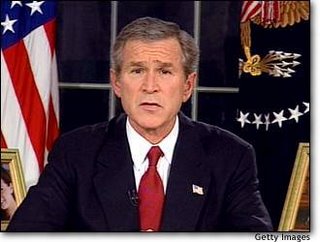
Camera focuses on President Bush sitting nervously behind his desk in the oval office.

Good evening. Tonight I speak to you on the 6th anniversary that evil attacked us. It was a wake up call. America was put on notice that our enemies hate us, hate our way of life and want to kill us. For six years I’ve spent every waking moment working to protect our way of life from people who despise freedom and hope.

My administration removed a brutal dictator from Iraq and toppled a regime in Afghanistan that supported the very terrorists who attacked us. We’ve strengthened homeland security and paved the way for a new mid-east based upon freedom and self-determination. Oppression is retreating and the terrorists haven’t attacked us since that horrible day. It is a record I’m proud of and I will never apologize for defending freedom.

In the early days after 9/11 we had unity and purpose. Over time that resolve of patriotism eroded in a wave of partisanship and political vendettas. Let me be clear: I do not agree with the recent activity of congress. It is a distraction from the global war on terror that emboldens our enemies. I believe congress has overreached and their unwarranted encroachment upon executive power is dangerous. They’ve undermined national security. The ability of future presidents to protect our country is compromised by the virulent partisanship in Washington today.

I believe God has entrusted our country with the sacred duty of spreading freedom and democracy. It is a divine trust that requires sacrifice and continued vigilance. We are at war and the cause of freedom is larger than any one person.

Many have given their lives to protect our freedom. Freedom comes with a price. Both the peoples of Iraq and Afghanistan are learning this. Our solders and their families understand this. I too understand.

I’ve labored for six years to defend freedom. I would’ve preferred to continue the fight until my term’s final day. I’ve seen plenty of tough days and don’t believe in quitting. But I do believe sacrifice is sometimes required for the greater good. I believe that is so today.

That’s why I’m resigning the Presidency at noon tomorrow. Vice President Cheney will assume the duties of this office upon my resignation.

I do this to restore the unity and resolve needed for victory. Given the stakes I have no problem relinquishing the power and prestige of the Presidency. It is an office I was honored to serve and I gave everything I had for my country. It is in the spirit of unity that I resign the Presidency so we can heal as a country and move forward.

I ask that all Americans come together now and support Vice President Cheney in the days ahead. The cause of freedom and our way of life is at stake. He will be in Laura’s prayers and mine. I hope he will be in yours.

To those who steadfastly supported and prayed for me, I thank you. Your support gave me strength. To those who opposed my policies I’ll simply say this: our opinions may have differed but I know we all care passionately about our country. As your President I did my best to serve everyone and I feel bonded to all Americans.

May God continue to bless the United States of America.

************************************************************************************

JIM LEHRER: President George W. Bush formally resigned his office in a short speech. He criticized congress for partisanship and overreaching and he appealed for unity. David what did you think of his speech?

DAVID BROOKS: I thought he ended on a high note and was true to himself. He hit on the themes of unity, resolve and fighting for freedom. Those were his themes during the early days after 9/11. I liked the appeal to unity for both supporters and his critics. I think it’s fair that he accused congress of partisanship. In many ways his impeachment was an act of political vengeance. Partly to avenge Bill Clinton’s impeachment and partly I think to punish Republicans for their previous political dominance.

JIM LEHRER: Mark is that how you see it?

MARK SHIELDS: I don’t Jim. I thought the speech was delusional at best and disingenuous at worst. Bush campaigned in 2000 and again in 2004 as the straight talking, plainspoken person who knows what he means and means what he says. But delusion and disingenuousness have been the hallmarks of this administration and it was in this speech. He laments the politics of vendettas but it was his administration that challenged the patriotism of those who dissented. It was his administration that exposed a covert CIA operative. The Scooter Libby trial revealed there was much more than an innocent leak from Richard Armitage.

And justification for the Iraq war wasn’t about spreading democracy. It was about protecting Americans from weapons of mass destruction. The House of Representatives made a compelling case that President Bush knowingly and willfully misled the country to war – apparently believing it would be a cakewalk. 4,500 Americans are now dead and our international prestige is at an all time low.

They also made a compelling case the President knowingly and willfully violated the law with the domestic surveillance program. Forty Republicans joined Democrats in supporting all counts of impeachment Jim. At least 18 Republican Senators are on record as supporting conviction before a single day of hearings in the Senate. This wasn’t partisanship and it wasn’t vengeance. This was supported by the mainstream.

JIM LEHRER: David?

DAVID BROOKS: Well … (smiles sheepishly), I think Republicans caved after a torrent of harsh publicity. And it’s troubling. It’s troubling for the constitutional process. I don’t see how one can prove intent on Iraq. Yes one may critique the administration’s judgment about Iraq. They had bad intelligence and after 9/11 didn’t want WMD’s winding up in the wrong hands. A lot of us shared that view (laughs and shrugs). I’ve lost count how many times the Senate intelligence committee reported the administration did not mislead about Iraq.

As for the domestic surveillance program – I’m on record for criticizing the administration for not working with congress on a new legal framework to replace FISA. As the majority party in the House, Democrats had the leverage to compel the administration to negotiate over a new legal framework that protected security and civil liberties. They opted to impeach the president instead of proposing solutions. This was not their finest hour.

JIM LEHRER: What about the appeal to unity Mark? Is that possible after everything that’s happened?

MARK SHIELDS: Jim first I want to address David’s points. The hearings in the House uncovered evidence we didn’t have all these years. I might question the wisdom of impeaching President Bush and leaving the White House in Dick Cheney’s hands. But testimony from intelligence analysts, the redacted memos from the Pentagon … I think the intent was quite clear. As for domestic surveillance – the hearings uncovered a troubling pattern of utilizing surveillance for purposes other than national security. We didn’t know that one year ago or two years ago. Again, I reiterate that impeaching the President and forcing his resignation may not be the wisest or best course. But it was certainly justified on evidentiary grounds.

As for unity – Vice President Cheney was Chief of Staff to a unifying figure in Gerald Ford who just passed away. I knew Gerald Ford. He wasn’t a friend but I knew him and admired him. Dick Cheney is no Gerald Ford. He’s not a unifying figure. His approval ratings are even lower than the President’s. Most believe Cheney was the real power behind the throne these past six years Jim. But they couldn’t get Cheney. They couldn’t get Rumsfeld who finally resigned to buy the President time. Now Cheney’s the President.

JIM LEHRER: You never agreed with impeaching President Bush.

MARK SHIELDS: Well Jim I question the wisdom of it. Not the justification but the wisdom. Bush was going to be gone on January 20, 2009. What happens now? Cheney has expressed no interest in standing for election. So for the next two years we have a commander and chief who isn’t trusted and has no incentive to earn trust or build consensus. Six years ago Cheney was regarded as the grown up with gravitas. He added maturity and judgment. Well it’s his misjudgments that resulted in the resignation of his President.

DAVID BROOKS: Cheney is an experienced operator. Behind the scenes he’s signaled to congressional leaders his willingness to be conciliatory. He knows congress is a lot more assertive right now and that he has to tread more carefully. The real question is whether Democrats will meet him half way or do they want to shed more political blood going into 2008.

JIM LEHRER: You think the Democrats are out for blood?

DAVID BROOKS: Well, the far left of the party, the liberal bloggers - they smell blood. The fringe of the Democratic Party was at first critical of Speaker Pelosi for standing in the way of Bush’s impeachment. When impeachment went forward they were critical of John Conyers for not going after Cheney too. They risk appearing as if they want to overturn the national elections of 2000 and 2004. The public is sick of partisanship. They want fresh ideas on how to win in Iraq, win the war on terror, improve education, solve immigration and reduce our dependence on foreign oil. So far all they’re getting from Democrats are investigations, hearings and impeachment.

JIM LEHRER: Mark?

MARK SHIELDS: Jim the Republicans investigated Bill Clinton to exhaustion over a land deal and an illicit affair. The public was against Bill Clinton’s impeachment but Republicans did it anyway. Democrats if anything were more restrained than the public wants right now about war and peace. Polls overwhelmingly show they want both Bush and Cheney held accountable. Again, I question the wisdom of impeaching Bush if you can’t remove Cheney as well. But this is far beyond a small fringe of the Democratic Party. I suppose in that sense we do have unity.

JIM LEHRER: David any sense about whom congress would consider approving as the next Vice President. For our viewers benefit - the Constitution requires that a majority of both houses of congress approve the next Vice President.

DAVID BROOKS: Two names I’m hearing are Jack Danforth and Tom Kean.

JIM LEHRER: Jack Danforth the former Senator from Missouri and former New Jersey Governor Kean …

DAVID BROOKS: Was the Chairman of the 9/11 Commission and very critical of the Bush Administration. This is an interesting dance. Democrats have leverage as the majority in the House and don’t want to give a prospective Republican nominee in 2008 a leg up. And plenty of ambitious Republicans interested in the White House don’t want someone like John McCain selected as Vice President. Or Condi Rice for that matter. Danforth and Kean may be seen as safe but unifying choices.

JIM LEHRER: Mark?

MARK SHIELDS
: I think Kean would be an inspired choice. Too good a choice might make Cheney feel more vulnerable. The public I’m sure would much prefer a Tom Kean in the White House over Dick Cheney. It’s hard to imagine Kean having much influence in a Cheney Administration. I’m sure Cheney would pick Rumsfeld if he could get away with it. As for John McCain – I’m not sure he would want it. At this point being associated with this administration is not viable for one’s political health or presidential ambitions.

JIM LEHRER: What about policy David? Are we likely to see many changes?

DAVID BROOKS: Well … Cheney’s advisors have spoken on deep background that they plan to propose a round of new tax cuts as a way to rally and unify their conservative base heading into an election year. They know the Republican caucus will be fractious with a wide open primary season and tax cuts might help provide some cohesion. On foreign policy Cheney is just as determined as Bush to stay the course. Even more so (laughs).

JIM LEHRER: Mark what about the possibility of a pardon as Ford pardoned Nixon?

MARK SHIELDS: I think that’s inevitable Jim. Cheney will use a pretext of moving forward and avoiding further distractions with a pardon. Bush and his lawyers are certainly aware of any evidence than might implicate the Vice President. It’s common knowledge a rift now exists between Cheney and the Bush families. Cheney can mend fences, protect himself from a potentially dangerous witness and unlike Ford he’s not running for anything and won’t care about any backlash.
**********************************************************************************
Jim Lehrer invites historians Doris Kearns Goodwin, Haynes Johnson, Michael Beschloss, Richard Norton Smith into the conversation. And they pontificate further about the speech, Bush’s legacy and future repercussions. Bottom line: Dick Cheney could wind up in the White House. Something to think about.

Saturday, September 09, 2006

A Podcast Interview With Congressional Candidate Chris Owens

On July 10th I posted a podcast interview with congressional candidate Chris Owens of Brooklyn, New York’s 11th congressional district. As I am new to podcasting, the host site I used at the time wasn’t very good. I’ve finally come up with a better one. Since the Democratic primary for the 11th district is Tuesday, September 12, I thought it made sense to repost the podcast.

This district is a human mosaic of 654,000: 60 percent blacks, 20 percent whites, 12 percent Hispanics, 4 percent Asians and 4 percent other ethnicities. The minorities, mostly Caribbean Americans and other immigrants, comprise 80 percent of the district.

The 11th is historically significant because it was created pursuant to the Voting Rights Act. In 1968, the district elected the first black woman to Congress – Shirley Chisholm. Since then the predominantly black population has been represented in Washington by one of their own. The incumbent, Major R. Owens is retiring after serving in Congress since 1984. An African-American, Representative Owens is highly regarded among progressives for his commitment to strengthening public education. He also happens to be the father of candidate Chris Owens.

Ironically, it is the candidacy of a white politician named David Yassky who has generated controversy in the 11th. Yassky is the only white politician among four candidates vying for the Democratic Party’s nomination. There is virtually no doubt the seat will remain in Democratic hands this November.

Yassky is a city councilman who originally planned to run for Brooklyn District Attorney. He abandoned that race, changed his residence to the 11th district and quickly raised $1 million for the campaign. Some regard him as an accomplished public servant with much to offer. Others believe that Yassky calculated he couldn’t win the race for District Attorney and preferred to campaign for an office in which the black vote would be split three-ways. Yassky contends he entered the fray after “soul searching.”

City Councilwoman Yvette D. Clarke currently represents part of the 11th District and challenged Representative Owens in a three way primary two years ago and came in second.

State Senator Carl Andrews is favored by the Democratic Party’s New York establishment and was endorsed by gubernatorial candidate Eliot Spitzer and former Mayor David Dinkins. Even as Andrews enjoys their support he is also attempting to distance himself from the Democratic organization, where he was close to Clarence Norman Jr., the former Brooklyn Democratic leader who was convicted on corruption charges in 2005.

Chris Owens was an elected Community School Board member and president. His government experience includes working with former City Council President Andrew Stein as well as over a decade in the private sector in the health care industry. Owens promotes himself as “The Real Progressive” in the race.

He supports our immediate withdrawal from Iraq, President Bush’s impeachment, single payer health care and opposes the Atlantic Yards development project to provide a Brooklyn home for the New Jersey Nets basketball team.

Click here to listen to the interview. Please be advised this is not a “soundbite” interview as we covered a lot of ground.

Monday, September 04, 2006

Taking Genocide Personally

I visited Poland shortly after turning 21. It was March 1990 and I was fortunate to be studying in England my junior year of college. After a rigorous semester of study I jumped at the chance to see Eastern Europe during my next semester break. The memories remain fresh sixteen years later. The tour group put Auschwitz and Birkenau on our itinerary.

For me Birkenau had the greater impact. It was usually hot as we walked the grounds. Days earlier when we first arrived in Poland it was bitter cold. There were crematoriums only partially destroyed by the Nazis in their attempt to conceal evidence prior to the war's conclusion. A lake where the ashes of cremated Jews was dumped remained.

I was the only Jew among our small group and sensed I was impacted differently than the others. Physically I was nauseous and struggled to walk. The others were horrified as decent human beings but it wasn’t quite the same for them – at least that’s how it seemed to me. I strolled by myself to an area overlooking a crematorium pit and reflected.

Among the people in our group was a kind-hearted graduate student from Cambodia and survivor of the Khmer Rhouge. He approached and stood next to me. We talked and I explained my family’s Polish history. A grandfather who escaped the Nazis and came to America at the age of 16 with his brothers while their parents remained behind. My great grandfather was especially heroic in helping Jewish children escape death in Poland before the Nazis finally caught up to him. Prior to Hitler he had been a prestigious judge but after September 1939 he was just another Jew marked for death.

Empathetically he observed, “For you this is personal.” We chatted and I learned about his personal history. He was a few years older than me and had a British accent. The Khmer Rhouge murdered his parents in the 1970s and he had no family in Cambodia. Surveying the scene and stillness of Birkenau he said “all genocide is personal to me.”

If I live to be 100 years old I will never forget those words and the conviction they were spoken with. Sadly I never got his name and upon returning to England I never saw him again. Yet those few minutes produced the most poignant conversation I ever had. All genocide is personal to me.

To our collective international shame the world does not take genocide personally. The conflict in Darfur is over three years old and the community of nations is disinterested, pre-occupied or incompetent. The previous three years illustrates humanity's callous ineptitude.

Early in 2003 a rebel group attacked government sites, saying the region was being neglected by Khartoum. These insurgents claimed their aggression was justified because the government oppressed black Africans in favor of Arabs. The region is arid and impoverished and people were competing for limited resources.

Darfur means land of the Fur and had previously experienced tension over land and grazing rights between the mostly nomadic Arabs, and farmers from the Fur, Massaleet and Zagawa communities. The two primary rebel groups are the Sudan Liberation Army (SLA) and the Justice and Equality Movement (Jem). Recent peace talks were setback because of infighting in both groups.

The Sudanese government acknowledges mobilizing militias after rebel attacks but denies any relationship with the Janjaweed, accused of “cleansing” black Africans covering large tracts of territory.

Darfur refugees claim the Janjaweed attack villages on horses and camels, exterminating men, raping women and stealing anything they can. Many women report being abducted by the Janjaweed and held as sex slaves. Another vile atrocity are babies conceived from rape. Rape victims are typically told by perpetrators they want to make a "lighter baby."

Human rights groups, the American Congress and former Secretary of State Colin Powell all acknowledged that genocide was taking place. To its everlasting shame, the United Nations reported in February 2005 there was no intent to commit genocide. Just imagine an international body reporting in 1942 that Nazi Germany had no intent to commit genocide against the Jews of Europe.

Sudan's government denies any accountability for the Janjaweed and President Omar al-Bashir has called them "thieves and gangsters." International pressure and the threat of sanctions did finally compel the Sudanese government to promise disarming the Janjaweed. But they have not been disarmed.

Millions have fled the villages destroyed by the Janjaweed, towards camps near Darfur's main towns. There is not enough food, water or medicine to accommodate them.

International relief agencies have been heroic in Darfur but they are unable to penetrate vast areas because of the fighting. SLA leader Minni Minawi, signed a peace deal in May 2005. According to Amnesty International his fighters have abused people in areas opposed to the peace deal. A smaller SLA faction and JEM did not sign onto the agreement.

Approximately 7,000 African Union troops are deployed in Darfur with a limited mandate. There are too few soldiers to police the area and the operation can’t be funded much longer. And Sudan continues to resist western diplomatic pressure for the UN to take control of the peacekeeping mission. Recently the UN deliberated over a plan for17,000 troops and 3,000 UN policemen but there is deadlock and nothing has happened. And the killing continues.

What can we do? What can we do individually and as a country? The situation seems beyond hope and we’re besieged by so many other challenges domestically. We’re also governed by warmongers who prefer taking lives for oil instead of saving lives as members of the human race. Individually, few and this certainly includes myself, are willing to risk our lives. I can’t pretend I’m ready to join a relief agency and globe trot to Darfur.

But that rationalization is too convenient, too easy and too dismissive. Ultimately, our collective failure as human beings stems from not taking genocide personally as my companion from Cambodia told me sixteen years ago in Birkenau.

Every one of us can do something. For the netroots that means promoting awareness and raising money on behalf of organizations trying to save lives. Perhaps our promotion will also facilitate recruitment on behalf of organizations that are short staffed. Hopefully the netroots community can help pressure politicians into taking genocide personally as well.

I’ve been blogging since November ’05 and have no excuse for not writing sooner about genocide in Darfur. If all of us in the netroots community make it our business to periodically remind our readers about the crisis, promote agencies that need money or volunteers and encourage activism to influence politicians we can have an impact bigger than ourselves.

One organization is Doctors Without Borders/Médecins Sans Frontières (MSF). MSF has over 162 international volunteers and 2,000 Sudanese staff saving lives in 24 locations in Darfur. In Chad, MSF assists refugees from Darfur in 11 locations with a total of 33 international staff. Click here to learn more about their work and make a donation.

Another heroic entity is SOS Children’s Villages. SOS currently operates two SOS Family Centers providing hundreds of severely affected children and single mothers with therapy and counseling, which is carried out by the organization's specialized staff. Click here to learn about their needs and make a contribution.

Bloggers can make a difference by ocasionally promoting just two different organizations that provide relief and save lives. Hence, can help save lives ourselves. If anyone wishes to promote other organizations and provide links where readers can make contributions please do so in your comments.

It’s time for all of us to take genocide personally.
************************************************************************************
ADDENDUM:
Click here to review the growing number of comments in my cross posting at European Tribune. As always the ET community is thoughtful and provocative.

Sunday, August 27, 2006

Reminiscing About the Future: Chuck Hagel vs. Hillary Clinton

Richard Nixon manipulated Americans into believing he had an honorable exit strategy from Vietnam. Ronald Reagan successfully convinced voters he championed a Norman Rockwell society that valued hard work and neighborhood generosity. In 1988, oilman George Herbert Walker Bush won in part as the “environmentalist” candidate. Twelve years later his son stole the presidency after campaigning as a “plain spoken” truth telling man of the people with a “humble” foreign policy.

Perception usually triumphs reality in politics. That is apparent in Nebraska Senator Chuck Hagel’s nascent campaign for president. Hagel is shrewdly positioning himself as the sole antiwar candidate in the Republican Party. Ironically, Republicans just might nominate a candidate running on an anti-war platform in a brazen display of chutzpah and hypocrisy. PsiFigther37 posted an especially trenchant analysis about Hagel in My Left Wing on August 20th. It’s worth reading as he/she catalogued Hagel’s misrepresentations of his own record on various issues. PsiFighter37 concluded that,

“The blogosphere may appreciate what they view as Hagel's truthfulness in addressing our foreign policy. But he is nothing more than your ultraconservative Republican who is scheming for a political run in the future. The man does not deserve praise. He deserves the greatest of scorn for being a politician without principles, someone whose political ambitions are written all over his actions.”
I agree with PsiFighter37 but suspect reality will be dwarfed again. Typically, the GOP’s nomenklatura rallies behind a candidate they consider both a winning horse and reliable steward of their interests. Usually, a GOP nominee is deemed acceptable with varying degrees of enthusiasm by their rank and file after the party establishment gives its’ blessing.

Several months ago the favored candidate of Republican apparatchiks was Virginia Senator George Allen. Allen’s combination of affability and vapid intellect is just the sort of politician Republican elites know can win and be controlled. But Allen’s recent stumbles have wounded his national stature and he may not even prevail against James Webb this November.

Hence, there is a void in the Republican Party with no obvious heir to George W. Bush. GOP elites are flocking to John McCain, who in spite of his recent calculated outburst against the Bush Administration has fully embraced neo-con policies. However, GOP core constituents do not respect McCain and his continued support for the Iraq War will undermine his national stature. In 2008 the strongest Republican candidate will likely be the one with the most rhetorical daylight from the Bush Administration’s national security policies. That is not John McCain who has actively courted Bush’s supporters.

Hagel has carved a niche as a traditional Republican realist on foreign policy. Other candidates may attempt to break with the Administration in 2008 but will appear opportunistic in doing so. Chris Shays for example is vulnerable to ridicule because he conveniently flip-flopped on Iraq three months prior to facing the wrath of disgruntled Connecticut voters. It’s an obvious deathbed conversion with no credibility.

Hagel is different because he rhetorically challenged the rationale of Bush’s policies in Iraq even more than some Democrats in recent years. Furthermore, Hagel has rhetorically challenged Bush for portraying dissent as unpatriotic. His record as PSI37 points out suggests support for neo-con imperialism as well as corporatist greed. There is also Hagel’s unsavory relationship with Diebold. Nonetheless, it’s perception that counts and the press appears eager to anoint the former Vietnam veteran as a sensible and tough centrist who is up to the job.

It’s not hard to see Hagel prevailing in the 2008 Iowa caucuses. Even conservative Iowans are far less enthusiastic about Bush’s foreign policy. Disenchantment with the Iraq war will only increase nationwide the next two years and probably more so in Iowa. Meanwhile, Hagel can shamelessly pander to the state’s religious fundamentalists, preach the virtues of lower taxes and smaller government and appeal to Iowans as a regional son from Nebraska. For good measure he might also be able to say, “I’m the only candidate who can appeal to Democrats and independents in a general election.”

Republicans rejected McCain’s in 2000 when he attempted to promote his general election appeal. However, Republicans may feel even more endangered in 2008 then they do today. If Democrats retake congress this November then Hagel can easily appeal to their instinct for survival. Should Democrats fall short this November the GOP will remain accountable for all that is wrong in 2008. That also works to Hagel’s advantage because on foreign policy he’s positioned himself as the only agent of change in the Republican Party.

McCain prevailed in the 2000 New Hampshire primary because of cross over independent voters. Those independent voters in New Hampshire may rally to Hagel’s banner after a victory in the Iowa caucuses and the momentum that goes with it. Hagel would then be on a roll and national polls would further reinforce his stature as the GOP’s strongest candidate in November.

After New Hampshire in 2000, McCain was overwhelmed by a vicious counterattack from the Republican establishment. Does McCain sanction the sort of counter attack against Hagel that Bush waged against him in South Carolina? Hagel stood up for McCain then. Such a counterattack on McCain’s behalf would only backfire. There’s no way he can. And rhetorically Hagel will appear more in step with the majority of voters that decide general elections than McCain because of Iraq – even though they’re records are indistinguishable.

Perhaps the other candidates such as Mitt Romney, Mike Huckabee or Sam Brownback might get traction but they haven’t established their own bona fides on national security separate from Bush. Hagel is the one Republican with rhetorical daylight from the Bush years. Yet Hagel can also combine his rhetorical daylight from Bush with appeals to cultural conservatives far easier than McCain. Brownback has the cultural appeal but comes up short on Iraqi policy and Romney is a flip flopper on abortion. I can’t see Republicans nominating Mike Huckabee and for damn sure they’re not nominating Rudolph Guilani no matter what the polls say.

So two years from now the headlines may read, “Republican nominee Chuck Hagel declared he’s the one to get America out of Iraq.” There will be the necessary platitudes about prudence, coordination with allies, and a methodical withdrawal that preserves our strategic interests. But the message that will stick is only the sensible conservative and military veteran Chuck Hagel can get us out of Iraq. That is powerful.

Is the Democrats best answer to this challenge Hillary Clinton? Personally, I’m partial to Senator Russ Feingold and would also be enthusiastic about Al Gore’s candidacy. Perhaps John Edwards could prevail in Iowa and stop her. Wesley Clark also appeals to me. But what if the Hillary juggernaut can’t be stopped and her institutional advantages sweep her to the Democratic Party’s nomination?

If Democrats fail to coalesce around an alternative early on Hillary prevails whether we like it or not. Furthermore, there may also be consequences to Hillary winning too easily. If the anti-war Left does not mount an effective challenge, Hillary will straddle the political fifty yard line on Iraq and foreign policy generally. She’ll take the usual partisan pot shots (perhaps Rumsfeld will still be there!) but not renounce her initial support for the war or propose any timelines to withdraw.

Hillary is boxed in. Unlike Edwards, Hillary can’t apologize for her vote to authorize the war without appearing insincere. As a woman she’s confronted with the stereotype about toughness and doesn’t want to appear soft. And she’s rhetorically advocated for more troops in Iraq. Her partisan criticisms of how Bush has prosecuted the war will fail against a nominee such as Hagel telling voters he will get us out. How can Hillary criticize Republicans for diverting resources from the war on terror to Iraq when she’s advocated for more troop deployments?

An office colleague I respect is a good bellwether for how independent voters think. He describes himself as a political “agnostic” when it comes to Democrats and Republicans. A veteran who served in Vietnam he despises Bush’s record on national security and voted for Kerry in 2004. When I asked him about a hypothetical match up between Hillary and Hagel he immediately said he would vote for Hagel because, “he can get us out of Iraq. Only Nixon could go to China. Maybe it takes a Republican to get us out of Iraq.” His visceral reaction disturbed me. It’s the Republicans who got us into Iraq and Hagel is just as guilty as the rest of them! Perception triumphs reality again.

As PsiFighter37’s August 20th diary illustrates, Hagel has many contradictions and should be held accountable for them. Hillary is the wrong messenger for Democrats to defeat him. She’s too mealy mouthed, too corporatist and too insincere. True strength stems from authenticity combined with a record of clarity and sound judgment. Hillary Clinton embodies none of those virtues. Preposterous as it sounds, a Hagel vs. Clinton race means Republicans prevail on a platform to exit from Iraq. We can’t let them get away with it.
*********************************************************************************
ADDENDUM:
I cross posted the above topic on Daily Kos and the comments, critical and favorable make for interesting reading. Click here to review them.